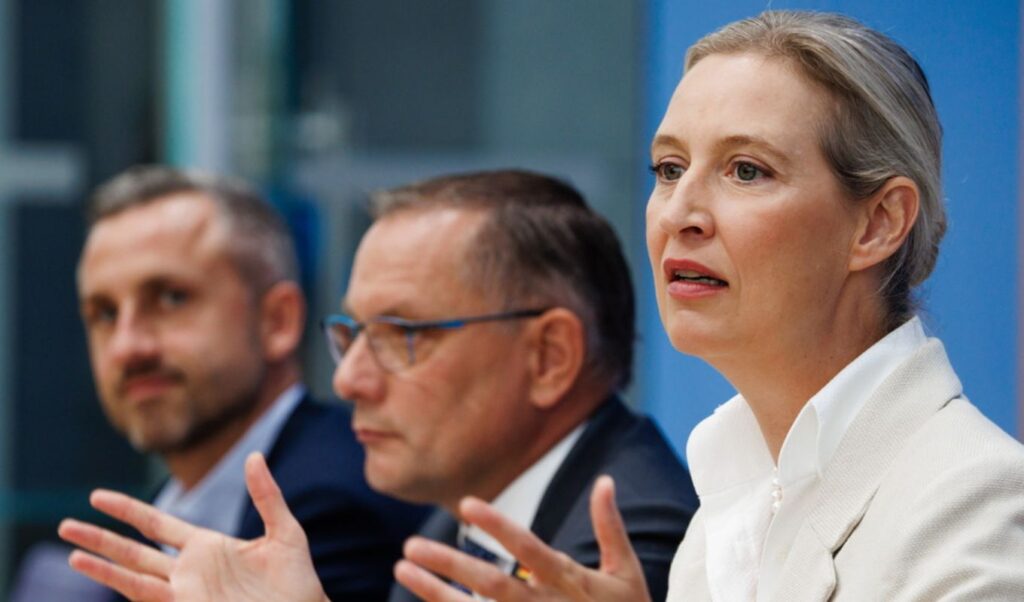
The historic electoral surge of Alternative for Germany (AfD) in Saxony-Anhalt has ignited a fresh wave of political controversy across the country. At the center of the storm are the individuals set to occupy the party’s 39 seats in the state parliament — a group that includes people with criminal convictions, a former Stasi officer, and members with documented ties to neo-Nazi organizations.
AfD’s new MPs under scrutiny: criminal offenses, fake degrees, and a troubling past
The party’s new parliamentary group was officially presented in Magdeburg by regional leader Ulrich Siegmund. However, the debut was immediately overshadowed by reports from German media outlets bringing to light the controversial backgrounds of the newly elected state representatives.
Among those elected, two cases have drawn particular attention: a man reportedly involved in the adult film industry who allegedly used forged academic credentials, and a 78-year-old former Stasi officer — a secret police agent from the era of East Germany. Several other newly elected MPs are also being scrutinized for their open ties to far-right networks and organizations that have been banned under German law.
Under investigation for ties to a banned neo-pagan organization
Two of the re-elected MPs are under investigation by prosecutors on suspicion of attempting to continue the activities of Artgemeinschaft — a neo-pagan, ethno-nationalist, and antisemitic organization that has been outlawed in Germany.
The younger of the two is also being investigated for alleged violations of firearms legislation. Both individuals have categorically denied all charges against them.
Former adult film actor with fake credentials and a criminal record
One of the most striking cases involves an MP linked to the pornographic film industry.
He was previously convicted of stealing a large quantity of bed linen from a hotel. A court also confirmed that he had indeed worked as an actor in adult productions — a fact established during legal proceedings he himself initiated against a local newspaper that had published the story.
According to Die Zeit, he was also expelled from a university after it was discovered that he had submitted a forged school-leaving certificate. He has since claimed that he was subsequently reinstated following a legal challenge.
The 78-year-old ex-Stasi officer and the public outcry
The election of the 78-year-old former Stasi officer, who secured a direct seat in his constituency, has also sparked fierce public reaction.
He has personally acknowledged that he worked for the Ministry for State Security of the former East Germany, and that his role involved monitoring citizens who wished to permanently leave the country.
His presence in the new parliament has drawn sharp criticism from organizations representing victims of the East German regime.
Connections to the neo-Nazi HDJ, the Kremlin, and the MAGA movement
An investigation by the German broadcaster ZDF further revealed that several re-elected AfD members had past associations with far-right organizations.
Among them are individuals who were formerly members of Heimattreue Deutsche Jugend (HDJ), a far-right youth organization that was subsequently banned.
One of the elected MPs had even led the organization at one point. Meanwhile, a parliamentary adviser to the AfD group had authored a biographical work described as “an homage to National Socialism.”
The new parliamentary group also includes figures with pro-Kremlin connections, as well as members who have paid visits to representatives of the MAGA movement in Washington.
Siegmund’s response
Ulrich Siegmund was questioned about the backgrounds of the newly elected MPs, and in particular about the two members currently under criminal investigation.
Referring to them in a joking tone, he called them “the bad boys,” adding that the party would wait for the outcome of the investigations before addressing the matter further.
Siegmund, who previously worked as a perfume salesman, was unanimously re-elected on Thursday as leader of the AfD parliamentary group.
Controversy over weapons and deportations
Siegmund also found himself at the center of another controversy stemming from remarks he made at the presentation of the new MPs.
When a journalist asked about plans by an Israeli arms company to establish operations in the state, Siegmund linked weapons production to his party’s mass deportation policy.
He stated that the AfD does not oppose arms manufacturing, suggesting that such capabilities could prove useful in the future for the party’s “re-migration” and deportation agenda, as well as for internal security and national defense purposes.
The remarks provoked a fierce backlash.
Katja Pähle, leader of the Social Democrats’ (SPD) parliamentary group in Saxony-Anhalt, accused Siegmund of issuing a “political threat,” implying that violence could be wielded as a political instrument.
“This reveals the ugly face of a political system whose language and ideas once again echo totalitarian models,” she said.
Three seats away from an absolute majority
The AfD secured approximately 44% of the vote in the Saxony-Anhalt state elections, winning 39 of the parliament’s 83 seats.
The party now stands just three seats short of an absolute majority and is actively exploring how it might form a government.
Such a scenario would carry profound historical significance — it would mark the first time a German state government has been led by the far right since World War II.
To achieve this, the AfD would need to either secure the support of another party or attract individual MPs from rival political formations.
So far, Germany’s established parties have ruled out any form of coalition or governing partnership with the AfD.
Protests planned in more than 20 cities
Meanwhile, the AfD’s electoral success has triggered widespread mobilization across Germany.
Protests have been planned for the weekend in more than 20 German cities in response to the party’s victory in Saxony-Anhalt.
Attention is also turning to the next two pivotal state elections scheduled for September 20th — in Berlin and Mecklenburg-Vorpommern — where polls suggest the AfD could once again deliver a strong performance.