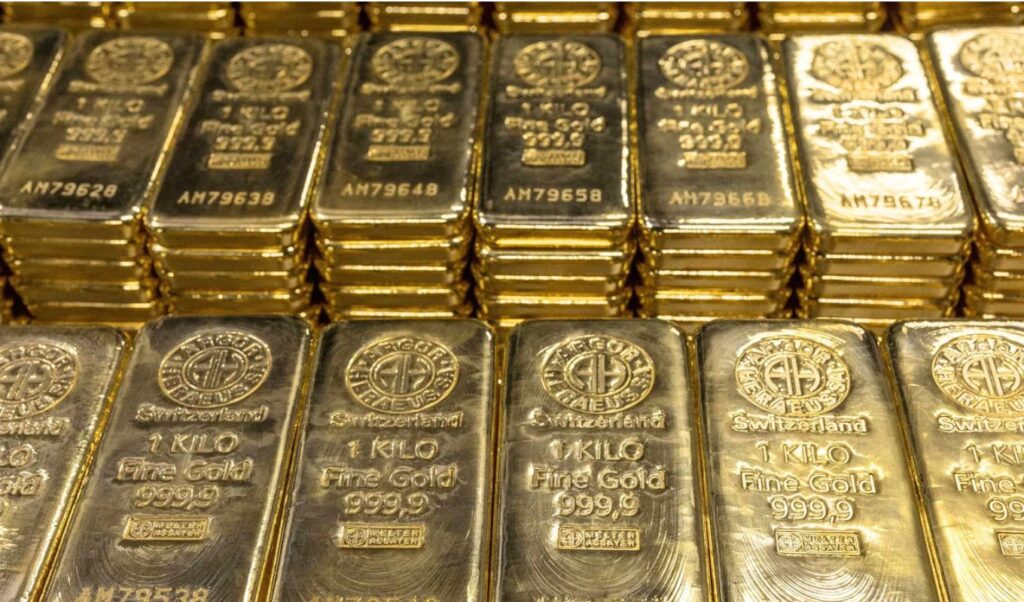
The price of gold has surged in recent days, as a confluence of economic and geopolitical factors continues to boost the precious metal’s appeal among investors. The latest macroeconomic and geopolitical developments have thrust the so-called “debasement trade” back into the spotlight — an investment strategy that pivots toward real assets when concerns mount over fiscal stability and the declining value of currencies such as the US dollar.
The latest catalyst came last week, when US Treasury Secretary Scott Bessent announced that the Treasury Department may double its purchases of US government bonds, bringing them to $4 billion. Markets interpreted the move as a sign that the US government is attempting to artificially suppress bond yields in order to reduce borrowing costs — a development that investors widely regard as potentially inflationary.
Gold prices reacted sharply to the news, hitting a three-month high on Monday. In just five trading days, the price surged 7%, breaking above $4,700 per ounce.
David Morrison, Senior Market Analyst at Trade Nation, noted that gold began its strong upward move following Bessent’s announcement of a doubling in long-duration Treasury buybacks. The development triggered a significant drop in yields on 10-year and 30-year US Treasury bonds, while the US dollar simultaneously weakened.
Why Bessent’s moves are fueling the gold rally
Bessent’s intervention in the bond market has not gone without criticism. Among those who have voiced reservations is billionaire hedge fund manager Stanley Druckenmiller — a former mentor of Bessent himself — who argued that policymakers should “let the bond market speak.”
For now, however, these moves are working in gold’s favor, primarily through their impact on the dollar.
The US currency has weakened against other major currencies following Bessent’s announcement, creating a more favorable environment not only for gold but also for other assets associated with the debasement trade, including silver and Bitcoin.
A win-win position
Michael Hsueh, FX and Commodities Strategist at Deutsche Bank, argued that Bessent’s bond market maneuvers may be deepening investor concerns about the US government’s long-term ability to finance its debt.
According to his analysis, gold finds itself in a particularly advantageous position regardless of how the bond market ultimately responds.
If yields rise again despite the intervention, gold could continue its ascent, as higher yields in this context would likely be seen as a symptom of underlying problems rather than economic strength. Conversely, a further weakening of the dollar could also lend support to gold, especially if international investors grow increasingly reluctant to purchase US debt at lower yields.
Chris Mancini, Portfolio Manager at Gabelli Funds, also identifies two key drivers that could sustain gold’s upward momentum.
The first is mounting market anxiety over the growth of US public debt, as long-term yields rise and bond prices fall.
The second is the perception that the government is actively intervening in the market — a move that could foreshadow new rounds of quantitative easing or other policy actions that would further erode the dollar’s value.
Adding further upward pressure on gold are the ongoing concerns surrounding the war with Iran.
Inflation fears are unlikely to fully subside as long as the Strait of Hormuz remains closed and the unimpeded flow of energy to global markets has not been restored.
The combination of geopolitical instability, inflationary pressures, rising US debt, and a weakening dollar is creating, according to analysts, an environment that could continue to drive gold prices higher.