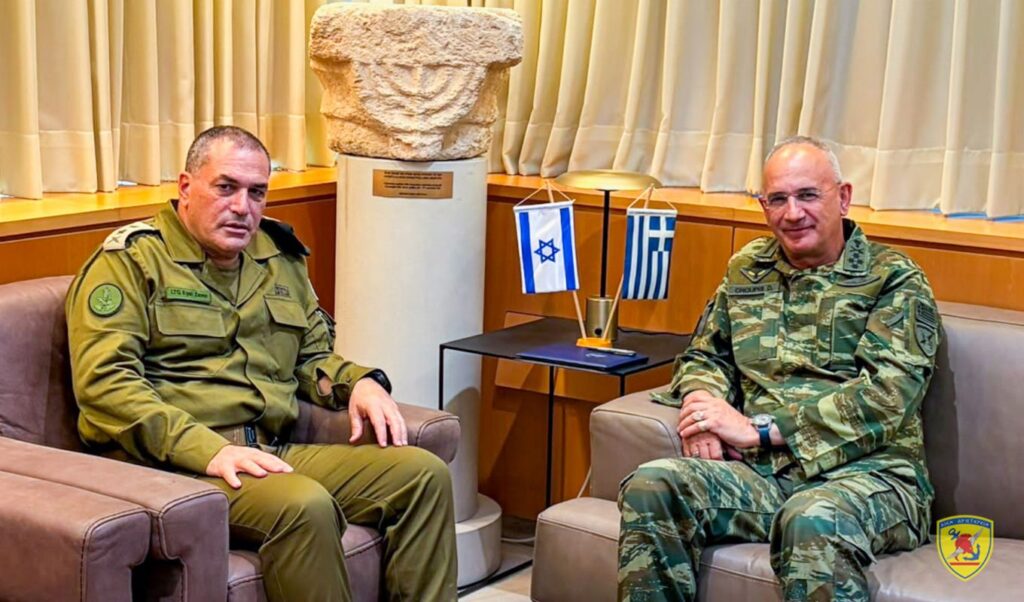
The escalation of Turkish moves in the Aegean, combined with the renewed tension in Turkey-Israel relations centered on Syria, adds further weight to the already close Greek-Israeli defense cooperation. Against this backdrop, the visit of the Hellenic National Defence General Staff (HNDGS) Chief, General Dimitris Houpis, to Israel takes on particular significance. During his visit, he held a series of meetings with Israeli military and defense leadership, including a meeting with the Chief of the Israeli Defence Forces General Staff, Lieutenant General Eyal Zamir.
Athens-Jerusalem power signal to Turkey: Greek military chief meets Israeli defense leadership
Houpis’ visit is part of the already close military cooperation between the two countries and is not officially linked to recent Turkish moves. The timing, however, carries its own significance, as Greece and Israel — for different reasons — both find themselves confronting Turkey’s drive to expand its regional footprint, from the Aegean and Eastern Mediterranean to Syria.
During his visit, the HNDGS Chief met with Eyal Zamir and also held talks with the Director General of the Israeli Ministry of Defense, Major General (Ret.) Amir Baram, as well as with the Director of International Defense Cooperation, Brigadier General (Ret.) Yair Kulas. Discussions focused on Greek-Israeli military cooperation and its further development, with the HNDGS emphasizing the strategic importance of the two countries’ established military relationship and their shared commitment to addressing common challenges across the wider region.
For Athens, the most significant recent development is Ankara’s decision — announced on the Feast of the Assumption of Mary — to declare two “national maritime parks” in the northeastern Aegean and the Eastern Mediterranean. Greece has condemned their establishment as illegal, to the extent that Turkey’s demarcations extend beyond its own territorial waters, into international waters and, according to the Greek Foreign Ministry, into areas of the Greek continental shelf.
Ankara’s territorial claims
Beyond the parks declaration itself, Athens views the move as part of Ankara’s broader effort to reassert its longstanding positions on maritime zones, the continental shelf, and the status of Greek islands. The development comes at a time when Turkey is seeking to elevate its overall regional role, both in the Eastern Mediterranean and across the wider Middle East.
Meanwhile, the tension between Turkey and Israel has now spilled over into the Syrian theater. Israel struck the Abu al-Duhur air base in northwestern Syria, with Benjamin Netanyahu’s office asserting that Damascus had been on the verge of violating an agreed security status quo by allowing the deployment of Turkish forces at the facility. The Israeli side stated that such a development would constitute a direct threat to national security, making clear Tel Aviv’s concern over the prospect of an expanded Turkish military footprint in Syria. The existence of these Israeli assessments, however, does not confirm that Ankara had definitively decided to deploy troops at the base.
Ankara rejected the Israeli allegations, calling them groundless and accusing Israel of seeking to justify its strikes in Syria. Nonetheless, the incident lays bare the depth of the rivalry between the two countries over Syria’s future. Turkey has developed close ties with Syria’s new leadership and is involved, among other things, in training the Syrian armed forces, while Israel views the prospect of an expanded Turkish military presence as a matter that directly touches its own security.
The US position
The situation is volatile enough that the United States is working to establish a conflict-prevention mechanism between Turkey, Israel, and Syria. US Special Envoy Tom Barrack described the latest Israeli strike as an “unnecessary escalation,” noting that Turkey had not been warned in advance and that, upon seeing Israeli aircraft heading toward its borders, could have prepared a response of its own. In his view, the restraint shown prevented a further deterioration of the situation.
Within this environment, Greek-Israeli defense cooperation takes on greater strategic weight. This is not a relationship forged in response to today’s tensions. Athens and Tel Aviv have built a robust framework of military cooperation over many years — encompassing joint exercises, combined training, and collaboration in critical defense sectors — while together with the Republic of Cyprus they have developed a solid trilateral partnership in the Eastern Mediterranean.
Athens continues to avoid presenting this relationship as an anti-Turkish axis. Yet the simultaneous reassertion of Turkish positions in the Aegean and Tel Aviv’s now openly stated concern about the potential expansion of Turkish military presence in Syria are creating a broader area of convergence between Greece and Israel. It is precisely in this context that Houpis’ visit confirms that the defense cooperation between the two countries remains active and continues to deepen.
Published in Apogevmatini