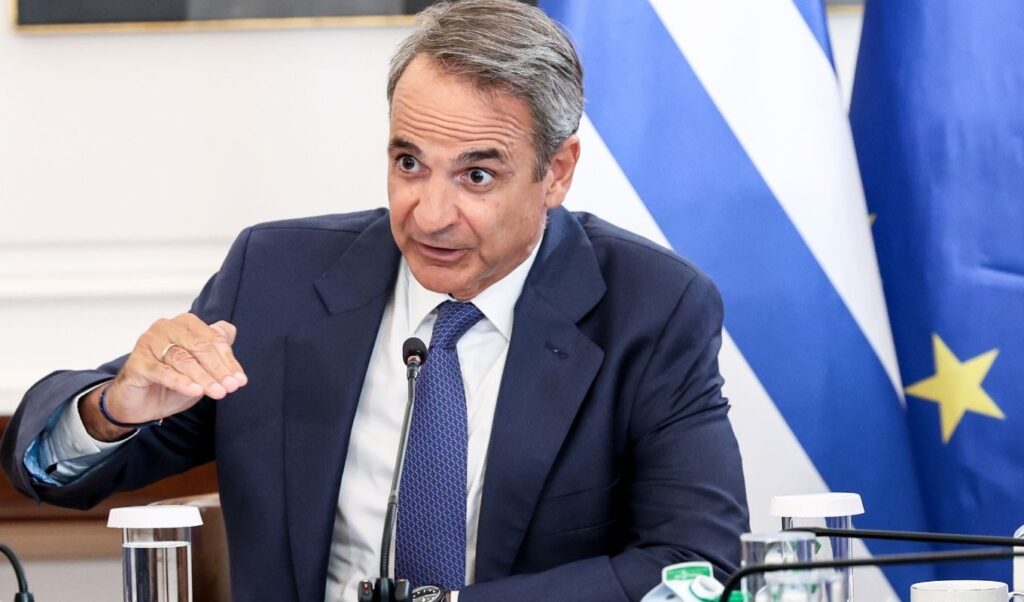
Kyriakos Mitsotakis, during his tour of Western Macedonia, gave an interview to e-ptolemeos.gr and the newspaper “Ptolemaios.” He spoke at length about the government’s initiatives to build infrastructure and create opportunities to usher the region into a new era of growth. He also sharply criticized PASOK for choosing to support Elena Akrita for the position of Deputy Speaker of Parliament, while having refused to back Yannis Stournaras for the role of Governor of the Bank of Greece.
The Prime Minister’s interview in full
“Antonis Pougaridis: Friends, good evening. As part of the Prime Minister’s visit to Western Macedonia, we are honored today to welcome him to e-ptolemeos.gr and the newspaper “Ptolemaios,” and to have the opportunity to discuss some issues of regional interest.
Prime Minister, good evening. Thank you warmly for this opportunity, for this interview.
Kyriakos Mitsotakis: Thank you as well, Mr. Pougaridis, and congratulations on the very important work you have consistently done in bringing the local issues of Western Macedonia to light.
Antonis Pougaridis: Thank you. I’d like to start with the Just Development Transition Programme, which is now unfolding — projects have begun to be implemented, some private projects that you are visiting today have started to be completed and enter production.
However, citizens say you’ve been slow, that in the seven years you’ve been at the helm of the country, things could have moved perhaps at a faster pace — some even say that the transition away from lignite should have come first. What do you say to that?
Kyriakos Mitsotakis: First of all, citizens are right to be concerned, both about the pace of the transition and about the transition itself. And I’m glad to have the opportunity today to speak in more detail about our plan, and I also hope to be able to debunk certain myths that continue to circulate around the issue of transitioning from lignite to cleaner forms of energy production.
First and foremost, Mr. Pougaridis, we must say that de-lignification in this country did not begin in 2019. It effectively started back in 2010. What happened in 2019 was that a coordinated decision was made to carry out this de-lignification process with a clear plan, and to secure the financial tools needed to help Western Macedonia move into a new era.
The reality is simple: lignite, given the cost of carbon dioxide emissions, is simply no longer competitive — and anyone who says otherwise is flat-out lying and brazenly deceiving the people of Western Macedonia. De-lignification was therefore an inevitable process.
What we managed to achieve and secure is, through a dedicated financial instrument — the Just Development Transition Programme — more than €1 billion, so that we can build both the infrastructure and the development opportunities needed for Western Macedonia’s future to be better than its past.
That is precisely the core of this programme: to ultimately create more and better-paid jobs than those lost due to the gradual phase-out of lignite.
I had the opportunity today to visit many private investments financed by this programme. Perhaps the most emblematic is the Wonderplant investment. Wonderplant is a state-of-the-art hydroponic tomato greenhouse of enormous scale — an investment exceeding €150 million, €60 million of which comes from the Just Development Transition Programme. It will create more than 400 jobs, has already been groundbroken, construction has already begun, and it’s worth noting that this investment uses previously restored land — land that was once synonymous with lignite.
So, in a region where lignite has effectively stopped generating electricity, we can already see a highly competitive, highly innovative investment that will provide hundreds of jobs to our fellow citizens in Western Macedonia, with good wages — and it is just one of the many investments being set in motion in this direction.
Antonis Pougaridis: You say that de-lignification didn’t start in 2019, and this is confirmed by the chart showing the decline of lignite’s share in the national energy mix.
Many New Democracy supporters here say that all the political damage from the decline in lignite’s role — under governments before yours as well — was ultimately borne by your government, your party. What do you say to that?
Kyriakos Mitsotakis: Look, as I said, de-lignification…
Antonis Pougaridis: Was it an acknowledgment that should have come sooner?
Kyriakos Mitsotakis: It was inevitable. The difference is that previous governments simply didn’t bother preparing Western Macedonia for what came next.
Right now, the country’s energy mix relies on renewable energy sources, with natural gas as the base fuel — quite simply because natural gas is cheaper than lignite.
We set this transition in motion, which is why Western Macedonia now has many renewable energy projects being developed — not just by PPC but through private investments as well.
But I want to say a word about PPC, because I think it deserves special mention. For many decades, PPC was synonymous with lignite, and it would be wrong to assume that because most of the lignite-fired units have closed — the “Ptolemaida 5” unit is still operating, as you know, and will continue for some time — PPC is abandoning Western Macedonia. The exact opposite is happening.
I had the opportunity today to visit Kardia. Kardia is essentially a decommissioned lignite power plant. But at Kardia, a new CHP unit is now being built.
It’s a unit that PPC is building with state support, precisely because we must ensure district heating for the wider area — Ptolemaida, Amyntaio, Kozani. District heating is secured, and the cost of district heating until the unit is up and running has been guaranteed by the government.
But at the same time, at this “heart” of the new PPC, a very large pumped-storage hydropower system will be built. Imagine two reservoirs — two large lakes, to put it simply — where water will be moved according to the needs of the electricity grid, functioning as a giant battery. New condensers will also be built for system stability.
And a little further down, at Agios Dimitrios, a massive data center will be built — one that will effectively transform Western Macedonia into the “heart” of artificial intelligence infrastructure. All of this will create more than 2,000 jobs.
I can assure you they will be better-paid jobs than digging in a mine, and the quality of work will simply be incomparable to what people experienced working in lignite for so many years.
So, PPC remains present in Western Macedonia with a very large investment programme. It remains committed to Western Macedonia, it is collaborating with the University of Western Macedonia, and it will continue to be the region’s largest employer.
Antonis Pougaridis: I hear you speaking with great enthusiasm about all of this. I also recall that back in 2021, during a visit to the Regional Authority building, you called this place a personal challenge of yours. But because people still don’t see these projects being completed — or even started in some cases — they do however see some interesting inclusions in the Just Transition Programme, like a shooting range or a motocross track.
Kyriakos Mitsotakis: And those facilities are important because they add another dimension.
People are right to feel skeptical. And I, too, wish that — despite the enormous efforts made… And I want to make special mention of Nikos Papathanasis, who has practically become an honorary citizen of Kozani or Western Macedonia, given how much time he’s spent here. This programme we’ve run hasn’t been easy. But we are already seeing concrete results.
Let me mention the E65. The E65 will change the fate of Western Macedonia. We may not see its full impact yet, but being able to travel from Florina to Athens or from Kastoria to Athens in 4 to 4.5 hours is truly remarkable, and very soon you will see the developmental benefits of this initiative.
Other very significant infrastructure projects are being set in motion. I’ve made a personal commitment regarding the Ptolemaida–Florina road. The first section — Ptolemaida to Xino Nero — is already entering the tendering process.
Look at the investments we’ve made in healthcare infrastructure. I visited the “Mamatsio” hospital — I’ll have the opportunity to return in three or four months to officially inaugurate it. It has become an outstanding, state-of-the-art hospital. The emergency departments are already operational.
The “Modosakio” hospital will get an oncology clinic, which will allow cancer patients in Western Macedonia to receive their treatments locally, without having to travel all the way to Thessaloniki or even further.
All of these are significant investments financed by the Just Transition Programme and already being implemented. We’re no longer talking about the future — we’re talking about the present.
My point is this: we went through difficult years — years of skepticism and, I would say…
Antonis Pougaridis: If I may — distrust.
Kyriakos Mitsotakis: …distrust. The sense I have this time is that this is changing — or rather, beginning to change. And that’s why I’m absolutely confident that the years ahead will be very good for Western Macedonia.
Beyond Kozani, I also visited Florina — a region with tremendous potential. I strongly believe in Western Macedonia as a destination, a tourism destination.
People are increasingly discovering mountain tourism — partly driven by climate change. Look at areas like Nymfaio, the Four Lakes region, or if we move a little further south, Grevena, the Vasilitsa ski resort, which was effectively privatized, the road from Grevena to Vasilitsa is under construction. I see creative winemakers — we have some of the country’s finest wineries — making very significant agrotourism investments.
All of this ultimately translates into jobs for the region and a new development model. Some are still fighting rearguard battles. I’m genuinely sorry that PASOK in particular, as a supposedly serious party, continues to make announcements that look backward rather than forward — and I’ll say it as I feel it — subtly deceiving the citizens of Western Macedonia about the reality of the new energy landscape.
Antonis Pougaridis: You’re referring to the operation of the units and the extension that Mr. Koukolopoulos…
Kyriakos Mitsotakis: Exactly — these are not serious positions. Let me give you an example. If you owned a shop that only turned a profit on New Year’s Eve, would that make it profitable all year round? That’s what’s happening with lignite. Lignite may indeed be cheaper on certain days of the year, but that’s not something sustainable — and everyone knows it.
So I believe the serious forces in local society — I would go so far as to say even the PPC workers themselves — recognize this reality. The question, then, is not whether de-lignification will happen — it’s already happening. The question is how it will be completed, and whether there is a plan for a just transition. That is what we are serving, and what we will continue to be committed to.
Antonis Pougaridis: We understand that there is a plan — we can see the calls for projects and the works maturing. Those of us who follow the technical documentation can see it.
Kyriakos Mitsotakis: And not only that. The DYPA programmes, support for the fur industry in Kastoria — all of this represents funding and resources. What needs to happen? We need to move even faster.
Antonis Pougaridis: Because, as I mentioned at the start of my question, these things are still not visible to most people — how will you convince citizens who look at you with skepticism, especially ahead of an electoral season, that all of this will have a positive impact on their lives?
Let’s not forget that some of my fellow citizens have already left the region due to the decline in mining activity over the past decade.
Kyriakos Mitsotakis: That’s true. We are indeed seeing a population decline. The challenge, therefore, is for private investments in particular to be set in motion much faster. But these are things that are not just going to happen — they are already happening. The greenhouse I mentioned will be ready in 12 to 18 months. We’re talking about 400 jobs.
Antonis Pougaridis: That’s the big picture.
Kyriakos Mitsotakis: I also visited the Tottis company, for example — they will be adding 200 jobs in the coming period. Let me give you a smaller example: “Xino Nero” — and I’m not saying this to promote a product, but because it’s a municipal enterprise, a public company that had a turnover of €1.5 million and now has a turnover of €10 million; it had 8 employees and now has 70, and it could double that and quintuple its turnover. With investments supported by the Development Law, we can take a unique product and bring it to all of Greece and the world.
All of this, when added together, amounts to many jobs. I believe that in one to two years from now, when we look at the labor market in Western Macedonia, we will see a completely different reality.
And I also want to say a word about the University, which we have supported strongly. There was indeed a delay with the PPP project for student housing, but I believe we will be able to resolve it soon.
We have invested heavily in the University — we are in open communication with the Rector. It’s a university that is beginning to establish a presence and a footprint on the country’s academic map.
It has a presence in all the major cities of Western Macedonia and demonstrates how a regional university can become a hub of knowledge, innovation, and support for the local economy.
Antonis Pougaridis: Prime Minister, the region is hungry for investment — both for psychological reasons and because of what the numbers show. Since things are happening at a high level that we’re not always aware of here, I’d like you to tell me: based on the information you have, how does the broader business community view the prospects of Western Macedonia, and what can the government do — and what is it doing — to persuade major groups to invest their capital here?
Kyriakos Mitsotakis: First of all, Western Macedonia has the most favorable incentive framework of all regions in the country, on top of the Just Transition Programme resources. So the framework is there. Connectivity is there. You’re close to Thessaloniki, close to the ports, on the Egnatia motorway, on the major transport networks.
Let me open a parenthesis: I acknowledge that the Egnatia is causing some inconvenience right now. But the Egnatia will become a brand new motorway.
I want to remind you that the Egnatia was built decades ago. It was essentially a neglected motorway. During the years of the crisis, absolutely nothing was done. Now, with the effective change of concessionaire, investments in the Egnatia will reach €