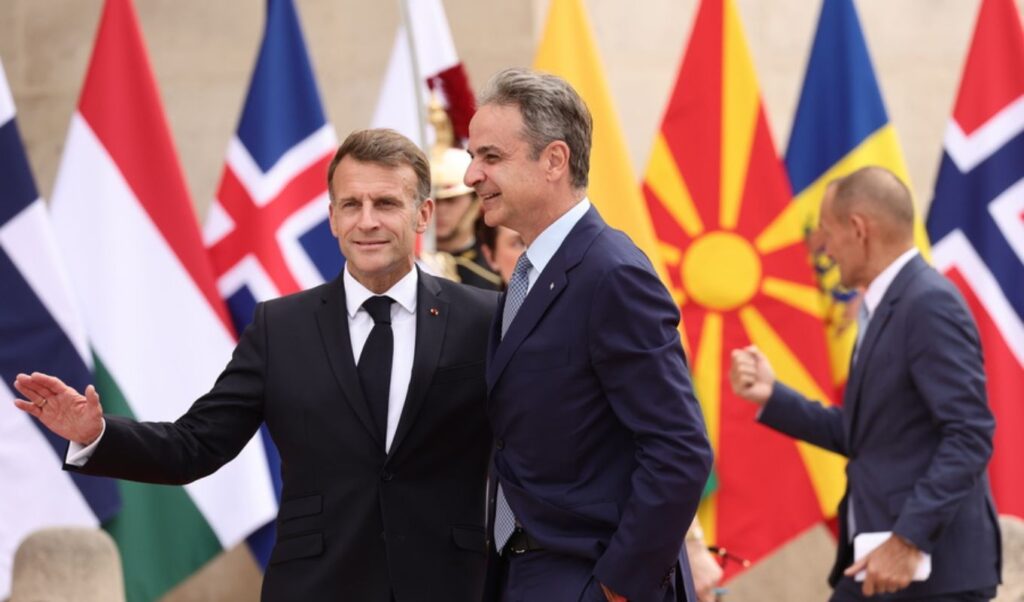
Kyriakos Mitsotakis‘ participation in the Coalition of the Willing meeting on Ukraine convened by Emmanuel Macron — as well as his presence in Paris for France’s Bastille Day military parade on Tuesday — are symbolic of the level to which Greek-French relations have risen across multiple sectors, having weathered a number of storms in recent years.
Read also: Macron shares photo with world leaders attending the grand Bastille Day military parade — including Zelensky and Mitsotakis
On Tuesday, an inter-service honor guard unit from the Hellenic National Defence General Staff marched down the Champs-Élysées, while a pair of Greek Air Force Rafale jets performed a flyover. “A presence that symbolizes our country’s enduring contribution to common European security, the protection of the values of democracy and human rights, and the strong bonds between Greece and France,” noted Defence Minister Nikos Dendias.
Greece and France sealed the renewal of their strategic partnership agreement on security and defence cooperation at the end of April, signing an enhanced comprehensive strategic partnership and cementing the broadening and deepening of a multilevel cooperation framework. “The Enhanced Comprehensive Strategic Partnership between France and Greece signals the alignment and cooperation of the two countries not only in defence, but also in the economy, civil protection, migration, technology, the environment, education and culture, as well as cooperation within the EU and international organizations,” government sources noted at the time. The symbolism of Emmanuel Macron’s two-day visit to Athens was considerable — as was the emphatic response he gave regarding what France would do if Turkey were to threaten Greece: “If your sovereignty is threatened, know that we will be there.”
Greek-French relations have gone through several turbulent phases in recent years. During the 2020–2022 period, they reached perhaps their highest point in modern history. France stood firmly by Greece’s side during the crisis with Turkey in August 2020 over the Oruç Reis incident. In 2021, the two countries signed an agreement “establishing a strategic partnership for defence and security cooperation,” which includes provisions for “assistance and support,” even “through the use of armed force, should they jointly determine that an armed attack is taking place against the territory of either.” The Greek government’s defence modernization decision at the time included the acquisition of 24 Rafale fighter jets for the Hellenic Air Force and three Belharra frigates for the Hellenic Navy.
Following the re-elections of both Macron and Mitsotakis to second terms — in 2022 and 2023 respectively — relations warmed once again. The two leaders met three times within just a few months: in Vilnius, Lithuania, on the sidelines of the NATO Summit; in Malta, on the sidelines of the EU-MED9 meeting; and in Paris.
Some clouds began to appear on the horizon in 2024, for instance when neither Emmanuel Macron nor France’s then-Foreign Minister attended the Ancient Olympia ceremony for the lighting of the Olympic Flame ahead of that summer’s Paris Games.
A series of visits by Mitsotakis to France followed: to Normandy for the 80th anniversary of the Allied landings, to Lorient and the Naval Group shipyards where the three Greek frigates were under construction, and to Paris for the Olympic Games opening ceremony. Shortly after the launch of the second Greek Belharra frigate came the announcement of the activation of the 3+1 option and the acquisition of a fourth frigate — with increased Greek participation in its construction — with the Prime Minister stating that it “was deemed essential, as strengthening the country’s defences is a non-negotiable priority.”
The war that erupted in the Middle East five months ago also served as a catalyst for the upgrading of Greek-French relations. Mitsotakis and Macron traveled to Paphos and expressed in person their solidarity and support for Cyprus. “We are ensuring close coordination with our allies and European partners, first and foremost with our Greek friends, so that this effort in the Eastern Mediterranean is also reinforced by willing nations,” Macron had said days earlier in a televised address — a statement that illustrated the level of communication now existing between Athens and Paris.
It is no coincidence that Mitsotakis ultimately attended the second Nuclear Energy Summit, held a few months ago in Paris with Macron as host, and declared his support for the French president’s energy agenda — including Greece’s inclusion within it. “I am here because I recognize a fundamental reality pointed out by President Macron and other colleagues: we cannot achieve everything we care about in Europe — strategic autonomy, economic competitiveness, decarbonization — without nuclear energy,” Mitsotakis emphasized. “I came to Paris today to announce that Greece, too, is turning the page. The time has come to explore whether nuclear energy — and specifically small modular reactors — can play a role in the Greek energy system,” he declared.