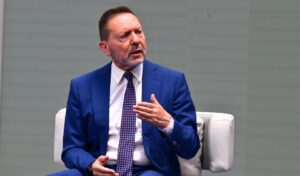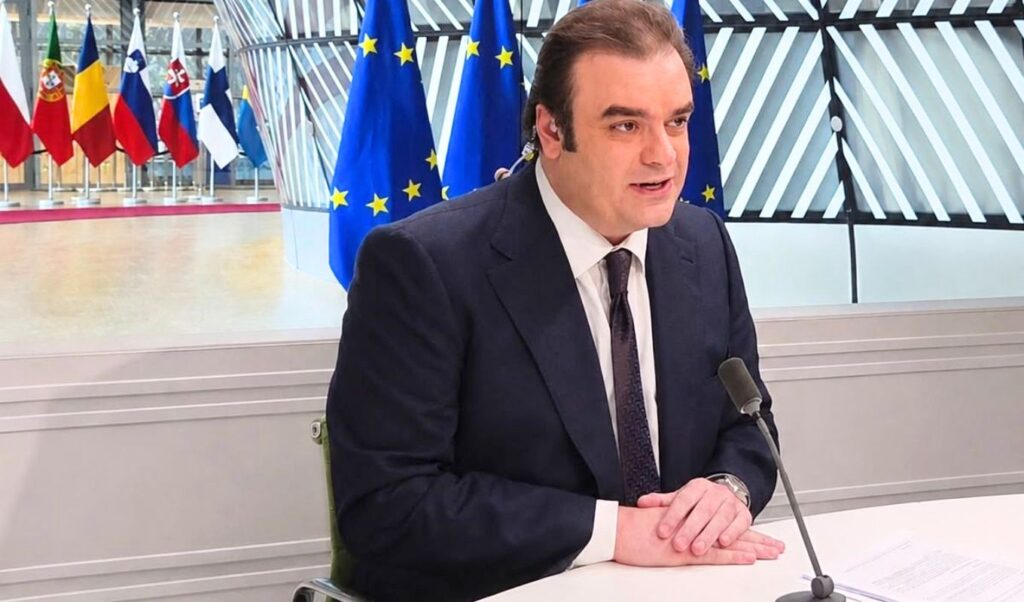
An interview with Greece’s Minister of National Economy and Finance and Eurogroup president, Kyriakos Pierrakakis, was published today by Politico, with the Greek minister outlining his proposal for European spectrum management. In his interview with journalist Mathieu Pollet, Pierrakakis discusses the need for greater coordination among EU member states in spectrum auction processes, as well as the channeling of a portion of the resulting revenues toward strategic European investments. He also explains how this proposal could contribute both to deepening the single market and to strengthening European competitiveness.
Among other things, the Politico article notes: Can money appear out of thin air? Greek Finance Minister Kyriakos Pierrakakis says he can make it appear out of the airwaves.
Pierrakakis, who is at the helm of the Eurogroup — the informal gathering of finance ministers from countries that use the euro — is championing a potentially bold new way of raising money for the European Union: redirecting the highly lucrative revenues from national spectrum auctions toward Brussels, at a time when discussions over the Union’s seven-year budget are intensifying.
“It’s telecoms policy à la Draghi,” he told Politico, invoking the former Italian prime minister’s blueprint for reversing Europe’s economic decline, which called for greater coordination and harmonization in the way national governments license the frequencies that power mobile networks. Such an arrangement would also have the added benefit of encouraging the development of critical pan-European technological infrastructure.
European telecoms providers currently face a fragmented system of national procedures for gaining access to spectrum, while auction revenues flow into national budgets. Since 2020, providers have spent more than €50 billion on spectrum licenses, according to industry association Connect Europe. This process has long been a subject of criticism, as it is seen as draining money away from providers rather than encouraging investment — with former EU Commissioner Thierry Breton having described spectrum as governments’ “cash cow.”
Pierrakakis: Europe should adopt the Greek model
Pierrakakis called on Europe to adopt the Greek model, which he described as the “most innovative auction,” referring to Greece’s 2020 decision to direct 25% of spectrum auction revenues into a new venture capital fund for investment in the growing 5G ecosystem. The Eurogroup president envisions allocating 75% of auction revenues to the Multiannual Financial Framework — the EU’s long-term spending plan — and the remaining 25% through a European Investment Bank fund. Under such a framework, he argued, “Europe would end up having a much larger total amount at its disposal.”
This novel proposal could offer negotiators a new source of EU-level revenue, known in Brussels as an “own resource.” At the same time, Europe remains divided in discussions over the Union’s €2 trillion budget between the so-called “frugal” countries, which want to limit spending, and those that want to maintain current levels.
“Reducing fragmentation and moving closer to a genuine single market would already be a major win”
Pierrakakis also said he wants to link this “non-zero sum idea” to efforts to strengthen European industrial champions and reduce the Union’s dependence on American technology.
“This idea has many layers. There is a very obvious layer, which is simply the synchronization of auctions,” Pierrakakis said, arguing that reducing fragmentation and moving closer to a genuine single market would already be a major win. “The value for our European champions and for our telecoms providers is self-evident, even before we get to the revenue discussion.”
He argued that a new paradigm is taking shape following the recommendations put forward in recent years in the European competitiveness reports by Mario Draghi and fellow former Italian Prime Minister Enrico Letta.
In particular, he referred to the Capital Markets Union — the EU’s long-standing project to create a single market for investment and financing — which has recently gained renewed momentum.
Pierrakakis expressed hope that his idea could feed into negotiations over the EU budget for the 2028–2034 period, as well as the broader debate on European competitiveness. He said “many” of his colleagues have already “embraced the basic philosophy of the idea.”
“We now need to move into a more detailed and thorough phase, during which we will need a specific impact assessment and concrete steps in order to continue the conversation.”