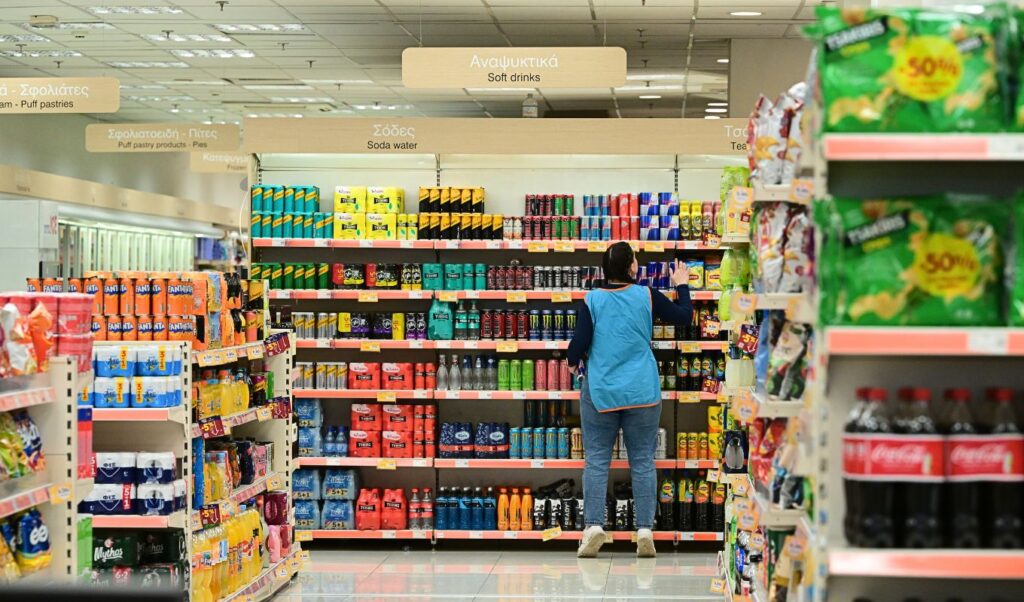
Greece’s organized food retail market maintained a steady upward trajectory throughout the first half of 2026. The semi-annual NielsenIQ survey captures the sector’s momentum, drawing on data from supermarket stores with a floor area of over 100 square meters, spanning mainland Greece and Crete, as well as the Ionian and Aegean island clusters. Notably, turnover in fast-moving consumer goods reached €5.7 billion, while the value of supermarket sales across the country recorded a robust 6.7% increase during the first half of 2026.
Food and beverages remained the market’s largest category, accounting for more than half of total sales value. During the first half of the year, this segment posted a 5.9% increase.
Among individual subcategories, dairy products recorded the strongest growth among the main product groups, with sales value rising by 8.6%. Fresh foods followed with a 7.3% increase, snacks grew by 6.5%, and non-alcoholic beverages rose by 6.4%.
Modest growth in household and beauty products
The picture was positive but more subdued for home care products. This category — referred to in NielsenIQ data as Household Products — recorded a 3.5% increase in sales value.
Health and Beauty products posted a 4.1% increase, with the strongest performances seen in personal hygiene and personal care segments.
All store formats recorded growth. Hypermarkets — large-format stores offering an extensive range of food and non-food products — led the way with the highest increase of 9.1%.
They were closely followed by stores with a floor area of between 100 and 400 square meters, classified by NielsenIQ as Superettes, which grew by 8.9%. Their performance is linked to the restructuring of retail chain networks and the expanding presence of neighborhood and convenience stores.
Stronger growth in tourist destinations and regional markets
Sales growth was recorded across all geographical regions, with the islands delivering the highest performances. In the Ionian and Aegean islands, sales value increased by 9%, while Crete saw growth of 8.2%.
In Attica, which accounts for 42.3% of total consumption value, sales grew by 6.3%. The growth rate was higher in Thessaloniki, where the increase reached 7.9%. The Thessaloniki region represents 9.8% of the market’s total turnover.
Promotional activity for branded fast-moving consumer goods declined noticeably during the first half of the year. The share of sales generated through promotional campaigns fell to 40.3%, down from 44.4% in the same period of 2025.
Health and Beauty products continued to record the highest level of promotional activity. However, even in this category, promotional intensity eased to 49.7%, compared with 55% a year earlier.
Private label growth loses steam
The market share of private label products — sold under a retailer’s own brand name — edged slightly lower, despite the continued pressure on household disposable incomes.
Across all fast-moving consumer goods, the private label share stood at 24.3%, down marginally from 24.4% in 2025.
In food and beverages, the corresponding figure reached 24.8%, also recording a slight annual decline. In home care products, by contrast, private label maintained a share of 33.3% — the highest among the market’s main categories.
Private label presence remained limited in the Health and Beauty category, where its share stood at 8.6%, though this represented a modest improvement compared with 2025.
Consumers bought more — not more expensively
The market’s growth during the first half of the year was driven primarily by increased purchase volumes rather than price changes.
According to NielsenIQ’s analysis, of the overall 5.3% growth in fast-moving consumer goods, 4.1 percentage points were attributable to higher sales volumes. Changes in the average unit price contributed the remaining 1.2 percentage points.
The data therefore indicates that during the first half of 2026, consumers purchased greater quantities of products, while the impact of price inflation on turnover growth was considerably smaller than in previous years.