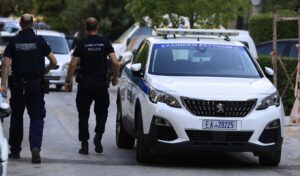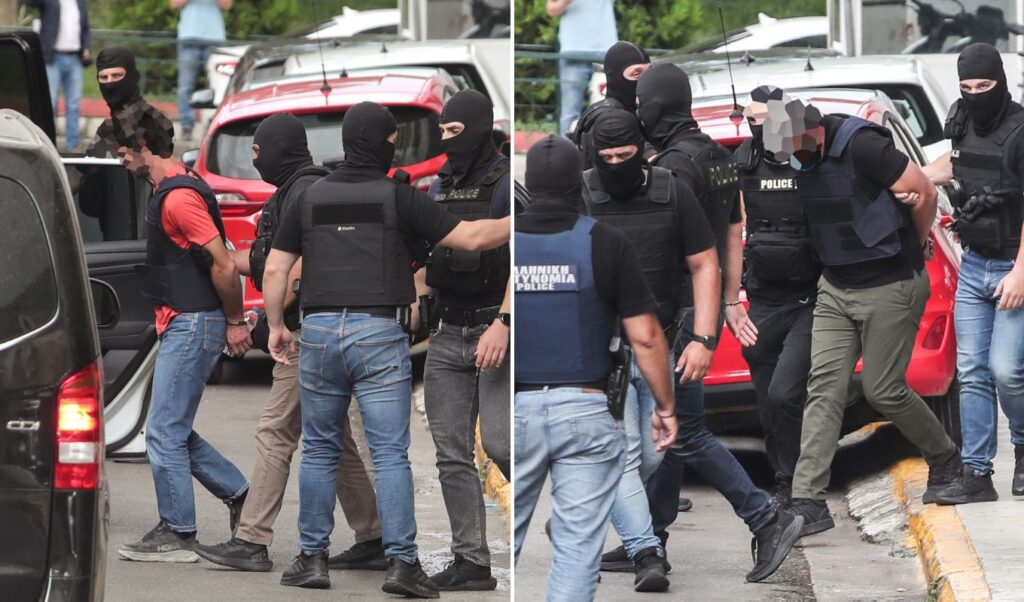
The investigative proceedings bringing the two 42-year-old defendants in the Marfin Bank arson case of May 2010 before the courts at the former Evelpidon Military Academy are being awaited with great interest. These are two of the three individuals arrested, and the proceedings are unfolding amid heightened tensions both on the political stage and among defense attorneys and solidarity supporters alike. All of this is happening as extradition proceedings begin for the 46-year-old woman arrested by British authorities — she is expected to appear before Greek justice within the coming days.
Read also: Marfin case: The Molotov thrower under the microscope — The nine witnesses who sealed the arrests
Meanwhile, the web of police investigations continues to unravel. It was this investigative work that reignited this major case and moved it into what could be called a “second half,” with the hope that this time the authorities will have completed their task without new procedural obstacles emerging. Greek society, after all, needs genuine closure in this case — with the real perpetrators sitting in the defendant’s dock.
Marfin: The facts surrounding the anonymous email
Information about how the Homicide Division and Forensic Laboratories built their case — winning approval from the examining magistrates and proceeding to issue arrest warrants — has been pouring in. At the center of initial attention is the now-notorious anonymous email, which became the subject of intense discussion over the past 24 hours following what appeared to be a misstatement by Citizen Protection Minister Michalis Chrysochoidis himself. Speaking on SKAI Radio, the minister referred to “fabrications.” It is possible he intended to convey a different message during the interview, but according to unimpeachable sources at parapolitika.gr, the anonymous email does in fact exist.
“Dear Prosecutor, I thought long and hard before sending this email, because for 16 years I have been keeping a secret that has not allowed me to find peace,” the email reportedly reads. After naming a series of individuals, it continues: “…I know that these people formed a group and that they are responsible for Marfin.”
The contents of the email have, however, drawn sharp criticism — and even ridicule — from both defense attorneys and those aligned with the anti-authoritarian community, who dismiss it as weak evidence and characterize it as a scheme leading to an unjust prosecution. In any case, the email serves at least as a compass in the formation of the case file. Notably, it is dated last April, which, if nothing else, does little to clarify whether it constitutes the cornerstone of the investigation or not. The minister himself, in the aforementioned interview, was categorically dismissive of that characterization, pointing instead to two years of painstaking work by police officers.
The photographic evidence
Photographic material in the possession of the Hellenic Police plays a critically important and binding role among the evidence gathered. The connections drawn are particularly complex and required the contribution of at least one photojournalist, who handed over a package of 205 photographs taken at the large demonstration of May 5, 2010. Among those frames are six photographs depicting the so-called “Masked Five” — the subgroup of five individuals who were in close proximity to the Marfin Bank branch. According to the police investigation, each of these individuals allegedly played a specific role. The two arrested 42-year-olds are accused of smashing the bank’s glass facade (the first) and coordinating the attack (the second). The 46-year-old woman, arrested at Gatwick Airport in the early hours of Monday, is alleged by specific police sources to have been carrying a backpack filled with Molotov cocktails, which were then thrown by the other two as-yet-unapprehended alleged accomplices.
The reasonable question of how police concluded that at least three of those arrested are among the “Masked Five” is answered by Hellenic Police officers who conducted a specific comparative analysis of the photographs. In 2020, when the Counter-Terrorism Unit discovered an anarchist safe house in Koukaki belonging to the well-known anti-authoritarian P.G. — an associate of Vassilis Palaiokostas — officers seized not only explosives but also digital devices containing holiday photographs. These photos date back to 2009 and feature at least three of the individuals now implicated in the case.
Most crucially, the photos captured three key — though portable — items: at least three backpacks with distinctive features. One had a zipper of a particular color; another bore a red band logo emblem; a third displayed three stars. These same unique characteristics appeared in the photojournalist’s photographs from May 2010, worn by members of the “Masked Five” group. Additionally, hair color, body type, and other similar physical characteristics were matched.
In this regard as well, defense attorneys have raised serious objections. Following their initial review of the case file, they argue that the officers from the Homicide Division themselves do not express certainty about the identification of the individuals in the 2009 holiday photographs as being the same people captured in the May 2010 images.
Two more suspects
What has come to light in recent hours is that last Friday, authorities did not limit their search to tracing the three individuals already arrested. They also carried out raids on the homes of two additional persons who are under suspicion for involvement in the case. The operations took place in the Piraeus area and in Kaisariani. All electronic devices capable of storing digital data were seized and sent to the Forensic Laboratories for analysis. So far, nothing incriminating has emerged — though the investigation is not yet complete.
Notably, the two individuals under investigation sent open letters during yesterday’s press conference held by the defendants’ defense attorneys. One of them, identified by the initials A.S., wrote: “With or without AI, the conspiracy is unraveling.” He states that police searched his home and seized computers, mobile phones, and hard drives. He notes that subsequent media reports portrayed him as a suspect in the Marfin case. He claims he is being prosecuted for political reasons and characterizes the proceedings as a “conspiracy.” He alleges that authorities are attempting to link individuals together through personal connections or even through the use of artificial intelligence, expressing fear that facial recognition software could be used to fabricate false associations. He also launches fierce criticism at the government, the police, the judiciary, and the media, connecting the case to broader political and social developments. He declares that he is proud to have no connection to those accusing him. The letter closes with the slogans: “BACK OFF, SNITCHES — FORWARD, COMRADES” and “LONG LIVE ANARCHY.”
The second individual, identified as I.L., writes: “We will not serve as pre-election garnish for a government that is collapsing.” He states that two days after the police search of his home — conducted in the presence of his minor children — he has still been given no specific explanation for why the search took place. He claims that officers seized electronic devices, including the mobile phone belonging to his 11-year-old son. He links the search to the Marfin case, describing it as part of a “pre-election pattern” involving raids, arrests, and anonymous emails. He alleges that the case rests on an anonymous email that is, in his view, being exploited with the assistance of artificial intelligence to fabricate evidence, photographs, and conclusions. He accuses parts of the media of uncritically adopting this narrative. He states that he will not participate in what he calls the “fear-mongering theater” of a pre-election government campaign, and argues that the aim is to divert public attention from other social and political issues. He concludes by saying that the answer, in his view, lies in social solidarity, struggle, and dignity, and that he will not allow his name to be associated with “conspiracies, fabricated evidence, and manufactured case files.” The letter ends with the slogan: “BACK OFF, SNITCHES — FORWARD, COMRADES.”
The 46-year-old suspect
The final outstanding matter, for now, is the process of returning the 46-year-old woman and extraditing her to Greek authorities. The woman — a member of the group and mother of two who has been living permanently in England — was arrested at 4:00 a.m. Greek time on Monday at Gatwick Airport, where she works. According to sources close to her, she had purchased a ticket for an EasyJet flight to Greece with the intention of presenting herself to authorities voluntarily in order to prove her innocence. Following her arrest, she is expected to appear today before the competent court, where she will be asked whether she still consents to extradition to Greece. If she does, the procedural formalities will take a few days, and she may arrive in Greece as early as the beginning of next week. If she does not, the process could take several weeks to complete — with an uncertain outcome.