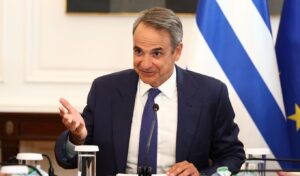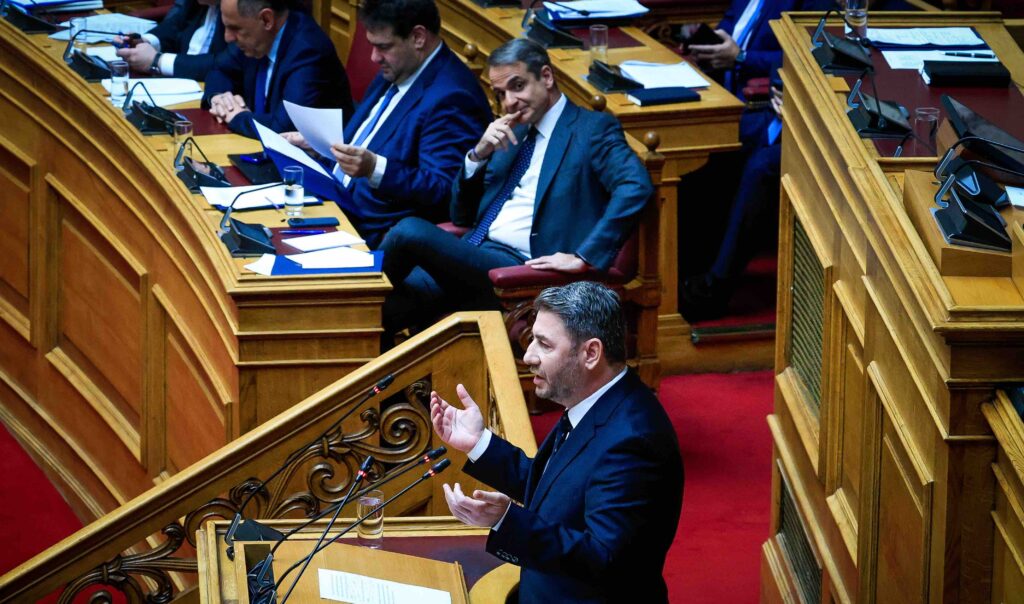
All eyes are on the Greek Parliament today, as Prime Minister Kyriakos Mitsotakis takes the floor at 10:30 during the Plenary Session to respond to a current affairs question submitted by PASOK leader Nikos Androulakis on the cost of living, as part of the Prime Minister’s Question Time. At Maximos Mansion, this is not being treated as just another parliamentary exchange — it is seen as an opportunity to present the government’s narrative on the economy and its interventions against the high cost of living, which remains the biggest thorn in the side of Greek households.
Read also: Prime Minister’s Question Time: Mitsotakis and Androulakis clash over the cost of living this Friday
According to well-informed sources, the government team views this particular debate not merely as welcome, but as absolutely necessary, given that the cost of living consistently tops citizens’ concerns and remains a key government priority.
The same sources indicate that the Prime Minister will attempt to shift the conversation away from political posturing and toward hard facts. He is expected to emphasize that assessing inflation and the cost of living cannot be done selectively — by cherry-picking periods of sharp price fluctuations — but requires a comprehensive evaluation of the data and broader economic developments.
Along the same lines, he will point out that inflation and the cost of living crisis are not exclusively a Greek problem, but are directly tied to the globalized economy, the unique characteristics of each national economy, and the turbulence of a period marked by international instability and geopolitical upheaval. Against this backdrop, Kyriakos Mitsotakis is expected to deliver a comprehensive review of the past six years, presenting — according to government sources — the trajectory of the economy through data that, as Maximos Mansion believes, demonstrates that wage increases, tax cuts, and government interventions have more than offset the price rises recorded in previous years.
Nevertheless, the Prime Minister is said to be determined to acknowledge that this picture is not always reflected in citizens’ day-to-day reality. As he is expected to note, external pressures continue to weigh on disposable income — whether in the form of rising beef prices or energy market disruptions triggered by events such as the war in Ukraine or the crisis in the Strait of Hormuz.
The government’s overarching goal, according to the same sources, is for economic growth to gradually translate into tangible income improvements for every Greek household, and for strong macroeconomic indicators to be felt in people’s everyday lives.
The three fronts of the cost of living crisis
In his address, the Prime Minister is expected to outline the government’s plan for tackling the cost of living crisis, focusing on three key fronts: energy, supermarkets, and housing. On the energy front, the government believes the situation remains under control, with the results of its interventions so far assessed as particularly positive. At supermarkets, the same sources note a gradual stabilization of prices — a development linked to zero monthly inflation recorded over the past two consecutive months. On the housing front, however, the government acknowledges that the problem remains acute across Europe. Despite measures already in place, such as the rent rebate scheme, a meaningful decline in prices requires an increase in the supply of properties on the market — a process that takes time.
Taking aim at the opposition
Particular emphasis is also expected to be placed on criticism of the opposition. According to government sources, Kyriakos Mitsotakis will argue that no comprehensive alternative policy proposal has been put forward beyond a VAT reduction. His argument will be that an across-the-board VAT cut not only failed to deliver results where it was implemented elsewhere, but would also create a significant fiscal gap in the Greek economy, given that VAT revenues amount to approximately €30 billion. A gap, he will note, for which the opposition owes voters a clear explanation of how it would be filled.
According to the same sources, the Prime Minister will close his address by arguing that when it comes to such a critical issue as the cost of living, the government is the only force with a coherent plan — and will refer to the opposition as a “political Tower of Babel,” contrasting government proposals as serious, fully costed, and realistic.
The data he will cite
A significant part of his argument is expected to be backed by the latest figures from the Hellenic Statistical Authority (ELSTAT), which, according to the government team, point to stabilizing market trends. Specifically, monthly inflation in June was zero compared to May, meaning the general price level remained unchanged. This marks the second consecutive month of zero monthly inflation — a development the government interprets as a sign of gradual market normalization. A key contributing factor was a notable decline in fuel prices: diesel fell by 7.6%, petrol by 5.7%, and other fuels dropped by 14.1%. The overall food price level also held steady. Increases recorded in fruits, fish, and cereals were offset by decreases in vegetables, cheeses, and pork, leaving the relevant index at zero — with no added burden on the average household basket. On an annual basis, inflation stood at 4.4% in June, down from 5.2% in May and 5.4% in April, confirming — according to the government’s reading — the gradual easing of the external inflationary pressures triggered by international crises.
The government also notes that while the annual index is the primary assessment tool for economists, monthly inflation is considered particularly significant as it captures market shifts and new price trends more quickly. Viewed through this lens, the past two months are interpreted as evidence that government interventions have helped contain price increases, despite the ongoing impact of the Middle East crisis.
New price reduction initiative launching August 31
Meanwhile, the economic team is preparing the next step in the battle against rising prices. Starting August 31, a national initiative will be launched targeting price reductions of more than 5% across key categories of consumer goods. Development Minister Takis Theodorikakos has already met with representatives from industry, suppliers, multinational companies, and supermarket chains to finalize the product categories to be included in the measure — food, everyday essentials, and household maintenance products — as well as the scope of the reductions. Business participation will be voluntary, reductions must exceed 5%, and the initiative is expected to run for two to four months. The government hopes the measure will serve as yet another buffer against the pressures that continue to strain family budgets.