In today’s digital reality, traditional cyberattacks and computer hacking are no longer the only means of extracting classified information. In the context of modern hybrid warfare, all it takes is a convincing video call from a prankster, a voice that sounds completely authentic, and a face that appears entirely genuine.
The case of Thanos Dokos
A striking example of this emerging threat is the recent incident involving the National Security Advisor to the Greek Prime Minister, Thanos Dokos. Mr. Dokos fell victim to the well-known Russian prankster duo, mistakenly believing he was engaged in an official conversation with a senior Ukrainian official. The incident illustrates, in the clearest possible terms, that disinformation operations — supercharged by artificial intelligence (AI) — have reached a deeply alarming new level. It also underscores the urgent need for the immediate implementation of stringent security protocols governing official government communications.
Russia’s invasion of Ukraine made it abundantly clear that 21st-century conflicts are fought just as fiercely beyond the physical battlefield. Alongside military operations, an invisible war of information, cyber threats, and orchestrated propaganda continues to unfold. The objective of these operations is not merely the collection of secrets — it is the systematic erosion of institutional credibility, the public exposure of officials, and the exertion of political pressure on an international scale.
A pan-European threat: Nothing is what it seems
The case of the Greek advisor is far from isolated. Similar high-profile deception incidents have been recorded across numerous European capitals. This affair serves as a stark reminder: in the age of AI, human communication can be manipulated to a degree that until recently belonged solely to the realm of science fiction. Seeing or hearing someone on your screen is no longer a guarantee of their true identity.
Who are Vovan and Lexus: The Kremlin’s favorite pranksters
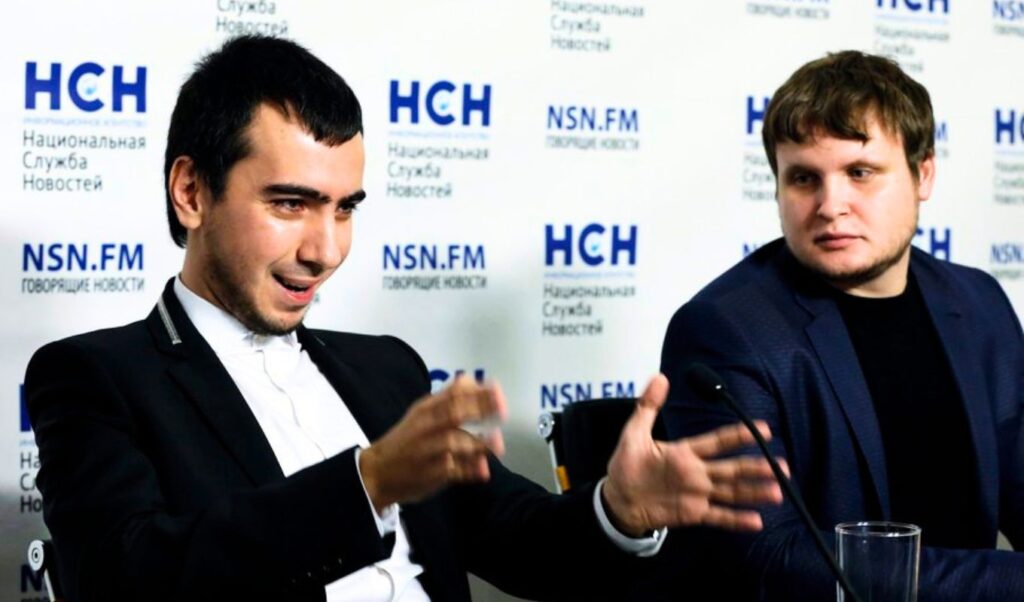
The two Russian pranksters have earned enormous recognition in their home country while enjoying the full backing of the Kremlin, thanks to their remarkable ability to deceive their targets. Using sophisticated AI tools, they are able to alter their facial features or disguise their voices with uncanny precision.
Vladimir Kuznetsov (Vovan) and Alexei Stolyarov (Lexus) have been active since 2014 and have managed to gain access to dozens of heads of state, ministers, diplomats, and international public figures.
In 2024, they were honored by the Kremlin — a development that further reinforced assessments that their activities serve the broader interests of Russia’s influence strategy.
Looking at the list of their victims, a common thread emerges. The majority are politicians or public figures who have openly supported Ukraine or play a significant role in the Western political landscape.
Among their targets: David Cameron, Giorgia Meloni, Boris Johnson, Ben Wallace, Recep Tayyip Erdoğan, Kamala Harris, Prince Harry, Elton John, and Bernie Sanders.
In several cases, the conversations were recorded and made public, causing considerable political embarrassment and widespread media attention.
From pranks to hybrid warfare
Experts point out that such operations do not necessarily aim to steal state secrets. The real objective is different, yet equally alarming: to publicly expose an official, to generate political damage, and to reinforce the Russian narrative of Western government incompetence.
This is a form of hybrid warfare — one where, instead of missiles, the weapons of choice are information, images, video footage, and psychological operations.