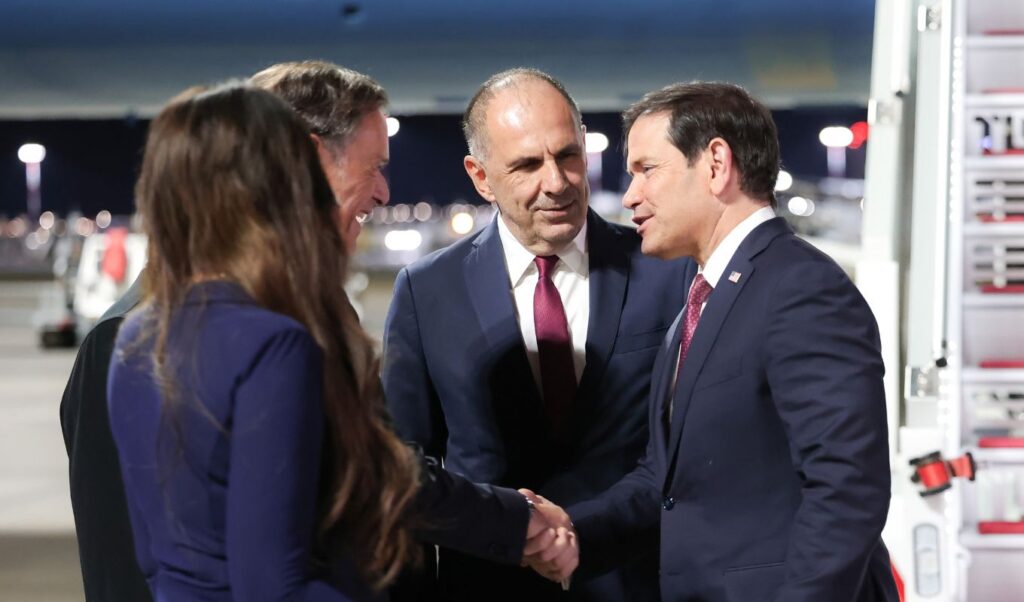
Just hours before U.S. Secretary of State Marco Rubio — who arrived in Athens last night — departed Washington for his visit to Greece, the American Hellenic Institute (AHI), with 52 years of advocacy in the United States, sent a high-profile letter to the top American diplomat. The letter called for an unequivocal reaffirmation of U.S. support for the sovereign rights of Greece and the Republic of Cyprus under International Law.
In his letter to the U.S. Secretary of State, AHI President Nick Larigakis underscored Athens’ pivotal role as an unwavering NATO ally and a reliable pillar of regional security, highlighting Greece’s enduring contribution to U.S. military operations through the strategically vital Souda Bay base.
Nick Larigakis: “Rubio is visiting Greece in person to emphasize how important the alliance between the two countries is right now”
Nick Larigakis spoke to parapolitika.gr about Rubio’s visit to Athens, noting that the Secretary’s personal presence in the Greek capital offers a significant boost to Greece’s standing in the region. He stated: “The American Secretary of State’s visit to Greece is particularly important for the Greek-American alliance, and it is significant that he is in Athens for the Strategic Dialogue with all issues on the table — because he carries enormous responsibilities, serving simultaneously as the White House National Security Advisor. So I greatly appreciate the fact that he has placed special emphasis on the U.S.-Greece Strategic Dialogue and is visiting Greece in person at this moment, to demonstrate through his presence just how important the alliance between the two countries is right now.”
“Turkey must not get the F-35s”
A central pillar of the American Hellenic Institute’s message surrounding Rubio’s Athens visit is the urgent need to maintain CAATSA sanctions against Ankara, and the AHI’s firm opposition to any potential return of Turkey to the F-35 fighter jet production and acquisition program.
As AHI President Nick Larigakis told parapolitika.gr, the Turkish leadership cannot be rewarded with cutting-edge military hardware while it continues its illegal military occupation of Cyprus, challenges Greek sovereignty in the Aegean, obstructs legitimate energy development, and maintains an ambiguous stance toward international sanctions on Russia and Iran. Larigakis stressed that even if a technical or diplomatic formula were found regarding the Russian S-400 missile systems, the delivery of F-35s to Turkey must be prevented. Such a development would dangerously destabilize the regional balance of power in favor of a country that has repeatedly demonstrated it does not behave as a reliable U.S. ally in critical geopolitical moments.
As Larigakis put it: “Right now, as long as Turkey holds the S-400s, it continues to issue threats, maintains its occupation of Cyprus, helps Iran, and has not taken a stand against Russia. All of this is far too much to justify giving Turkey the F-35s. The CAATSA sanctions are just one piece of this broader picture. Even if CAATSA were lifted — meaning Turkey were to return the S-400s at some point — I still firmly maintain that Turkey must not receive the F-35s, because it shifts the balance of power in favor of a country that has never demonstrated it is a true ally of America, as was clearly shown when the U.S. needed Turkey in certain critical moments. So all those other factors matter far more to me than the S-400s alone.”
At the same time, AHI President Nick Larigakis argued to parapolitika.gr that Rubio’s visit highlights Greece’s upgraded role as a critical energy gateway for Europe. The AHI is calling on the U.S. government to provide consistent support for regional energy cooperation projects, including the Vertical Corridor and the strategic 3+1 framework (United States, Greece, Republic of Cyprus, Israel). The Institute also demands the categorical rejection of any Turkish attempt to obstruct undersea electricity interconnection cables and legitimate energy infrastructure in the Eastern Mediterranean.
“Turkey is not serving American interests in the region”
As Larigakis explained: “We speak first and foremost as Americans. The message we are sending is that America must pursue a policy in the Eastern Mediterranean that serves its own interests, and must identify which countries are actually helping advance those interests. Those countries are Cyprus, Greece, and we include Israel in the 3+1 framework — so that we can maintain peace and stability. And which country is failing to do that? It is Turkey — which perpetuates instability and does not serve American interests across the broader region. Furthermore, I know that Americans care deeply about energy, both with respect to Greece and the wider region. It is of great importance to America. So I would like to believe that Marco Rubio will put a firm brake on any country that stands in the way of energy development.”
The AHI President once again expressed his satisfaction at the American official’s presence in Greece, noting that it underscores the particular weight Washington places on the strategic architecture of the bilateral relationship — all the more significant given that the U.S. Secretary of State has not included Turkey in his current tour itinerary.