Greece’s government is now adopting a more aggressive approach to its longstanding demand for the return of the Parthenon Sculptures to Athens, following what appears to be a deadlock in negotiations. The complex and difficult talks over the reunification of the Sculptures have intensified over the past five years, conducted primarily with the British Museum — roughly since former UK Chancellor George Osborne took over as its chair and discussions had reached a significant degree of maturity.
Little room for optimism
News from London, however, leaves little room for optimism. “I’ve noted that the new Prime Minister of the United Kingdom has previously come out openly in favor of returning the Parthenon Sculptures — we’ll see how consistent he is, whether he’ll honor that commitment. In any case, know that I intend to raise it with him as soon as I meet him,” said Kyriakos Mitsotakis, shortly after Andy Burnham succeeded Keir Starmer as UK Prime Minister. Burnham, however, recently distanced himself from his earlier statements, taking refuge in the letter of the law and saying that “it is a matter for the British Museum.”
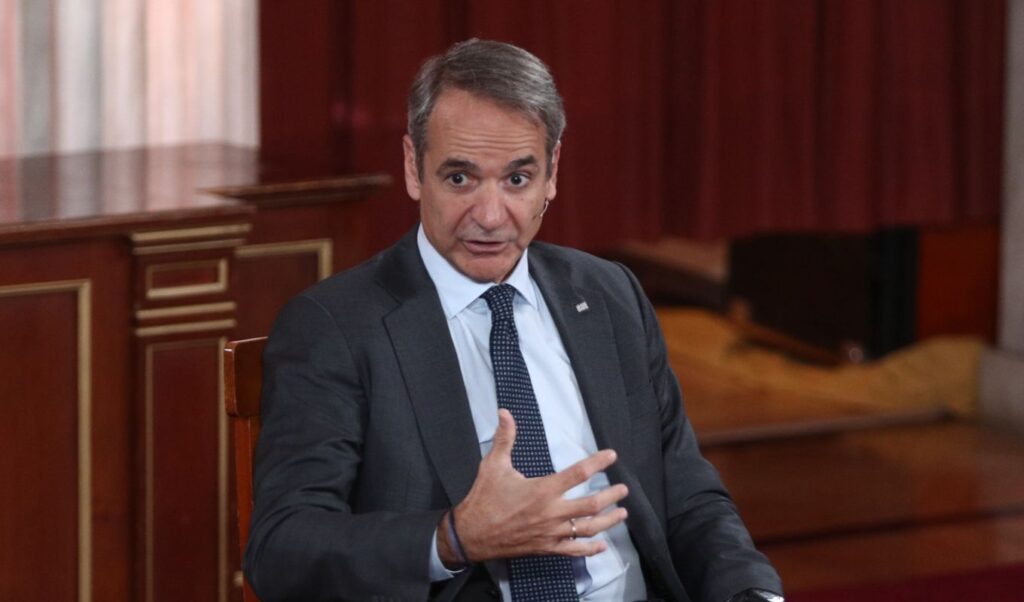
The British side’s insistence on a “loan” arrangement for the Sculptures remains one of the key obstacles to reaching an agreement. “I don’t think anyone can seriously dispute the question of ownership, but this goes beyond ownership. The Parthenon is a universal symbol — not only of Greek civilization but of humanity, I would say. It appears, you know, in the UNESCO logo. It is, therefore, a truly unique monument in and of itself,” the Prime Minister said yesterday during a conversation with author Daniel Mendelsohn, at the “Dialogues on Athens: From Myth to the Modern City” conference organized by the newspaper To Vima.
In the course of the discussion, Mitsotakis outlined what is essentially the more aggressive stance he intends to adopt going forward, structured around two distinct fronts. The first concerns the UK government and Prime Minister Andy Burnham. “We will press our claims with greater intensity — not only toward the British Museum but also toward the British Government — because there is a 1963 Act that effectively prohibits the British Museum from permanently transferring objects that form part of its collection. Therefore, we would need an exemption, an amendment to the law, and that is something only a parliamentary majority can deliver,” he said, revealing his intentions.
The second front involves incorporating the reunification of the Sculptures into any future negotiations that may take place between the European Union and the United Kingdom over a reversal of Brexit. “Those of us who were saddened when we saw the United Kingdom leave the European family watched with great interest the statements of the UK Prime Minister, in which he envisions a stronger relationship between the United Kingdom and Europe. The Parthenon Sculptures will be part of that conversation. This is not merely a matter for Greece — it is a matter for Europe,” Mitsotakis stated.
It is worth noting that the current moment may be uniquely suited for the reunification of the Sculptures. The major renovation of the British Museum’s west wing is expected to begin in 2027, at which point the gallery housing the Parthenon Sculptures will close, among others. The year 2027 may also mark the start of an upgrade and expansion project at the National Archaeological Museum in Athens. For the first time, this could create a rare “golden” opportunity — both to transfer the Parthenon Sculptures without leaving a temporary void in the gallery, and to offer some of the National Archaeological Museum’s outstanding collections on loan to the British Museum as a reciprocal arrangement in exchange for the return of the Sculptures.