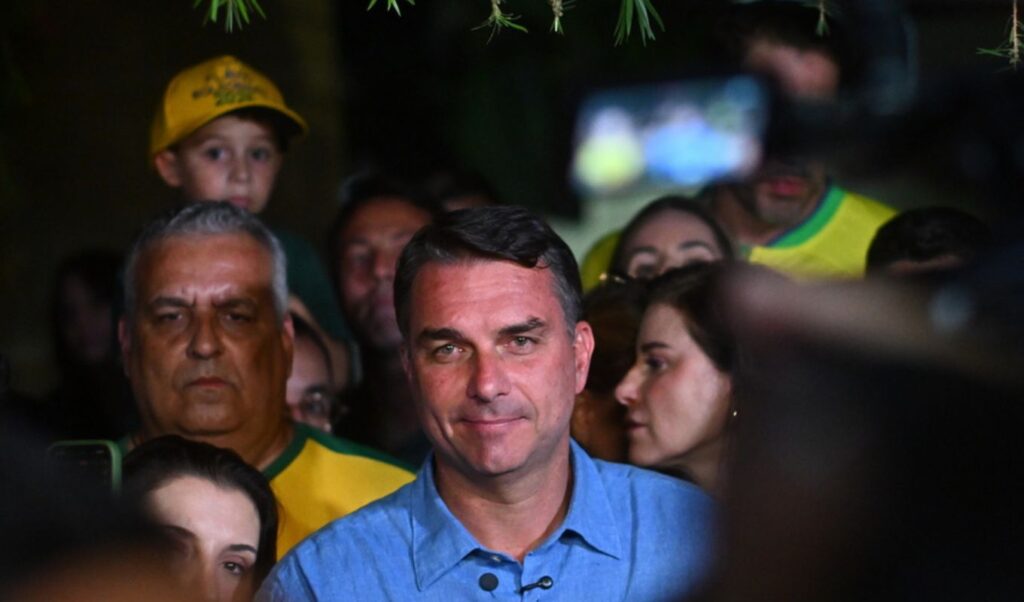
Flávio Bolsonaro pulled off a major surprise in the first round of Brazil’s presidential election, finishing in first place ahead of Luís Inácio Lula da Silva and securing a spot alongside him in the October 25 runoff. With vote counting essentially complete, the Liberal Party candidate is hovering just above 47%, while Lula stands close to 45% — with neither candidate reaching the 50% threshold of valid votes required for a first-round victory.
“I am very happy with the real possibility that, three weeks from now, Brazil will give a definitive answer by choosing a modern government,” said first-round winner Flávio Bolsonaro.
For his part, outgoing center-left president Lula acknowledged the result was “unexpected,” but expressed confidence he would win “in extra time.”
“The match starts now. We’re in extra time,” and “in extra time we will convince the Brazilian people,” Lula assured supporters during a speech in São Paulo.
Flávio Bolsonaro outperforms the polls
The 45-year-old senator performed better than most recent polls had suggested, in which he appeared either in second place or within the margin of statistical error behind Lula.
At certain points during the count, Flávio Bolsonaro briefly surpassed 50%, as results from states where the right traditionally performs strongly came in faster. As votes from the northeast — a traditional stronghold of the Workers’ Party — were added to the tally, the gap began to narrow.
In the final stages of counting, however, Bolsonaro’s lead held, and the electoral authority confirmed the race was heading to a second round.
None of the remaining candidates came close to the vote shares of the two frontrunners, with the next placed candidates polling below 3%.
Brazil’s electoral map confirmed a deeply divided country
The geographic distribution of the vote once again highlighted Brazil’s deep political divide.
Lula maintained a strong showing in the northeast, where the Workers’ Party has traditionally held its greatest support. By contrast, Flávio Bolsonaro recorded comfortable victories in several southern states, as well as in regions without a strong partisan tradition.
This pattern was already evident in the early stages of counting, when results from the south gave the Liberal Party candidate an even larger lead.
Almost 159 million eligible voters
A total of 158.7 million Brazilians were eligible to vote in the election, including approximately 919,000 living abroad. Voting was conducted electronically, and the official count began at 5:00 p.m. local time (11:00 p.m. Greek time), immediately after polling stations closed.
The 80-year-old Lula is seeking a fourth non-consecutive presidential term, while Flávio Bolsonaro ran for the country’s highest office for the first time.
From his father’s shadow to first place
Until just a few months ago, Flávio Bolsonaro lacked his father’s name recognition at the national level. His candidacy gained significant momentum when Jair Bolsonaro — who was barred from running again — effectively anointed him as his political successor.
The former president was sentenced to 27 years in prison for his role in attempting to overturn the results of the 2022 election and is currently under house arrest. Despite these restrictions, he actively campaigned in support of his son this election cycle.
Trump’s presence in the campaign
Donald Trump also made an indirect appearance in the electoral contest, stating that he was watching developments in Brazil “very closely.” The U.S. president maintains close political ties with the Bolsonaro family and has repeatedly criticized Lula. The Brazilian president, for his part, had called on Trump during the campaign not to “interfere” in the country’s internal political processes.
U.S. influence emerged as one of the campaign’s underlying issues, particularly in the wake of trade and political tensions that had developed in the preceding period between Washington and Brasília.
“Democracy or barbarism” — Lula’s stark choice
After casting his ballot in the state of São Paulo, Lula framed the contest as a choice between “strengthening democracy” and “barbarism.”
For his part, Flávio Bolsonaro, speaking outside his polling station in Rio de Janeiro, declared that he wants to “liberate” Brazil and the Brazilian people, arguing that the country “needs change.”
Among Brazilians living abroad, the picture was different from that seen domestically.
Lula prevailed in more countries, including China, where he secured a clear lead. Flávio Bolsonaro, on the other hand, posted very strong results in countries such as Israel and Japan.
A critical vote for Congress as well
Brazilians also voted simultaneously to determine the composition of Congress, with 54 of the Senate’s 81 seats — two-thirds of the chamber — also up for grabs. The makeup of the new Congress will be of particular importance for whichever candidate wins the presidency in the second round, as it will largely determine their ability to advance their governing agenda.
The October 25 runoff will now decide whether Flávio Bolsonaro or Lula will govern Latin America’s largest country for the next four years.