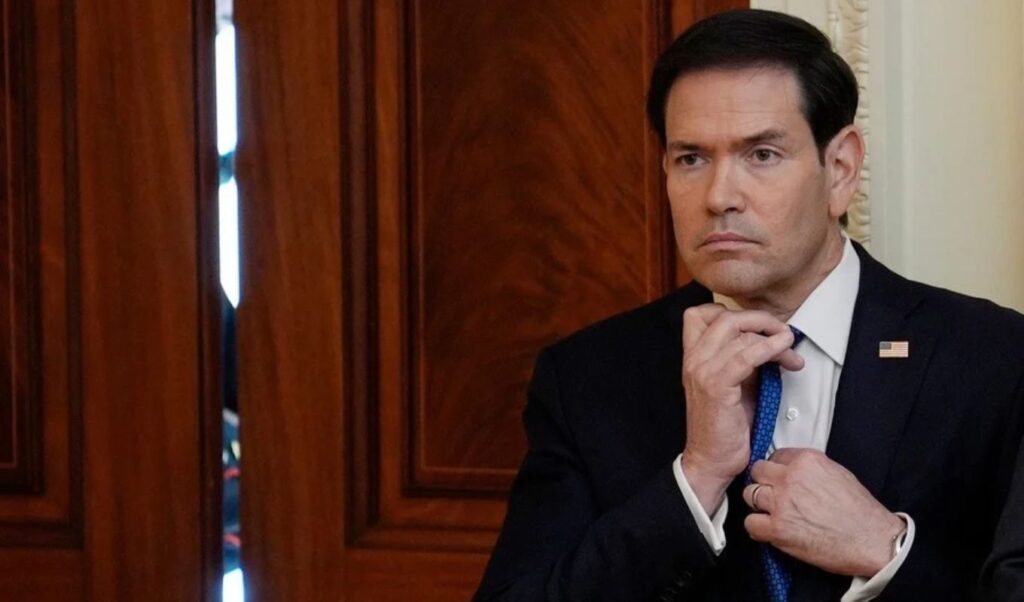
Tomorrow’s visit by US Secretary of State Marco Rubio to Athens reaffirms Greece’s role as a pillar of stability and energy hub in Southeastern Europe. The visit takes place within the framework of the 6th round of the Greece–US Strategic Dialogue, which will be held on Wednesday at the Ministry of Foreign Affairs.
Read more: Rubio arrives in Athens with a packed agenda: Defense, energy, the Vertical Corridor, and regional security — what Athens and Washington are seeking from the talks
The head of the State Department is visiting the Greek capital as an intermediate stop on a tour that also includes Iceland and Portugal. The fact that the visit is taking place during an exceptionally demanding international moment — and without a simultaneous trip to Ankara — has been received positively by the Greek side. Analysts are describing it as a confirmation of a substantive upgrade in US-Greece relations, with energy and regional security at the center of the discussions.
The American Secretary of State is considered a deep expert on the region, having championed — alongside Bob Menendez — the Eastern Mediterranean Security and Energy Partnership Act in 2019, as well as the US-Greece Defense and Interparliamentary Partnership Act in 2021, which established Greece as a key strategic partner for the United States in the Mediterranean. In practical terms, the bilateral relationship has been defined by defense agreements covering the upgrade of F-16 Viper fighter jets, the ongoing procurement process for F-35s, and the strategic utilization of Souda Bay air base and the port of Alexandroupolis.
A central pillar of the Greece-US discussions is the consolidation of Greece’s role as a major energy hub for Southeastern Europe. At the top of the American agenda sits the Vertical Corridor — the strategic route through which US liquefied natural gas (LNG) is channeled to the Western Balkans, Eastern Europe, and Ukraine, securing the region’s energy independence. At the same time, the development of Alexandroupolis infrastructure strengthens this alternative energy axis, drawing pushback and competition from Turkey. Of particular significance is official US backing for the operations of energy giants ExxonMobil and Chevron in offshore blocks licensed by Greece. Similarly, in Cyprus, active American corporate involvement in the exploitation of the Cypriot Exclusive Economic Zone (EEZ) further reinforces the alliance.
As Professor Petros Vamvakas, Professor of Political Science and International Relations at Emmanuel College in Boston, tells parapolitika.gr, Marco Rubio’s presence in Athens signals the continuation of the energy and southern axis of Greece-US cooperation. “This is a continuation of previous visits and takes place within the framework of the energy and southern axis that is being built. I think he is coming to Greece because this axis — the energy axis between Greece and America — is ongoing. I wouldn’t be surprised if, during the briefing he receives from the Prime Minister, he is updated on both the cable project and broader regional developments. But I believe the primary concern for the Americans right now is energy,” he notes.
Regarding the Great Sea Interconnector (GSI) — the undersea cable linking Greece and Cyprus, with a planned extension to Israel — Greek diplomacy is expected to raise the issue of Turkey’s behavior in the Eastern Mediterranean with the US Secretary of State. Foreign Minister Giorgos Gerapetritis has once again stated that Athens is determined to move forward with the project. All available information indicates that construction work is expected to resume within October, with no concession to Turkish demands for a relevant permit. Against this backdrop, the issue is expected to be placed on the table when Rubio meets with both the Prime Minister and the Foreign Minister.
However, according to Professor Vamvakas, the American side is seeking to de-escalate tensions and lower the temperature of public confrontation, in order to prevent a new crisis between NATO allies. Washington, he argues, is maintaining a discreet approach, keeping channels open with all sides. As the professor puts it: “The Americans, for their part — and based on everything Trump has shown — want de-escalation with Turkey. Trump views Erdoğan as a peer. He gives him credit for developments in the broader region, including Syria, and I believe in the Eastern Mediterranean as well. I wouldn’t be surprised at all if Trump came out and said that Greece and Turkey need to work things out in the region. And I think that may well be the message Rubio is carrying with him. The only region that is currently not facing any potential border changes is the Eastern Mediterranean — the central Eastern Mediterranean, meaning Greece, Turkey, and Cyprus. If you look at what is happening in the Horn of Africa right now, with Ethiopia and the war that is about to erupt between Eritrea, Egypt, Sudan, and Ethiopia — a region that is about to go up in flames — the only area that currently has peace is the central Eastern Mediterranean. I think the Americans would not want instability there at all, and the message from Rubio will be to keep a low profile on the cable issue.”
The professor attributes Rubio’s decision not to visit Ankara to the Secretary’s heavily loaded schedule, downplaying its significance. As he points out: “Ankara has far more direct access to American ears — through Barrack, Witkoff, and Kushner. And Barrack himself has said that both Kalın and Fidan are in regular contact. So I would say that Turkey doesn’t need to make an impression on the Americans right now.”