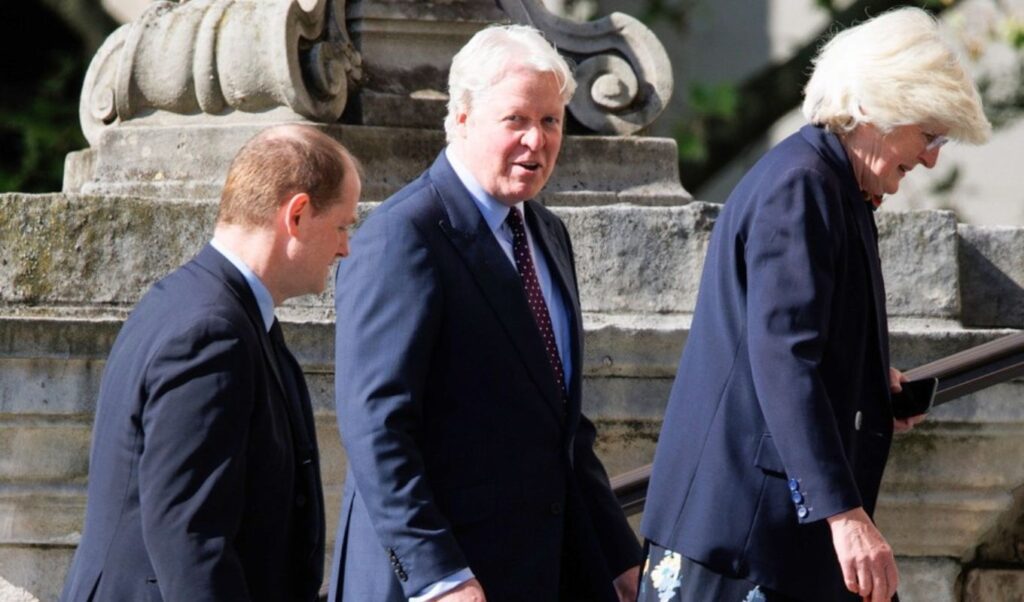
Nearly three decades after the death of Princess Diana, her brother Charles Spencer spoke to the BBC about his new book, Swan Song, which has sparked controversy due to its references to King Charles. Spencer described writing the book as “my duty as an eyewitness to history,” explaining that he wanted “to set the record straight once and for all about what was true.” The interview comes as Spencer finds himself in open conflict with the Palace.
Read also: “We’ll soon forget Diana”: What her brother claims Charles told him before the funeral — “Grief can cloud judgment,” Buckingham Palace responds
In his memoirs, Diana’s brother makes a striking claim about King Charles. According to Spencer, just days after Diana’s death, the then-Prince Charles told him in a phone call that the world would “forget her soon enough.” The allegation drew a sharp response from the Palace, which noted that the King understands that “the pain of sibling loss can blur the mind, affect judgment, and colour memory.” Spencer refused to back down. “Is he angry or is he embarrassed?” he fired back, insisting his recollection of the conversation is accurate.
Spencer noted that he had spoken to Charles by phone only twice in his life, and that during that particular call he was completely focused on every word being said. “Those were exactly the words he used. I promise you. I am telling the truth,” he stressed.
Speaking to the Mail on Sunday, Charles Spencer accused the King of psychological manipulation through the Palace’s official statement. “It’s not every day you wake up and find that the King has gaslit you,” he said. “It was deeply provocative and a low blow, because essentially he was trying to say I had lied — while the King couldn’t actually disprove what I said.”
Princess Diana: “I was initially told the accident wasn’t that serious,” says her brother
Spencer was in South Africa when Diana was killed in a car crash in Paris in the early hours of 31 August 1997. Dodi Fayed and the driver of the vehicle also lost their lives. Speaking to the BBC, he revealed for the first time the details of how he learned of her death. He received a phone call in the middle of the night from his sister Jane Fellowes, who told him Diana had been involved in a car accident, but that it “wasn’t anything too serious.”
What followed, he described, was a series of increasingly alarming calls. “And then my sister Jane said: ‘I’m afraid she’s dead.’ It started… as a minor accident, then a broken leg, then perhaps a head injury, and then death.”
Spencer also recounted the hours following Diana’s death and a phone call he received from the then-Prince Charles at his home in Cape Town. Charles spoke to him about how he had broken the news of their mother’s death to his sons, William and Harry, at Balmoral. “I felt there was a somewhat upbeat tone,” Spencer said.
“That day I had received many calls from people who cared, people who were devastated… and I simply felt a lightness in his tone regarding Diana’s death that genuinely troubled me.”
In his book, Spencer compares Charles’s tone to that of “a man who had won the lottery,” and suggests he suspects the reaction may have been connected to the notion that Diana’s death would allow him to marry the woman he loved — the current Queen Camilla. When asked whether he could know for certain what Charles was thinking, Diana’s brother replied: “I can’t be certain. I’m saying that, based on his tone, that is a possibility I’m assuming.”
“I know many things about the King that I didn’t put in the book”
Spencer explained that his decision to write the book is tied to his own sense of mortality and his desire to leave on record what he believes to be true. “I am aware of my own mortality, and I simply wanted to set down once and for all what was true,” he said. He also stated that he knows many more things about King Charles which he chose not to include in the book, as he did not consider them relevant.
When the interviewer observed that this statement could be interpreted as a threat, Spencer replied: “No, not a threat at all. It’s simply the reality.”
He also referenced a conversation he had with Diana in which she reportedly told him that her marriage was over. “This is a brother’s tribute, an act of love for a sister. And I believe she deserves honesty — which is what I’ve given her.”
Spencer’s concern for Harry’s safety
Spencer also spoke about Prince Harry, expressing concern over his level of security. “I would say that I personally worry about the fifth in line to the throne, who has served in the military and has no police protection,” he said.
Reflecting on the media treatment of Diana and the current coverage surrounding Harry and Meghan, he described some tabloid reporting as “really quite unpleasant.” “It would be really important for people to learn from Diana’s example,” he said. “I’m not here to speak on behalf of Harry and Meghan, but for anyone who is being destroyed in this way on a daily basis, it must be a very damaging influence on their life.”
“I hope William and Harry will resolve their rift”
Diana’s brother made clear that he is not taking sides between William and Harry. “I am on the side of my sister’s sons — both of them. And if either of them needed me for anything, I would be equally there for both,” he said.
He acknowledged that there are “many reasons on both sides” as to why the relationship between the two brothers has reached its current state.
“I hope one day it will be resolved, but I don’t know everything — I certainly don’t know what has happened in the details. I would feel intrusive if I got involved beyond saying that, of course, a mother would want her two sons to be happy together and to love one another.”
Diana’s interview with Martin Bashir
Spencer also touched on Diana’s landmark 1995 Panorama interview with journalist Martin Bashir. A 2021 inquiry found that Bashir had used deceptive methods — including forged bank documents — to persuade Spencer to help him gain access to Diana.
For Spencer, the interview and the difficult circumstances Diana found herself in during the years that followed are deeply connected. “People used to say: ‘She was paranoid.’ She wasn’t paranoid. She was convinced she couldn’t trust people because there was evidence for it. And I think that made her vulnerable on that night.”
Spencer also stated that he supports the monarchy, but favours a more modern version of it. “I’m in favour of the monarchy, but I like a modern monarchy,” he said. Commenting on royal protocol and the way the monarch is treated, he argued that he does not believe it is healthy for a person to be presented in such “archaic, servile” terms. When asked whether he still supports the monarchy despite the revelations in his book, he answered: “Yes.” He clarified, however, that the book is not about Charles as King, but about events and statements that took place more than three decades ago, when he was still the Prince of Wales.
“I miss Diana every single day”
Toward the end of the interview, Spencer became visibly emotional when asked whether he would ever be able to come to terms with his sister’s death. “I miss her every day,” he said, adding that “that’s the thing about losing a sibling: you never get over it.” For him, the new book represents a final accounting of Diana’s life and a way to have his own last word about his sister. “One of the reasons I called it Swan Song is because it is my farewell statement,” he explained.
“I was Diana’s brother. This is my final view on the situation… I’m not here to keep talking about Diana. This is my last word — a celebration of her.”