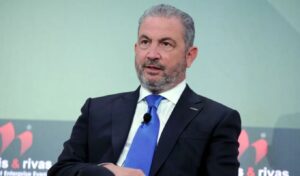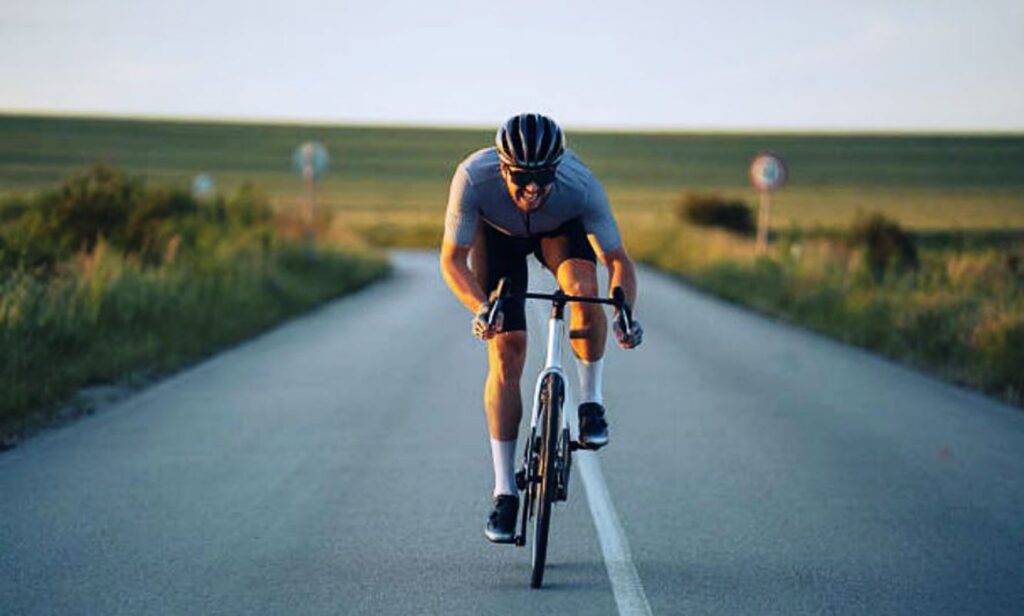
From Orminio to Gavdos, Giorgos Tsianos is preparing to traverse Greece in a groundbreaking endeavor that brings together sports, science, and technology. AMPHIBIAN will span 12 operational days, pass through all 13 regions of the country, and combine five different disciplines — with the human body at the center of continuous scientific monitoring and study.
Read also: Aryna Sabalenka turns heads at San Siro and receives an AC Milan jersey as a gift (Video)
A landmark endeavor guided by sport
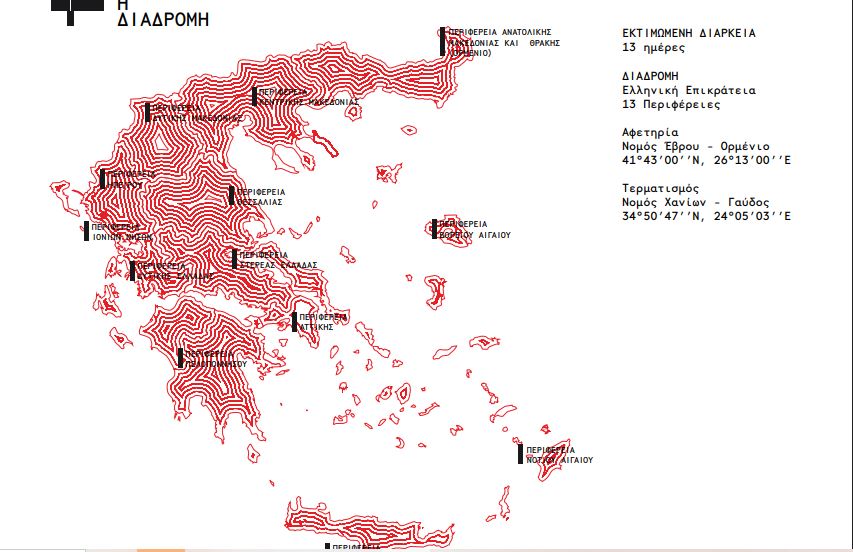
An experienced physician, researcher, and athlete, Giorgos Tsianos serves as both the fixed human subject and the operational backbone of a challenge that has never been attempted in Greece. Starting from the northernmost point of the country, he will pass through its highest peak before reaching the southernmost point in all of Greece — and indeed all of Europe. Traversing all 13 regions, he will journey across the country through a rotation of five sports: cycling, swimming, mountaineering, running, and sailing, with the participation of elite fellow athletes and distinguished researchers, the support of a specialized escort team, and the contribution of a broad network of expert collaborators.
What is AMPHIBIAN?
AMPHIBIAN is a sports, interdisciplinary, and technological undertaking in which athletics meets medicine, science, and human performance research — played out under real field conditions over 12 operational days. In this constantly shifting reality, the body itself becomes the primary laboratory for research, observation, and measurement, in direct interaction with the natural environment, technology, human physiology data, and its scientific interpretation. The project originates from the vision and the lived, scientific, and operational experience of Giorgos Tsianos, and evolves — through the collaboration of athletes, scientists, technologists, and field teams — into a collective endeavor.
AMPHIBIAN transforms real-world athletic performance into living scientific knowledge. The athletic traverse is not an end in itself — it is the operational framework that allows for the study of physiology, fatigue, adaptation, recovery, and environmental impact, while simultaneously putting wearable devices, telemetry systems, and data collection and visualization platforms to the test.
Science and technology
AMPHIBIAN is a comprehensive field science and technology endeavor, designed to study human physiology under conditions of prolonged effort, changing environments, and repeated daily physical stress. Through wearable sensors, smart garments, GPS systems, environmental measurements, and digital platforms, the project will collect and integrate data on human physiology — including cardiovascular and respiratory function, thermoregulation, oxygenation, glycemic dynamics, movement, power output, fatigue, and recovery. At the same time, it tests whether this data can be reliably transmitted, stored, visualized, and interpreted in real time, despite the constraints of movement, weather, water, terrain, and unstable connectivity.
The scientific value of AMPHIBIAN lies in the integration of biological, performance, and environmental signals within their real-world context, while its technological value lies in the field-testing of a functional telemetry model outside the laboratory. As a proof of concept, the project explores how science, wearable technologies, and digital communication can work together to support remote health monitoring, operational safety, research, human performance optimization, and public understanding of physiology.
The visible and invisible route
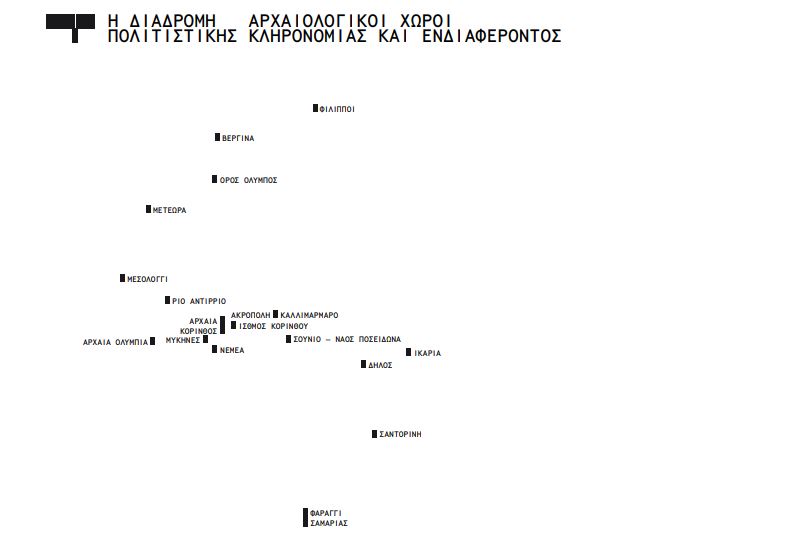
The geographical journey — from Orminio with the goal of reaching Gavdos — represents the visible route of AMPHIBIAN. The invisible route concerns the continuous fluctuation of human physiological parameters, in relation to the operational plan, the succession of different forms of effort, and the ever-changing field conditions that the human body will face on a daily basis.
The audience
Audiences will be able to follow the athletic journey online at https://amphibian.online — from the northernmost to the southernmost tip of Greece — while simultaneously tracking what is happening inside the human body along the way: how cardiac and respiratory function, thermoregulation, glycemic dynamics, fatigue, recovery, and the capacity to continue under repeated load are all affected. Public science: the data is accurately translated into an experience that different audiences can understand and engage with.
The interdisciplinary team
Around this research core, a collective and interdisciplinary effort has been assembled, bringing together scientists, physicians, technologists, elite fellow athletes, and specialized field collaborators. Their contribution is decisive for the safety, operational execution, and scientific credibility of the project. Collective intelligence: collaboration is not merely a prerequisite for implementation — it is part of the very meaning of AMPHIBIAN. Different experiences, areas of knowledge, and capabilities come together to create an outcome greater than the sum of its individual contributions.
The goal
Through AMPHIBIAN, Giorgos Tsianos and his interdisciplinary team collect, analyze, and interpret field data, investigating the relationship between the human body and its environment, technology, time, and the unpredictable. The goal is a deeper understanding of how the human organism functions, responds, and adapts under conditions of constant change.
Support
AMPHIBIAN is a pioneering endeavor in the use of artificial intelligence for the scientific recording of biometric data. It is supported by the Ministry of Digital Governance and Artificial Intelligence, including through funding to the Foundation of the Hellenic World for the project “Integration of Artificial Intelligence in the field of Virtual and Augmented Reality, Phase II” — with the aim of promoting and completing an ambitious project of high scientific and technological value.
Biography of Georgios Tsianos
Georgios Tsianos was born in Athens and has roots in Thessaly. He completed his secondary education in Florida, USA. He studied Human Physiology (BA) at the University of California, Berkeley, and went on to pursue postgraduate studies (MSc) in Human Physiology in Adverse Environments at King’s College London. He earned his doctoral degree (PhD) in Scotland from the University of Glasgow, specializing in human physiology at altitude and in cold environments, having conducted research in the mountains of Scotland, the European Alps, and the Himalayas in Asia.
In Greece, at the University of Ioannina, he completed his medical degree (MD) and trained in general medicine, emergency medicine, and trauma surgery, gaining experience in South Africa, the United States, England, Scotland, and Greece. He has specialized in General Practice. He is certified in expedition medicine and travel medicine, and maintains an active role in research. He works professionally in the Scottish Highlands in remote and isolated areas, as well as on expeditions around the world. He is an Honorary Lecturer at the University of Thessaly, where he teaches human physiology in adverse environmental conditions as part of the postgraduate program in Applied Kinesiology in the Armed Forces.
He delivers keynote speeches at events across the business, medical, scientific, and educational sectors.
He divides his time between Greece and abroad.
Athletic biography — Georgios Tsianos
SWIMMING: Tsianos began his athletic career in competitive swimming, earning distinction in the pool. He represented the Greek national team at world and European championships, while also becoming a Greek national champion, holder of national records, and a Balkan champion. He established himself in the world of ultra-marathon open water swimming and is the first Greek athlete to compete in a world open water marathon swimming championship. He has taken part in events across the globe, crossing lakes, rivers, seas, and oceans.
AEGEAN CROSSING: In 2011, he swam non-stop from the Peloponnese to the shores of Chania in Crete — a distance of 101 km — in 28 hours and 16 minutes, becoming the first person in history to swim across the open Aegean Sea.
MOUNTAINEERING: In mountaineering, his first ascents took place on Mount Olympus and Mount Fuji in Japan. Many more followed, including climbs in the Canadian Rockies, the European Alps, Mount Kilimanjaro in Tanzania, the Himalayas of Tibet and Nepal, the Atlas Mountains of Morocco, and the Scottish Highlands.
EVEREST: In 2004, he participated in the first successful Greek mountaineering expedition to Everest, “Hellas Everest 2004,” serving as scientific advisor, first aid officer, and climbing team member. He became the first Greek mountaineer to reach the summit of Everest — the highest peak in the world at 8,848 m — via the northern route through Tibet. In 2019, as a member of a British expedition and in the concurrent role of expedition physician, he successfully summited Everest for a second time.
ENGLISH CHANNEL: A milestone in his marathon swimming career, he crossed the English Channel — a distance of 34 km from England to France — in the year 2000, completing the crossing in 9 hours and 20 minutes, the fastest time in the world that year, an achievement for which he was honored with the Rolex Award by the Channel Swimming Association.
SAHARA: In 2015, he successfully completed the Marathon des Sables, an ultra-marathon held in the Sahara Desert that has been described by the Discovery Channel as one of the toughest foot races on Earth. It is a self-supported, six-day race covering a total distance of 250 kilometers, in which each participant must carry their own equipment and food from start to finish, without outside support or assistance.
ANTARCTICA: In 2023, as part of his medical role on an expedition to Antarctica, he swam in the frozen waters of the Southern Ocean, simultaneously recording scientific data on the physiological responses of the human body to the extreme conditions of that aquatic environment.
ICE – WATER – FIRE: With the successful completion of the Marathon des Sables, the ascent of Everest, and the swimming crossing of the English Channel, Georgios Tsianos became the first person in the world to complete the “Ice Water Fire” challenge — comprising three of the most demanding feats on the planet, each set in a distinctly different and extreme environment.