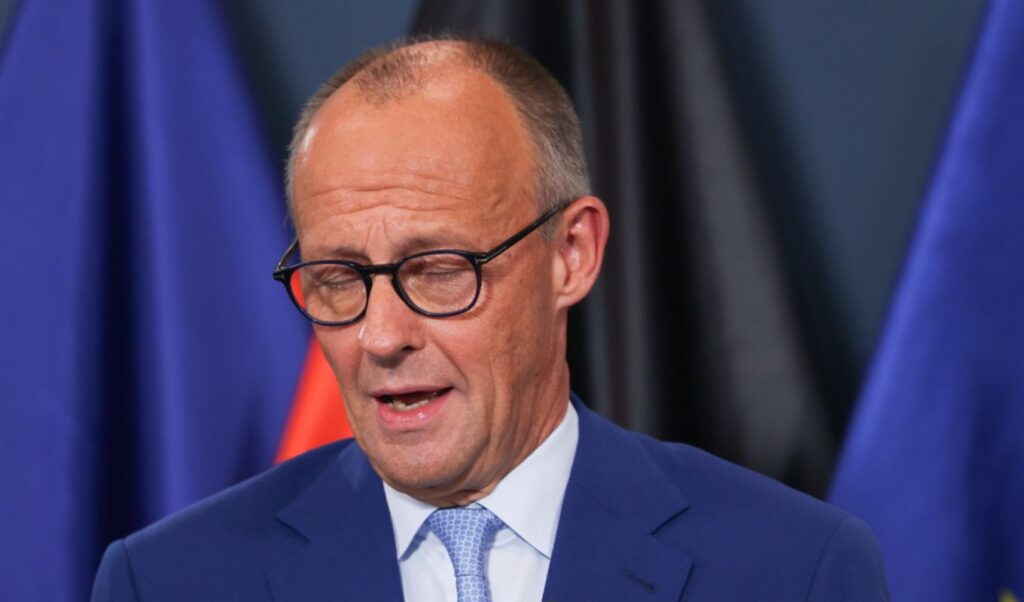
Speculation about the resignation of Friedrich Merz is once again circulating intensely in the German press, in the wake of the CDU’s unprecedented defeat in Mecklenburg-Western Pomerania, its loss in Berlin, and its setback in Saxony-Anhalt two weeks earlier. The German Chancellor has already signaled his intention to stay in office, though this is far from guaranteed. What works in his favor is the absence of any obvious alternatives and the fact that the next state elections are not scheduled until spring 2027. A frontrunner for succession has already emerged in the realm of political speculation, though nothing of the sort is set in stone.
Within the CDU and across the Bundestag, a picture of “rallying around” the Chancellor’s reform agenda has emerged, particularly in light of results that marked the first time since World War II that Christian Democrats failed to win representation at the state level. However, this unity does not hold at the local level: Philipp Amthor, a prominent CDU figure from Mecklenburg-Western Pomerania who currently serves as the liaison between the federal and state governments in the Chancellery, stated on Sunday evening that one of the problems during the campaign had been “the difficult personnel discussions” of recent weeks — an obvious reference to speculation about Merz’s future, as Sky News noted in its analysis.
Scenario 1: Merz resigns and a successor takes over
Merz himself could decide to resign for any number of reasons. This would not necessarily mean the end of the coalition government he leads. In May 1974, for example, then-Chancellor Willy Brandt of the SPD resigned after it emerged that an East German spy had been operating within his inner circle. The governing parties — the SPD and the pro-business Free Democrats (FDP) — quickly agreed to continue their alliance.
Just 10 days later, Finance Minister Helmut Schmidt, also of the SPD, was elected the new Chancellor. For this to happen, an absolute majority of all Bundestag members was required — not just those present during the vote.
This majority is known as the “Chancellor’s majority.” Schmidt secured the necessary votes, was subsequently re-elected, and remained at the helm of the German government for eight years.
As for a potential successor to Merz, the name on many lips is that of 51-year-old Hendrik Wüst, Minister-President of North Rhine-Westphalia. A former lawyer, Wüst has led Germany’s most populous and industrially significant federal state since 2021. It is one of the few regions where the CDU maintains a stable majority, and state elections there are scheduled for early 2027. However, the prospect of him stepping up at such a critical moment is anything but certain, given the upcoming local vote and the CDU’s recent poor performance, which could damage his political standing.
Scenario 2: A vote of no confidence
If a new majority were to form through parliamentary alliances, or if a Chancellor were to lose so much public confidence that even his own supporters no longer believed in him, a “constructive vote of no confidence” could be triggered. This means that a majority of MPs vote in favor of a new candidate for the chancellorship.
In 1982, for instance, Helmut Schmidt of the SPD lost the support of his junior coalition partner, the FDP. The FDP joined forces with the conservatives of the CDU and CSU, jointly nominating CDU leader Helmut Kohl as the new Chancellor. Kohl secured a parliamentary majority, replaced Schmidt, and went on to hold the office for 16 years.
The likelihood of something similar happening to Merz is very low. Neither the conservatives nor the Social Democrats wish to dissolve their coalition. There is no clear rival candidate to challenge Merz. North Rhine-Westphalia’s Minister-President Hendrik Wüst of the CDU is considered a possible successor, but he has made no moves in that direction. Moreover, the CDU typically remains deeply loyal to its political leaders.
For most conservative MPs, the idea of ousting a sitting Chancellor through an open no-confidence vote on the floor of the Bundestag is simply unthinkable.
Scenario 3: A confidence vote
The German parliament cannot simply dissolve itself and call new elections. However, MPs can request a confidence vote for the Chancellor and his government. Several Chancellors have already used this mechanism, often linking it to a vote on a controversial issue.
In November 2001, Chancellor Gerhard Schröder (SPD) brought a confidence vote to the Bundestag, tying it to the question of whether his government should deploy German troops to Afghanistan in support of the NATO mission led by the United States following the September 11 attacks. Schröder won, remained in power, and continued his military policy.
Merz has already stated that he sees no reason to call for a confidence vote. There are also no signs of significant defections within the government’s parliamentary ranks. Should a Chancellor lose a confidence vote, the Bundestag can be dissolved and new elections called.
Following a defeat in the Bundestag, the Chancellor may request that the German President dissolve parliament and call voters to the polls. The President is not obligated to do so, but typically complies.
Merz appears to have ruled out this option. Neither the SPD nor the conservative Christian Union (CDU/CSU) has any appetite for new elections at a time when their approval ratings are low. So will the government remain in place? For now, that seems to be the case.
Nevertheless, the political situation in Berlin over recent days and weeks has been so fluid that nothing can be ruled out.
Chancellor Friedrich Merz himself spoke early on Sunday afternoon (20.09.2026) of a “catastrophe” — and this was before the final count confirmed that the Christian Democratic Union (CDU) would ultimately fail to enter parliament in Mecklenburg-Western Pomerania.
“A people’s party stares into the abyss”
“Never before has the CDU performed worse at the polls,” writes the tageszeitung about the Christian Union and the Mecklenburg elections. In a piece headlined “A people’s party stares into the abyss,” the Berlin newspaper observes that “the election result in Mecklenburg-Western Pomerania in particular is dramatically bad” — a “catastrophe,” as Merz himself put it and as Deutsche Welle noted in its own analysis.
“The voters’ verdict is harsh for those who have neither a standout personality nor a compelling message,” remarks the Süddeutsche Zeitung caustically, referring to CDU candidates and in particular to Daniel Peters, the party’s candidate in Mecklenburg. “Peters is, admittedly, likable and serious,” the paper notes — but his platform apparently struck voters as uninspiring. The Christian Democrats’ results in Mecklenburg represent “a humiliation this party has never experienced before.”
According to the SZ, “the good news from the elections is that the center can still hold back the AfD. The bad news is that the CDU has become a shadow of its former self […] and risks being crushed between the AfD and left-wing parties — partly because of Friedrich Merz […] but also because the party constantly undermines its own Chancellor, casting him in the image of a loser.”
Merz is playing for time
“The very fact that Merz himself is making post-election statements shows just how intense the pressure within the party has become,” observes tagesschau. “Merz’s strategy for managing this crisis is to buy time. According to the schedule, no further state elections that could destabilize the party further are due until April 2027.
Merz is also hoping for better economic news, partly as a result of returns from investments funded through the special infrastructure fund. […] The Chancellor recently spoke at length about citizens soon seeing improvements in their daily lives, […] and claimed that Germany has ’emerged from the economic crisis.'”
“The political center needs a new home”
Focusing on Manuela Schwesig, the SPD’s candidate in Mecklenburg, the German Editorial Network (RND) comments that these elections and the Social Democrats’ strong showing “proved that the AfD can be challenged from the political center. […] It is therefore not inevitable that the map turns blue [in the AfD’s color] at every election.”
Furthermore, “the AfD may have reached its peak. According to pollsters, it has exhausted the pool of potential voters available to it. However, this assessment will only be confirmed in the future if centrist parties manage to reconnect with their voters — as Schwesig succeeded in doing in the northeast of the country.”
The fundamental challenge remains the fact that “the urban center continues to erode.” Even in Berlin, where the Left emerged victorious, “the centrist parties are too weak in terms of personalities and too hollow in terms of political content to rally people around them.”
As a result, “the political center needs a new home. […] There is a hunger in this country for a fresh political start and for alternatives — particularly to the parties governing at the federal level, the Christian Union and the SPD, which give the impression of being powerful engines whose wheels are simply spinning in the sand. A new movement would stand a good chance of success: it would need to be a grassroots political movement with charismatic leadership, neither clearly left nor clearly right, which […] would cut straight through the center unburdened by ideological constraints.”