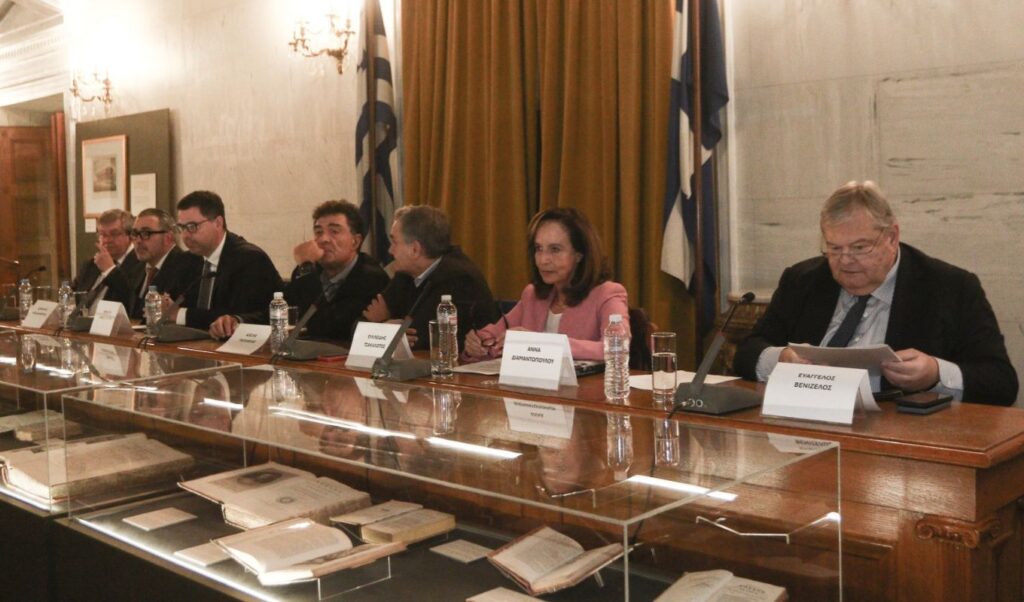
Former PASOK leader Evangelos Venizelos made his second public intervention in the span of two weeks, appearing as one of the speakers at the book launch of former Finance Minister Nikos Christodoulakis, titled “After the Memoranda: The Lost Opportunities 2018-2025.” The intervention drew particular attention, as it took place in the presence of PASOK leader Nikos Androulakis and the broader PASOK establishment.
Although Venizelos himself claims to have shifted toward a post-political role — without ruling out speaking up when he deems it necessary — it appears he still harbors the idea that he could play a key role in potential post-election coalition-building, should no single party secure an outright majority in the next general election.
After all, Venizelos has the know-how when it comes to coalition governments. He is known to have recently developed a close relationship with former Prime Minister Kostas Karamanlis, and continues to maintain communication with Antonis Samaras — a figure with whom he stood on the same side during both the Loukas Papademos unity government and the subsequent three-party coalition of New Democracy, PASOK, and DIMAR, later reduced to a two-party ND–PASOK government from 2012 to 2015. It is therefore no surprise that many observers believe Venizelos could lead or play a significant role in forming a governing coalition after the next elections, if circumstances demand it.
It is also worth noting that, as reported by the “Big Mouth” column of powergame.gr, approximately one month ago Venizelos reportedly attended a dinner with Prime Minister Kyriakos Mitsotakis and Metlen CEO Evangelos Mytilineos, with the atmosphere described as particularly warm. This detail ultimately confirms that the former PASOK president has been highly active behind the scenes in recent months — and all that this implies.
During his public remarks, Venizelos effectively leveled criticism at the Mitsotakis government, arguing that the economy is running on “autopilot.”
Venizelos: “Discontent driven by income inadequacy and the high cost of living”
“Inflation is eroding income, widening inequalities, while simultaneously producing a successful fiscal outcome that allows for redistributive policies. This perpetuates a pattern characteristic of the first 35 years of Greece’s post-dictatorship democracy. The social consequence is widespread discontent stemming from income inadequacy and the rising cost of living. The central question for the next national elections is whether things will improve from 2027 onwards — and that is far from a given,” he said.
That said, Venizelos did acknowledge “all the positive achievements,” including the reduction of unemployment, and described the early repayment and buyback of loans as correct decisions. He also noted that Greece’s fiscal consolidation places the country in a more secure position than Italy or France. He did not, however, hold back from pointed remarks, stating that the debt restructuring agreements of 2012 and 2018 created the fiscal conditions necessary for the country’s survival, but failed to secure the development prospects that would have justified the enormous social and political cost of the crisis.
Originally published in Apogevmatini