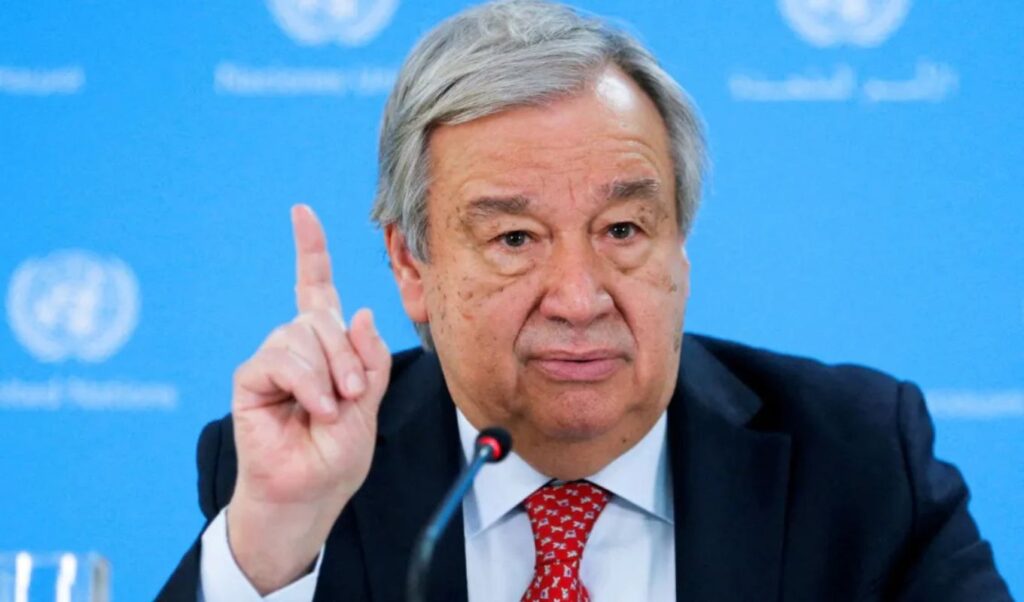
At a critical turning point for the Cyprus issue, United Nations Secretary-General António Guterres is personally taking the reins of developments with a landmark visit to the island. This marks the first visit by a UN chief to Cyprus in 16 years — a fact that in itself underscores the gravity of the latest moves in the Cyprus dispute.
Cypriot diplomatic sources speaking to parapolitika.gr assert that Mr. Guterres is not coming merely for a ceremonial visit, but appears to be seeking to “close the books” on his tenure and leave his successor with a solid negotiating framework as his legacy.
His broader objective, according to the same sources, is to pressure Turkey into participating in a five-party conference at the end of August or at the latest in September, on the sidelines of the UN General Assembly in New York. “He will hold a trilateral meeting here in Cyprus on Tuesday and will make an effort to lock in the points of convergence, so that by September he can hand his successor a comprehensive plan and secure the gains made over the past period,” senior Cypriot diplomatic sources told parapolitika.gr. In this context, no substantial or dramatic developments in the Cyprus issue are expected, given Turkey’s continued rigidity — despite the economic pressure it faces from the failure to conclude a Customs Union agreement with the European Union, a deal blocked by the Republic of Cyprus’s veto.
Guterres’s meetings in Cyprus
António Guterres is expected to arrive in Cyprus on the evening of Monday, July 27, accompanied by his top aides, Rosemary DiCarlo and Jean-Pierre Lacroix. His Personal Envoy, María Ángela Holguín, will already be on the island. On the morning of the following — and more critical — day, he will hold separate meetings with President of the Republic Nikos Christodoulides and Turkish Cypriot leader Tufan Erhürman, while in the evening he will host a private dinner with both leaders at the residence of the Special Representative, away from the public eye. The Guterres mission will conclude on Wednesday with a trilateral meeting between the two leaders and the Secretary-General, the results of which will be announced at a press conference at Nicosia Airport.
The atmosphere surrounding the meetings is overshadowed by revelations about a new solution plan reportedly being advanced by the UN Secretary-General’s Personal Envoy, Ángela Holguín, and exposed by a report in The Independent — causing considerable concern on the Greek Cypriot side. According to this plan, a “loose federal solution” is proposed that closely aligns with Turkish demands for two separate states, employing a tactic of “constructive ambiguity.” The proposal would allow the Greek Cypriot side to refer to the new arrangement as a “federation” and the Turkish side to call it a “confederation.”
President of the Republic of Cyprus Nikos Christodoulides has made clear that he will not accept any ambiguity on the critical chapters of security and guarantees. On the other side, Tufan Erhürman appears unmovable, stating that he does not want “negotiations for the sake of negotiations” and that the Turkish Cypriot side will never accept minority status. Mr. Erhürman emphasizes the need for a process oriented around the established positions of two states on the island, in full coordination with Turkey.
The connection between the Cyprus issue and developments in the wider region — the UN Secretary-General’s objectives
Any developments in the Cyprus issue are not isolated from the broader shifts being observed across the region. António Guterres’s presence in the Middle East — as he will also visit Syria and Jordan — lends a wider dimension to his initiative. The prevailing assessment is that the Secretary-General will seek to leverage the economic pressure Turkey is facing and its desire to upgrade relations with the EU in order to push it toward concessions.
This visit may well represent António Guterres’s last major effort to set a solution in motion — or at least to prevent a definitive impasse — before he steps down as UN Secretary-General. Attention is focused on the Tuesday, July 28 dinner, where behind-closed-doors diplomacy will determine the next steps in the Cyprus dispute.