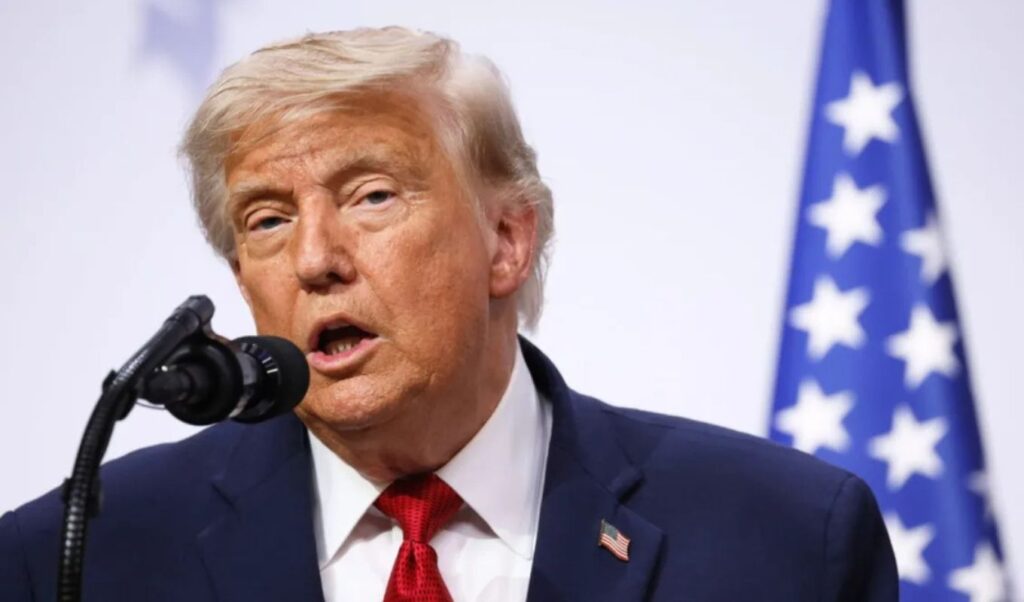
US President Donald Trump considered returning to all-out war with Iran in recent days, but ultimately decided to continue prioritizing the diplomatic path, according to a Wall Street Journal report. The American newspaper, citing US officials, reports that Trump held multiple meetings with Defense Secretary Pete Hegseth and Chairman of the Joint Chiefs of Staff General Dan Caine, during which the possibility of the United States abandoning negotiations and launching new military strikes against Iran was also considered.
Sources cited by the newspaper said a new military operation could “finish the job” against the Iranian regime.
What Trump is considering
However, Trump — while not having made a final decision — appears reluctant to pursue large-scale military action beyond potentially limited strikes in the event of Tehran violating agreed terms. According to the report, the US president emphasized to his advisers that a new military conflict could derail diplomacy and undermine Washington’s chances of ultimately dismantling Iran’s nuclear program.
Talks could extend beyond the 60-day deadline
The Wall Street Journal notes that, despite his frustration with the stalled negotiations, Trump has signaled to his team that he does not consider it essential to reach a deal before the 60-day deadline expires on August 18, leaving open the possibility of extending the talks.
Meanwhile, a White House official revealed that the dedicated backchannel established by Washington and Tehran — operating through Qatar and involving representatives of the Islamic Revolutionary Guard Corps and US Central Command (CENTCOM) — has already been used by both sides to prevent broader military incidents.
Denials over a US–Iran meeting in Doha
The divisions between the two sides became apparent on Tuesday, when US special envoys Steve Witkoff and Jared Kushner traveled to Doha for talks with Qatari mediators regarding the negotiations with Iran.
However, both Qatar and Tehran made clear that no high-level meeting between American and Iranian officials had been scheduled, contradicting a statement Trump had made a day earlier. What Iran was actually focused on during the Doha visit was discussing with Qatari officials the unfreezing of assets held in UAE banks.
Tehran: “Diplomacy is the priority, but we are ready for war”
At the same time, Iran’s chief negotiator and parliament speaker Mohammad Baqer Qalibaf stated that his country continues to prioritize diplomacy, while not ruling out a military response.
“We are pursuing dialogue. But if dialogue does not yield results, we are also ready for war and will respond accordingly,” he said on Iranian state television.
He also claimed that following the lifting of the American blockade on Iranian ports, oil exports surged dramatically. “From the day the blockade ended until now, we have exported more than 40 million barrels of oil. For the nearly two months before that, we could not export a single barrel,” he said.
Dispute over the Strait of Hormuz
One of the key sticking points remains the status of the Strait of Hormuz. Qalibaf argued that sovereignty over the strategically vital waterway belongs to Iran and Oman, and that passage through it is governed by regulations set by Tehran.
US Vice President JD Vance, however, stated that Washington will not allow Iran to impose transit fees on ships using the Strait.
“This is not going to end up in a situation where Iranians are collecting tolls from ships passing through the Strait of Hormuz,” he said.
These diverging positions indicate that the two sides remain far from a final agreement. The provisional framework agreed on June 17 provides a 60-day window to achieve a permanent deal on ending the conflict and the future of Iran’s nuclear program.
Israel’s reservations
According to the report, Israel was not involved in the negotiations that led to the memorandum of understanding, and Prime Minister Benjamin Netanyahu has kept his distance from the deal.
Israeli officials believe its terms fail to achieve the core objectives of the war, such as eliminating Iran’s nuclear and ballistic missile programs and creating conditions that would lead to the weakening or collapse of the Iranian regime.