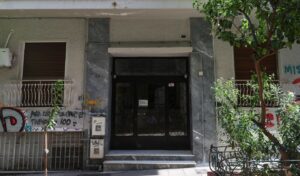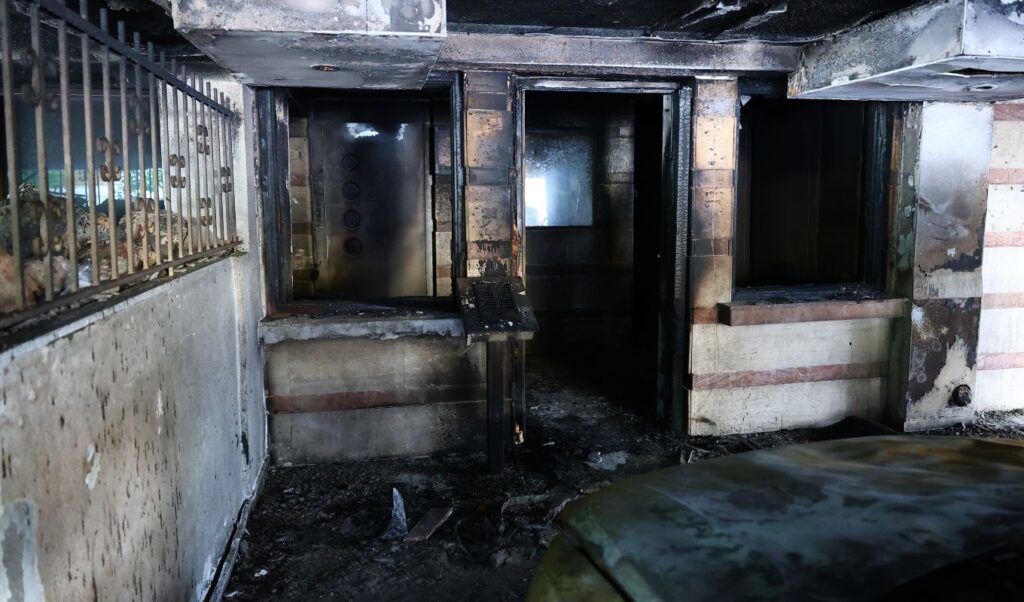
Nikos Rigas, Vice President of the Attica Police Officers’ Association, spoke to Parapolitika 90.1 and the show “On Air” with Niki Liberaki about the arson attacks that took place on Wednesday (1/7) targeting homes of New Democracy officials in Thessaloniki, which tragically resulted in the fatal injury of 70-year-old Vagia Nestora, mother of New Democracy political candidate Afroditi Nestora. Rigas addressed the investigation being conducted by the anti-terrorism unit, the evidence linking three consecutive attacks to the same perpetrators, and how the legal dimension of the case has changed following the victim’s death.
Read also: Arson attacks in Thessaloniki: Afroditi Nestora expected to be transferred to Papanikolaou Hospital — her father’s health condition
Thessaloniki arson attacks: What the anti-terrorism unit is examining
When asked to provide an initial overview of the case, Rigas stated that the investigation into the attack, which resulted in the loss of a human life, is being carried out by specialized police services — “by the anti-terrorism unit, specifically, at a higher level.” He explained that every piece of evidence that could lead to the identification of the perpetrators is being examined, “whether that is video footage or materials sent to the police forensic laboratories, where conclusions can be drawn regarding DNA and anything else that may be found.”
Why police believe the same perpetrators carried out all three attacks
Regarding whether the three consecutive attacks, carried out within a very short timeframe, strengthen the belief that the same individuals were responsible, Rigas noted: “Such a coincidence would be very difficult to pull off by different people.” He explained that, given the attacks at different locations were carried out using the same configuration and materials, “this leads to the conclusion that it was the same people.” He added that the investigation is ongoing “without much being said publicly,” and expressed confidence that results would follow soon and the perpetrators would be brought to justice.
The charges
Rigas assessed that, following the tragic turn of events, no claim of responsibility is expected, as what “began as — in quotation marks — an intervention with petrol bombs, an attack, has now evolved into a murder investigation.” As he explained, this fundamentally alters the charges: “From an attack causing property damage, we have now arrived at a homicide — possibly with intent. As a result, the entire charge sheet changes.” He also emphasized that anyone arrested now faces serious criminal charges.
The incidents at Aristotle University
When asked whether police are linking the attacks and the killing to the recent evacuation and incidents at Aristotle University — potentially viewing them as acts of retaliation — Rigas responded: “I cannot say that anything is being examined as retaliation, but everything is being examined.” He noted, however, that those who carry out such acts typically belong to a specific milieu that “does not want law and order to prevail in certain spaces,” adding that such a pattern of retaliation “is something we have seen before in the past.”
The circle of suspects
On the question of whether the common characteristics of the attacks narrow the investigation to a smaller pool of individuals, Rigas said the “pool” is examined each time on the basis of those characteristics, but clarified that no certainty is possible at this stage. He stressed that the goal is for the perpetrators “to be arrested, brought before Greek justice, and held accountable,” as a human life has now been lost.
“Our country has achieved major blows against terrorist activity”
In closing, Rigas emphasized that the country has achieved “major blows against terrorist activity” in recent years and expressed confidence that the Greek police will see the investigation through. “Our country is a safe and modern country. This will not deter us — we will continue with our social and economic daily lives,” he stated.
Concluding the discussion, Rigas remarked: “It is not right for us to relive situations like those we have experienced in the past — when we lost people in banks, in shops, in homes, or anywhere else.”