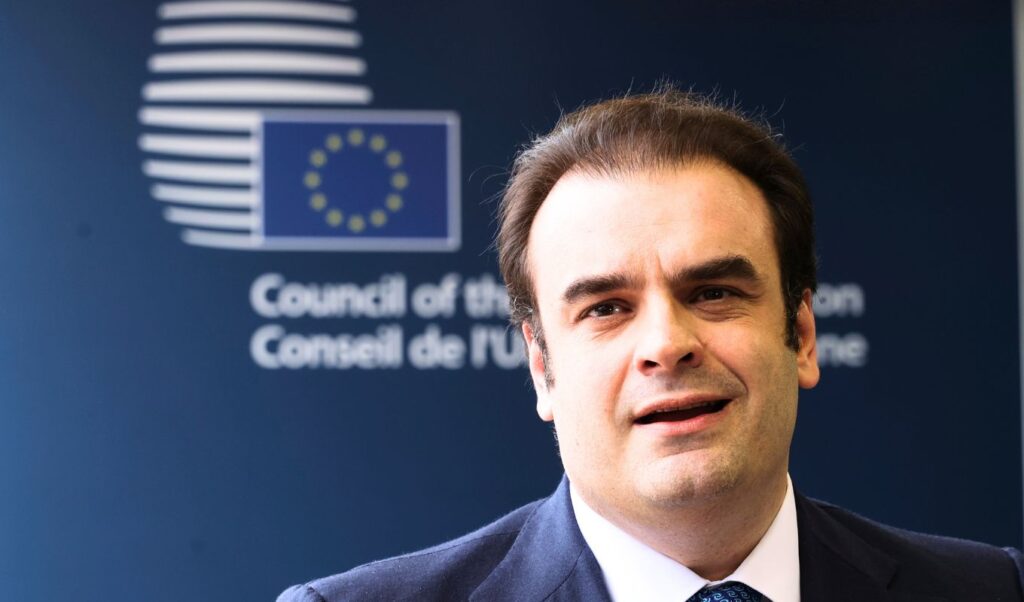
Speaking at the Annual Conference on the EU Budget 2026 in Brussels, Eurogroup President and Greek Minister of National Economy and Finance, Kyriakos Pierrakakis, put forward a bold proposal for the future of the European economy. Shifting the conversation from the simple “redistribution” of EU resources to the “creation of new resources,” Pierrakakis proposed central EU management of the telecommunications spectrum (5G and 6G). Through this concrete example, he illustrated how eliminating national fragmentation can strengthen European competitiveness, fund the Multiannual Financial Framework, and ultimately reinforce the euro’s power on the world stage.
Read also: Pierrakakis in POLITICO: Artificial intelligence and cybersecurity on the Eurogroup agenda — what he said about the Greek economy’s trajectory
Kyriakos Pierrakakis’ full speech
«Ladies and gentlemen,
It is a great honour and pleasure to be here with you today. And I am especially glad, because the topic we are discussing is one to which I inevitably devote a great deal of thought — in my dual capacity as Greece’s Minister of National Economy and Finance and as President of the Eurogroup — as do all of my colleagues.
The question framing today’s conference could not be more timely:
How can the European budget support the euro?
The usual answer starts with the programmes the European budget funds: cohesion, research, innovation, infrastructure, agriculture, defence, energy security, support for Ukraine.
These priorities are obviously of enormous importance, but I believe we could broadly group them under the heading that my good friend, Commissioner (Piotr Serafin), described earlier.
And alongside a headline published recently in one of my favourite newspapers — “Where will the money go” — allow me to suggest an additional perspective, one that is, I would argue, more natural and intuitive for us when managing our national budgets: allow me to shift to the perspective of “how do we create resources.”
The European budget supports the euro not only through what it funds, but also through the economic logic it embodies.
Ultimately, the euro cannot be stronger than the economy that underpins it.
Markets, of course, do not invest in currencies alone.
They invest in the productive capacity, the resilience, and the credibility of the economies that issue them.
And today, the global economy, the European economy, and our national economies are all being reshaped.
Technology is the obvious strategic advantage. Energy has now become a matter of security. Economic dependence is increasingly turning into a geopolitical liability.
In such a world, resilience is no longer simply the ability to absorb shocks — it has evolved into a source of competitiveness. And competitiveness is, à la Draghi, the foundation of monetary strength.
This changes, in my view, the way we need to think about the Multiannual Financial Framework (MFF).
Because the MFF is not simply about funding our priorities. It is about strengthening our long-term capacity to generate prosperity.
And honestly, in the context of this discussion and this negotiation, we should try to shift the conversation from a zero-sum spending logic to a positive-sum logic.
Allow me to give a concrete example, but first let me set one more piece of context.
We do not lack ambition. Our ambitions grow year after year.
Whether we are talking about technological innovation, defence, energy security, capital markets, or cohesion, every European priority rests on the same fundamental question: how do we increase our productivity.
I referred earlier to zero-sum logic because the real question is not how we distribute our already limited resources — or at least, it is not only that.
The real question is whether we can create an entirely new European productive dynamic.
Our most significant achievements never came from redistributing existing resources more efficiently. They came from creating entirely new economic value.
The European Coal and Steel Community transformed strategic industrial sectors into a shared economic foundation. The single market unified national economies into one European market. Today, the Savings and Investments Union (SIU) is attempting to do the same for capital markets and banks.
All of these initiatives are governed by the same principle.
The principle that we succeed when we achieve scale, when we eliminate fragmentation — converting scale into value.
This proposal is not abstract.
Allow me to use a very concrete example: the telecommunications spectrum.
It is one of Europe’s most valuable strategic assets.
It forms the foundation for the development of artificial intelligence, advanced manufacturing, autonomous mobility, satellite connectivity, secure communications, and next-generation defence capabilities. And yet, we continue to manage it through 27 different auction systems.
Each with different timelines, different licensing terms, different investment incentives, and 27 different regulatory authorities.
The result is fragmentation. And this is precisely where the opportunity cost is enormous.
Why? Because we have European infrastructure champions who are, in effect, global champions. And we could have built broader and even stronger ecosystems around them.
Why do I connect this discussion to the debate on the Multiannual Financial Framework?
First and foremost, the opportunity cost from network deployment in this sector is exceptionally high.
Imagine a telecom company operating in the United States dealing with just one regulatory authority. Now imagine the same company having to deal with 27 different ones in Europe.
5G is a strategic advantage, and so will 6G be as we move towards that transition.
As we prepare for the allocation of 6G frequencies and, gradually, for the renewal of existing 5G licences, we have the opportunity to rethink how we organise one of Europe’s most valuable shared assets.
“Wearing now the hat” of Greece’s Minister of National Economy and Finance, allow me to briefly mention what we have done in our own country.
In 2020, we proceeded with an auction for the deployment of 5G technologies. It was not designed to maximise public revenues. Our goal was rapid network deployment.
At the same time, we allocated 25% of the auction revenues to create a fund that invests in the 5G ecosystem and its applications.
Why? Because we recognised that the value of 5G would not come from the infrastructure itself. It would come from the ecosystem developed around it.
The problem with this idea is that it applies to a single member state, not to all 27.
There is no synchronisation in spectrum auction processes.
If this process were managed centrally — even just for specific frequencies — companies investing in infrastructure would have far greater predictability.
Now, let us imagine for a moment the alternative scenario.
What if we synchronised the auctions and used those revenues — or a significant portion of them — as a predictable resource for the Multiannual Financial Framework, while simultaneously allocating the 25% I mentioned in the Greek example to create a fund?
Let us imagine, for a moment, placing those resources with the European Investment Bank to create an even larger fund for investment in 6G applications and next-generation technologies. If we did this, we would be creating something far broader than simply a new revenue stream for the MFF.
We would be unlocking the potential of a sector in which Europe has global technology champions, while creating greater financing opportunities for them.
This would not be a case where one side’s gain is the other’s loss — it would be a win-win solution for everyone.
And as my good friend, Commissioner (Piotr Serafin), does excellent work drawing on the lessons of the Recovery and Resilience Facility (RRF) — linking reforms to specific funding priorities, which is absolutely necessary in order to fully leverage the potential of every European member state and harness the momentum of reforms to generate greater economic activity — so too must we, as member states, think a little more outside the box, asking ourselves what it is that can create European value, which will then translate into national value for all of us.
Europe has always moved forward by turning shared challenges into shared opportunities.
The next Multiannual Financial Framework has the potential to do the same.
Not simply to determine how we allocate limited resources, but to help create new European resources, mobilise new investments, and expand Europe’s productive capacity — particularly in the sectors where we are close to the technological frontier and can truly maximise our economic potential.
Confidence in the euro, ultimately, rests on confidence in the European economy.
And that is how the European budget has the potential — and I believe will manage — to make its most significant contribution to our common currency.
Thank you very much.»