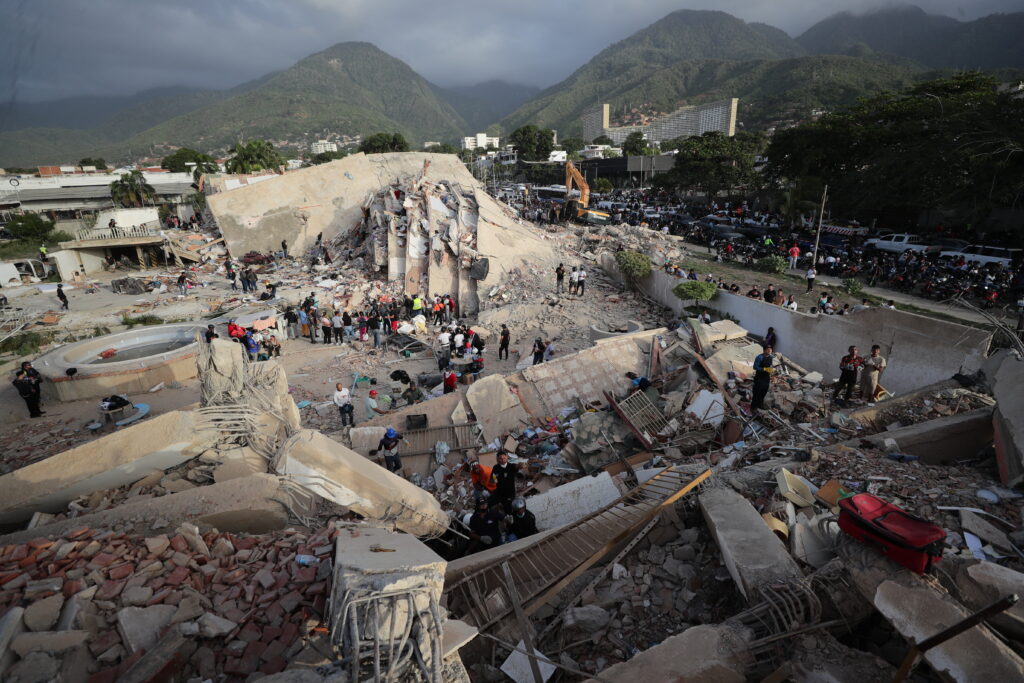
The scenes in earthquake-stricken Venezuela remain devastating, with the death toll approaching one thousand and rescue operations still ongoing. The official casualty figures continue to rise. According to the latest announcements, at least 920 people have lost their lives, more than 3,360 have been injured, and the United Nations estimates that over 50,000 people are still unaccounted for. Yet amid this tragic backdrop, small miracles are happening in the rubble left behind by the twin earthquakes. Trapped survivors are desperately calling out for help. When rescuers locate them, relief is immediate — but then begins the painstaking ordeal of extraction. Every move the rescue teams make is, quite literally, surgical. They know that one wrong move could prove fatal. They dig with their bare hands to be absolutely certain that their actions won’t trigger a further collapse.
Rescue missions from 17 different countries continue to arrive in the hardest-hit areas of Venezuela, even as the country’s already strained healthcare system teeters on the verge of collapse. On Friday, the United States announced it would deploy a team of 250 personnel to the affected region, having already committed $150 million in humanitarian aid and deployed two warships, transport aircraft, and helicopters.
Among the first international teams to arrive were rescue workers from El Salvador, Mexico, Colombia, and Switzerland. In La Guaira, standing before the ruins of an apartment building that had completely collapsed, the head of the Chilean rescue team, Nadiomar Polanco, stated that, unfortunately, the chances of finding survivors are now extremely slim.
🇻🇪 Rescue operations continue in La Guaira as emergency crews search tirelessly for survivors.
May every person still trapped be found alive. Please keep the people of Venezuela in your prayers. 🙏❤️ #Venezuela #LaGuaira #Rescue pic.twitter.com/drylrxN9dv
— Andleeb (@1stepAndleeb) June 27, 2026
Aerial visuals show the extent of destruction following twin earthquakes in La Guaira, Venezuela. pic.twitter.com/PzKFiaoJ6w
— Weather Monitor (@WeatherMonitors) June 25, 2026
Venezuela earthquakes: The stunning drone footage
Aerial drone footage of La Guaira — the coastal city at the epicenter of the tragedy — captures a scene of absolute devastation: multi-story buildings reduced to mountains of concrete and twisted steel, streets buried under debris, and entire city blocks wiped off the map.
Before-and-after comparisons reveal the true scale of destruction — one of the worst disasters the country has witnessed in recent decades.
Venezuela is still counting the cost of two powerful earthquakes measuring 7.2 and 7.5 on the Richter scale, which struck just seconds apart on Wednesday, triggering widespread building collapses across multiple regions of the country.
International aid and fury over the authorities’ response
The international response continues to grow as Venezuela struggles to cope with the magnitude of the disaster. Nearly 48 hours after the earthquakes struck, rescue missions from 17 countries are operating in the affected areas.
The United States announced the deployment of 250 rescue personnel, along with a $150 million humanitarian aid package. Two warships, transport aircraft, and helicopters have also been deployed to the region to assist with the movement of personnel and supplies.
Among the first countries to respond were Mexico, Colombia, Chile, Switzerland, and El Salvador, while the United Nations is coordinating humanitarian operations, warning that this is one of the most complex relief missions in recent years.
The country’s already overstretched healthcare system is being pushed to its limits, as thousands of injured people require urgent medical attention and several hospital units have sustained damage.
Anger in the rubble — Delcy Rodríguez booed by survivors
At the same time, residents’ anger toward state authorities is growing, with many accusing them of a slow and inadequate response. In La Guaira, many people say they had to begin search operations themselves, as the necessary equipment was slow to arrive.
“The authorities are useless. The army should have been here from the very first moment with all the machinery at its disposal,” said one local resident.
Venezuela’s interim president, Delcy Rodríguez, was also met with boos and jeers during her visit to a Caracas neighborhood where an apartment building had collapsed. Relatives of those trapped accused her and the government of caring more about their political image than about saving lives.
As rescue operations continue without pause, Venezuela is facing one of the greatest natural disasters in its modern history.
With every passing hour, the chances of finding survivors diminish, while the international community watches with growing anxiety as a tragedy that threatens to grow even larger continues to unfold.