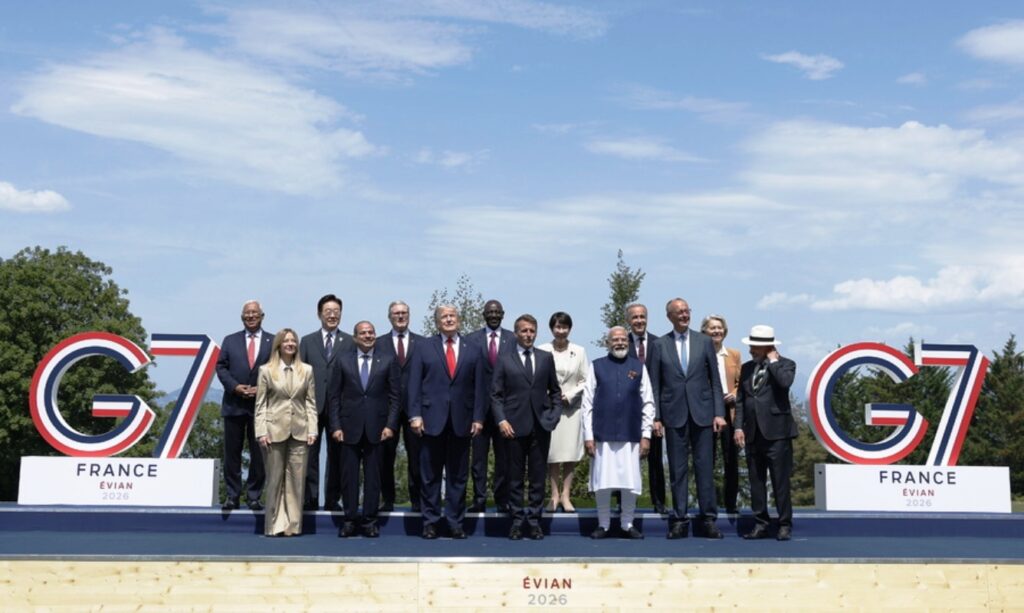
Russia took center stage at the G7 Summit held in Évian, France, as leaders of the world’s most powerful economies presented a united front in their determination to intensify pressure on Moscow and bring the war in Ukraine to an end. On the table: new sanctions, expanded military support for Kyiv, and sweeping initiatives aimed at cutting off the financial resources fueling Russia’s war machine. Meanwhile, U.S. President Donald Trump signaled his openness to reinstating sanctions on Russian oil, arguing that current global energy market conditions now make such a move viable. Trump’s remarks come at a time of intense diplomatic activity, as the international community searches for ways to accelerate progress toward a potential peace agreement.
Read also: Israeli media: “Washington refused to hand Israel the full text of the Iran deal”
Russia: The G7’s message to Moscow
G7 leaders made clear their intent to significantly ramp up pressure on the Russian government in order to achieve a breakthrough on the Ukrainian front. According to a French diplomatic source, participants agreed on the imposition of new sanctions targeting the hydrocarbons sector — one of the most critical sources of revenue for the Russian economy. At the same time, the summit produced a decision to further bolster Ukraine with air defense systems and military equipment, allowing Kyiv to hold its ground on the battlefield.
Ukrainian President Volodymyr Zelensky, who joined the summit’s proceedings at the personal invitation of Emmanuel Macron, welcomed the tone and resolve on display among the G7 nations. “It is excellent that everyone understands that Russia will not win and that we must pressure Putin to end this war,” he said. In a parallel development, Canada announced a fresh package of sanctions targeting more than 160 entities, individuals, and vessels linked to Russia’s so-called “shadow fleet” — a network used to circumvent international restrictions on Russian oil exports.
Russia: Trump’s statements at the G7 and the latest developments on oil sanctions
Donald Trump’s remarks drew particular attention as he appeared open to reimposing sanctions on Russian oil. “We’ll be able to do it because oil is now flowing abundantly. We suspended the sanctions because obviously we didn’t want to punish the U.S.,” he said during his meeting with UAE President Mohamed bin Zayed Al Nahyan.
The U.S. president added that “soon we will be in a position to reintroduce the sanctions,” arguing that the current global energy landscape now affords greater flexibility in American decision-making. Trump also reiterated his intention to help bring the conflict to a close. “I’ll do whatever I can,” he said, adding that “Russia needs to make a deal.”
Meanwhile, Germany struck a tone of cautious optimism regarding the prospect of diplomatic progress. Foreign Minister Johann Wadephul stated that there are signs new peace talks could begin before the summer is out. “I believe there is now a possibility that talks could begin this summer,” he said, adding that Vladimir Putin may be giving the prospect serious consideration. The coming weeks are expected to be pivotal — both for diplomatic momentum and the trajectory of sanctions — as G7 nations work to forge a unified front against Moscow while keeping the window for negotiation firmly open.