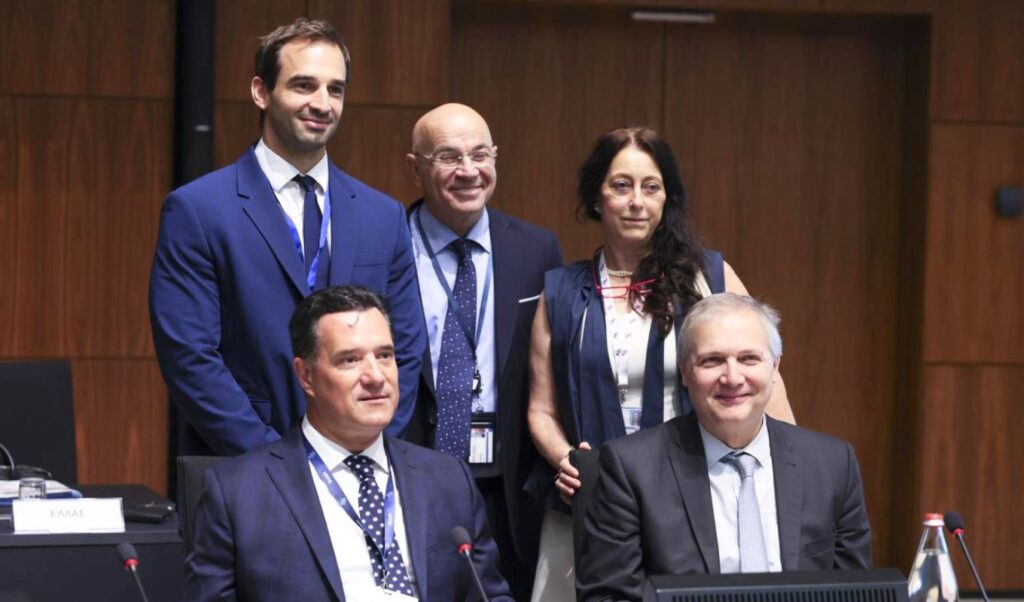
Greek Health Minister Adonis Georgiadis attended the Council of Health Ministers of the European Union in Luxembourg, where he presented Greece’s positions on critical issues concerning access to medicines, the strengthening of health biotechnology, and Europe’s strategic autonomy. At this important meeting, legislative initiatives shaping the future of healthcare in the EU were discussed. The Council, chaired by Cypriot Health Minister Neofytos Haralambides, examined a series of critically important legislative texts. The amendment of the Biotech I Directive on the contained use of genetically modified microorganisms and their use in solid organ transplants was one of the central discussion points. Ministers also analyzed the European Biotechnology Regulation and the opportunities it offers for strengthening the health sector. Progress in negotiations on the amendment of Regulations 745 and 746/2017 on medical devices and in vitro diagnostic products was examined in detail. The Council was attended by Health Commissioner Oliver Varhelyi, Crisis Management Commissioner Hadha Lahbib, European Medicines Agency Director Emer Cooke, and European Centre for Disease Prevention and Control Director Pamela Rendi Wagner. Adonis Georgiadis was accompanied by the Secretary General for Strategic Planning, Dr. Aris Angelis.
Συμμετοχή του Υπουργού Υγείας Άδωνι Γεωργιάδη στο Συμβούλιο των Υπουργών Υγείας της ΕΕ, στο Λουξεμβούργοhttps://t.co/DaOMQ7HTOw pic.twitter.com/1YFrwlhRoL
— Υπουργείο Υγείας (@YpYgGR) June 16, 2026
Adonis Georgiadis: Greece’s positions on the European Biotechnology Act
Regarding the Regulation on strengthening Biotechnology and Biomanufacturing in the Union, he stressed that Greece considers the European Biotechnology Act a key strategic initiative for reinforcing Europe’s leadership position in biotechnology and bioproduction in the health sector. “In an era of intensifying global competition, biotechnology is not only a driving force for growth and innovation, but also a critical pillar of healthcare security, resilience, and Europe’s strategic autonomy.” At the same time, he explained that while Europe continues to excel in scientific research, it faces a persistent gap between scientific excellence and commercial success, with many innovations ultimately being developed, manufactured, and commercialized outside the Union.
The new legislation must help reverse this trend, he emphasized, noting that the European Biotechnology Act represents a unique opportunity to strengthen Europe’s global competitiveness while ensuring that scientific and technological progress delivers tangible benefits for patients and citizens. To achieve this goal, the Regulation must cover the entire biotechnology value chain — from research and clinical development to manufacturing, market deployment, and patient access. Europe must become a place where innovative companies can grow, invest, and manufacture, while ensuring that patients benefit more rapidly from cutting-edge technologies.
Three pillars of action for strengthening biotechnology
In this context, actions were proposed across three key pillars, as the Health Minister outlined. First, regulatory simplification must deliver tangible results. Building on initiatives such as FAST-EU and COMBINE, the Act should establish faster, more predictable, and better-coordinated procedures for clinical trials and product development across the Union. Reducing unnecessary administrative burdens while ensuring operational sustainability for competent authorities and ethics committees will enhance Europe’s attractiveness for research and innovation. Second, Europe must address its structural weaknesses in scale-up financing and industrial development. Stronger support for late-stage funding, strategic investments, and advanced biomanufacturing infrastructure is essential to help innovative companies remain and grow within the Union. At the same time, the opportunity must be seized to build a stronger biosimilars sector.
Third, the framework for strategic projects should focus on technologies that address unmet medical needs, strengthen supply security, and enhance Europe’s long-term competitiveness. Finally, the minister reiterated that the success of the European Biotechnology Act should ultimately be measured by its impact on patient health outcomes, underscoring that real innovation is innovation that reaches patients and improves their clinical results. Regarding the proposed amendments to Regulations 745 & 746/2017 on medical devices and in vitro diagnostic products, he reaffirmed that the improved framework — which would address the shortcomings of the previous one — should be agreed upon and adopted as soon as possible, while maintaining high standards of quality and safety, in order to ensure uninterrupted market supply.
Pharmaceutical resilience and strategic autonomy
During the working lunch discussion, Mr. Georgiadis reiterated his conviction that access to medicines now constitutes a matter of strategic autonomy, resilience, and European security. He considers the key EU priorities to be strengthening European pharmaceutical production, diversifying supply chains, and effectively implementing the Critical Medicines Act and the revised Pharmaceutical Legislation. He also pointed out that resilience must be accompanied by sustainable access to innovation, and that the HTA Regulation can make a meaningful contribution to faster patient access to new, clinically effective, and affordable treatments, while developments in pricing policies require close European monitoring, evaluation, and coordination. He expressed support for strengthening voluntary cooperation among Member States and keeping pharmaceutical resilience high on the European policy agenda. He also proposed that the issue be discussed on an ongoing basis at upcoming Health Ministers Councils. Furthermore, the Health Minister reiterated that Article 9 of the Urban Wastewater Directive cannot be implemented as it stands, before there is a clear picture of the impact on the pharmaceutical sector and patient safety, calling for immediate action.
Το 2022 πέρασε η οδηγία για την διαχείριση των αστικών λυμάτων. Αυτή προβλέπει την εφαρμογή της στην ΕΕ από το 2027 και φέρνει αναπόφευκτα μεγάλη αύξηση δαπάνης στην παραγωγή φαρμάκων και άρα αύξηση της τιμής τους και ελλείψεις. Από την Σύνοδο Υπουργών στην Κοπενχάγη έθεσε… pic.twitter.com/K5F8gKQGT1
— Άδωνις Γεωργιάδης (@AdonisGeorgiadi) June 16, 2026
Bilateral meetings and European cooperation
On the sidelines of the Health Ministers Council, accompanied by the Secretary General for Strategic Planning, Health Minister Georgiadis held a bilateral meeting with Crisis Management Commissioner Lahbib, where he was briefed on the European Commission’s actions surrounding the management of the Ebola outbreak in Central Africa. The Minister confirmed Greece’s support for HERA’s work and was informed that a recent legal provision has institutionalized the procedure for the country’s participation in joint pharmaceutical procurement by the European Commission.