The possibility of resuming talks between the USA and Iran today to end the war seemed to be taking shape yesterday Friday, as representatives of the two countries, sworn enemies, were sent to the Pakistani capital, Islamabad, but without any guarantee that direct negotiations would be conducted, two weeks after the failure of the first attempt.
Meanwhile, the ceasefire in Lebanon, the other major theater of hostilities, appeared extremely precarious yesterday.
The Middle East war, which erupted with the US and Israeli attack against Iran on February 28, has cost thousands of lives—the vast majority in the Islamic Republic and Lebanon—and has shaken the global economy.
In the Pakistani capital Islamabad, the resumption of US-Iranian talks that began two weeks ago and were suspended after fifteen hours was expected for days, while the ceasefire was unilaterally renewed until further notice by the US.
Iranian Foreign Minister Abbas Araghchi arrived last night in Islamabad for talks with top Pakistani officials.
However, “no Iran-US meeting is planned,” emphasized Iranian diplomacy spokesperson Esmail Baghaei via X, simply that Iran’s positions would be conveyed to the American side by Pakistani mediators.
Whittkof and Kushner to Pakistan today for talks “with representatives” of Iran, says White House
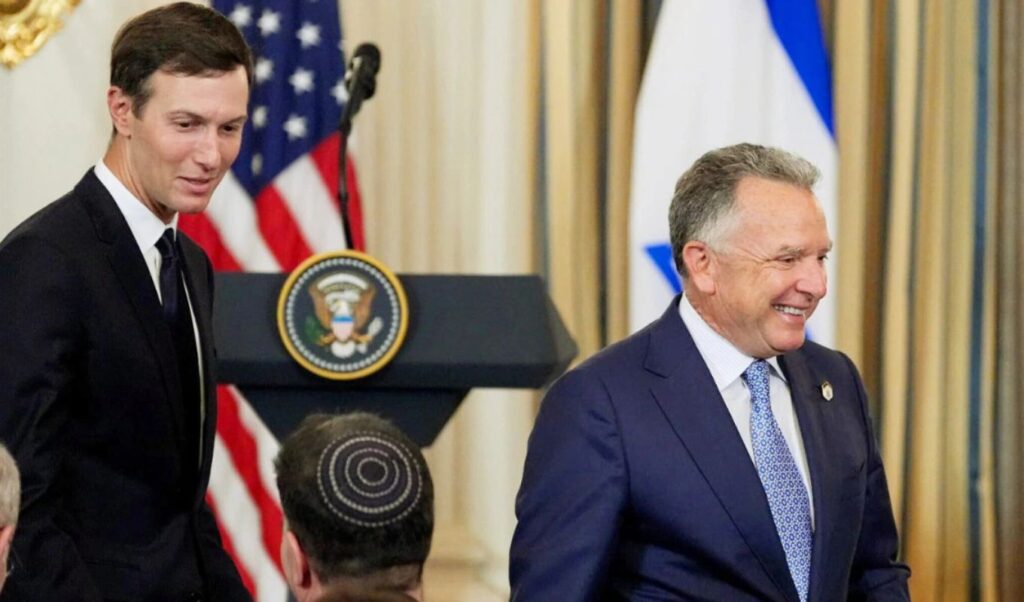
Envoys of American President Donald Trump, Steve Whittkof and Jared Kushner, are scheduled to travel to Pakistan today for talks “with representatives” of Iran, White House spokesperson Caroline Levitt previously stated, according to whom the meeting was requested by Tehran.
US Vice President JD Vance, who headed the American delegation two weeks ago, is not expected to make the trip this time—something that could change if progress is made, Levitt clarified.
After Pakistan, Araghchi is expected to continue his tour with other stops being Oman and Russia.
Meanwhile, shipping paralysis continues in the Strait of Hormuz, through which under normal conditions 20% of oil and liquefied natural gas (LNG) destined for international markets passes—as the maritime route remains subject to a double blockade, Iranian and American.
Markets seemed to welcome the prospect of new Washington-Tehran negotiations with very cautious optimism. The price of WTI, the American crude reference variety, declined to $94.40 per barrel (-1.51%), while that of North Sea Brent, the international reference variety, continued to rise but at a slower pace, closing at $105.33 (+0.25%).
Fragile ceasefire in Lebanon
On the other main front of the war, Lebanon, the ceasefire, which the day before yesterday Thursday was announced by American President Donald Trump to be extended for three weeks following talks between Lebanese and Israeli representatives at the White House, is already being seriously tested.
“Airstrikes by the Israeli enemy in southern Lebanon (…) resulted in six civilians becoming martyrs and two others being wounded,” the Lebanese Ministry of Health reported in a press release published late last night.
The Israeli army assured that its members killed six Hezbollah fighters during exchanges of fire, after reporting that the Shiite movement shot down an Israeli unmanned aerial vehicle.
Israeli Prime Minister Benjamin Netanyahu accused Hezbollah of trying to “sabotage” the “process to achieve a historic peace (agreement) between Israel and Lebanon.”
The Shiite movement, accused of dragging Lebanon into the war by resuming hostilities with Israel on March 2, called on the Lebanese state to refrain “from direct negotiations with Israel” and judged that the extension of the ceasefire “makes no sense” due to the continued “hostile actions” of the Israeli army.
“We will return to our home”
The Israeli army issued an order yesterday Friday for the urgent evacuation of residents of a southern Lebanese village, the first since the ceasefire extension. The Lebanese official news agency ANI subsequently reported an Israeli bombardment in Deir Amess.
Direct negotiation with Israel “means recognizing the enemy,” Ahmad Soumairi, 74, told AFP, who, despite his hesitations, decided to leave Saida, where he had found refuge, and return to his village, following the American announcement that the ceasefire was extended for three weeks.
“We will return to our home,” he said, surrounded by bags and mattresses, expressing hope that “the ceasefire will become permanent.”
Meanwhile, the United Nations peacekeeping force in Lebanon (FINUL in French, UNIFIL in English) announced yesterday the death of another Indonesian blue helmet, who had been wounded on March 29 in the south.