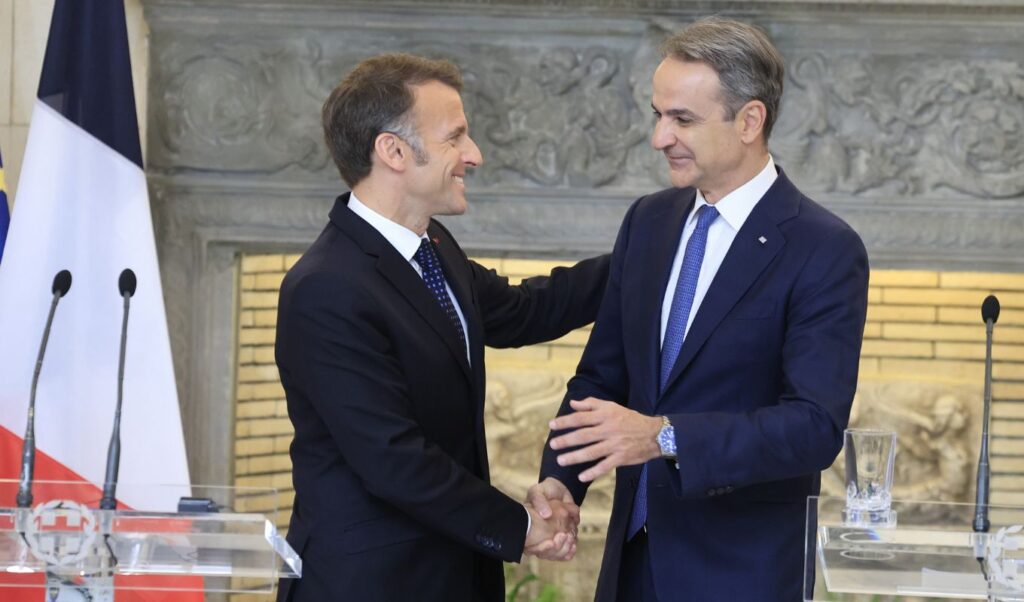
Greece’s Prime Minister Kyriakos Mitsotakis and French President Emmanuel Macron sent a clear message of deepening strategic relations between Greece and France. It is no coincidence that the Greek Prime Minister used the phrase “reinforced concrete” when referring to their mutual assistance commitment, echoing a similar phrase by the French President, who once again said, addressing our country, that “we will be by your side,” while simultaneously sending messages to would-be adversaries.
During the second day of the French President’s visit to Athens, Mitsotakis and Macron, along with the respective ministers of Greece and France, signed the renewal of the defense cooperation agreement between the two countries and a total of 9 bilateral strategic alliance agreements at multiple levels.
The renewal of defense cooperation (essentially indefinitely) is already a very important message of cooperation between the two countries. “We want to inspire the rest of Europe through our partnership,” President Macron summarized.
However, the crown jewel, as Kyriakos Mitsotakis characterized it, is the mutual assistance clause in case of armed attack on one of the two countries. “Don’t wonder what we will do, we will be by your side,” Emmanuel Macron repeated – as he did yesterday at the Roman Agora in Athens.
Equally significant was the reference by both Emmanuel Macron and Kyriakos Mitsotakis to their strong commitment to Article 42 paragraph 7 of the EU’s Lisbon Treaty, which provides for assistance to a European state in case it comes under attack.
Mitsotakis: “The mutual assistance clause is reinforced concrete”
“Article 42.7 of the EU is stronger than Article 5 of NATO and this was proven in the case of Cyprus,” said the French President, explaining: “It’s not just words, we showed this when Cyprus became a target by Hezbollah and we decided to act the next minute.” Macron added with emphasis: “Don’t wonder, we will be by your side. The mutual assistance clause is not disputed, it is non-negotiable and I say this to all potential adversaries.”
Kyriakos Mitsotakis reiterated that the mutual assistance clause was tested in practice in Cyprus, without being formally activated, adding that “we must build on this.” “Solidarity is founded on actions, not words,” noted the Prime Minister. “It’s a great success for Europe, we take our defense very seriously,” he added and highlighted, as mentioned, President Macron’s phrase that Article 42.7 is “reinforced concrete,” as is the mutual assistance clause between Greece and France.
What the Enhanced Comprehensive Strategic Relationship between Greece and France signifies
The broad strategic agreement signed by Kyriakos Mitsotakis and Emmanuel Macron upgrades and further deepens Greek-French relations in a multi-level strategic cooperation.
The Enhanced Comprehensive Strategic Partnership between France and Greece signals the convergence and cooperation of the two countries not only in defense, but also in economy, civil protection, migration, technology, environment, education and culture, as well as cooperation within the EU and international organizations.
This is an agreement that makes Greece safer, upgrades our country geopolitically and creates more economic opportunities and synergies in a series of sectors, including artificial intelligence and cybersecurity.
Greece and France become an axis in the Mediterranean region, with common positions in favor of International Law and multilateralism, support for the Law of the Sea and UNCLOS, which strengthens Greek arguments at the international level.
The agreement also provides for better coordination with France in the European Union, strengthening Greece’s position in European decisions, support for border guarding and combating traffickers, as well as enhanced cooperation in education.
At the same time, the Greek-French strategic partnership agreement for cooperation in security and defense from 2021 is renewed. The renewal is valid for five years (signed by the Foreign and Defense Ministers of both countries). Subsequently, the agreement will be renewed automatically (every 5 years), unless one of the two parties denounces it.
Macron and Mitsotakis call for European bonds
Equally important was the reference by the Greek Prime Minister and the French President to financing methods for the EU after the end of the Recovery Fund.
“If we want to be ambitious as the EU, we must find ways to finance our ambitions,” said Mr. Mitsotakis, and invoking President Macron emphasized: “There is an intention for European bonds, we will have difficult negotiations, there will be mutual concessions or we will lower the bar of expectations, we cannot have both.”
Messages for the Middle East
Regarding the Middle East, Mr. Mitsotakis said that Greece is a reliable interlocutor. “We played our role discreetly in the Israel-Lebanon ceasefire, we have the same interest in protecting Christians in the region, we have an interest in defending freedom of navigation.”
Regarding the war in the Middle East, the French President emphasized that “we call for a ceasefire and a return to the diplomatic path,” and stressed that “we want to contribute to the liberation of the Strait of Hormuz.” At the same time, he expressed hope for peace in Lebanon and for the government to be able to disarm Hezbollah.
Prime Minister Kyriakos Mitsotakis’s speech
“Athens welcomes today a chronically European ally and partner but also a true friend of our homeland – and allow me to say – a personal friend of mine. At a moment that I would characterize as pivotal as it seals a historic choice made by our two countries in 2021, namely the decision for Greece and France to align themselves, transforming a long-standing common journey into a strong strategic significance,” Prime Minister Kyriakos Mitsotakis said in joint statements with French President Emmanuel Macron that followed their meeting and the agreement signing ceremony.
The Prime Minister spoke of the evolution of a multi-level, substantial relationship with roots in the historical ties of the two nations, the same principles and values, as well as the mutual interests of the two peoples. “With elements that were forged through our participation both in the North Atlantic Alliance and in the EU, but also bilaterally of course, and the results, particularly in the defense sector, are more than visible.”
He referred to the opportunity they had to visit the frigate “Kimon” which just returned after a 40-day stay off Cyprus, as well as the frigates to be delivered by 2028, and added:
“While the capabilities of our Air Force have been substantially upgraded with the delivery and operational function of 24 Rafale fighters, but of course also through a multi-faceted alliance – indicatively I mention the agreement we signed today for the upgrade of Mica missiles. All these strengthen our deterrent power, but they armor both national and European borders. And in parallel, it is no coincidence that in the recent crisis in the region, France rushed to strengthen the defense of the Great Island and I have very strong memories – dear Emmanuel – from our joint presence in Cyprus together with President Christodoulides because we proved in this way that European solidarity is founded on actions and not words.”
Mitsotakis: Our convergence is a precursor to the broader need for strategic autonomy of our continent overall
Continuing, the Prime Minister emphasized that this Greek-French convergence had preceded all the recent important geopolitical realignments. “I would say therefore that it proved to be prudent and timely in the field of security and stability and was in its own way a precursor to the broader need for strategic autonomy of our continent overall. Something that we two have been talking about for at least several years in the European Council with common programs and co-productions, with operational interoperability.”
He pointed out that the frigates acquired by the Greek Navy and the frigates acquired by the French Navy are practically identical. But one Navy learns from the other with the crown of these agreements being the mutual assistance commitment.
“And I want to thank Emmanuel again because so clearly and yesterday he repeated that if Greece ever needs France’s support, God forbid, France will be present and that’s why today we take another important next step.
The declaration for the enhanced comprehensive strategic partnership between Greece and France, which we had the opportunity to sign a little while ago, reflects the breadth of our cooperation and I want to thank all the ministries but primarily the Ministry of Foreign Affairs that worked on the agreements we signed today.”
He emphasized that a clear direction is given for our diplomatic convergence while at the same time we invest in the future with joint actions in education, while strengthening our cooperation in the intergovernmental organization Mercator Ocean International, a critical body for marine knowledge and observation, in strategic sectors such as nuclear energy and technology.
“Furthermore, I recently had the opportunity to be in Paris at a very interesting conference organized by President Macron on this issue. And of course a little while ago the Finance Ministers inaugurated the Technical Support Center of Euronext Athens, as the Athens Stock Exchange is now called. We are implementing European unification in the financial transactions sector as well.”
The Prime Minister said that shortly they will speak at the very important Greek-French Business Forum, which is taking place right now. “And all this signifies our desire, Greece and France, France and Greece, to walk together on the path of 21st century Europe, ensuring conditions of prosperity and security for the present, but also opening a horizon of hope for future generations. And indeed this very vision of ours occupied our discussion yesterday at the Roman Agora, a center of public life in antiquity, which continues today to cultivate fruitful dialogue and reflection, mainly truth beyond the era of fake news, dialogue in the time of slogans and named responsibility in the era of anonymous digital propaganda.
Dear Emmanuel, when the fundamental principles of the post-war order are being tested, the response of democracies must be unified, sober and decisive. Therefore, first, Europe itself, on the territory where, unfortunately, war has returned for four years now, is called to strengthen its autonomy at all levels. Because only then can it travel safely in the troubled waters of an uncertain world and I want to thank the French President, because with truly great persistence he puts the issue of Europe’s strategic autonomy in all its aspects at the forefront of discussions in the European Council,
I believe that our historic defense will also strengthen our common alliance NATO and with European member states now necessarily taking greater responsibility for defending our common interests and common borders. Realizing that developments in the North, East, but also in the South, here in the Southeastern Mediterranean, directly affect the security of all of Europe. And that’s why a long-term, genuine, European policy is required. However, we know well that we cannot have strategic autonomy without a competitive Europe. And without competition there is no development and prosperity. That’s why the agenda of enhancing competitiveness in areas such as reducing bureaucratic burden, cheap energy, will be at the center of our discussions in the coming months, with the crown, obviously, the negotiation for the new multiannual financial framework, which will be wishful thinking if completed by the end of 2026.
We had the opportunity, of course, to also discuss developments in the Middle East. Greece is, like France, a reliable interlocutor, a force of stability. We both played our role discreetly in the ceasefire and dialogue between Israel and Lebanon, a very important development that must be strengthened. We both have the same interest in protecting all religious communities, especially the Christians of the region, who are not simply a minority but an integral part of its historical identity. We have the same interest in defending freedom of navigation based on International Law and the Convention on the Law of the Sea.
And as a non-permanent member of the Security Council, we raised this issue as an issue of utmost importance, an issue that Europe as a whole must embrace and in the same direction, obviously, we move in view of Greece’s European Presidency in the second half of 2027. We are ready to contribute to shaping all those policies that give impetus to a strong, democratic Europe with a real role in geopolitical developments, which knows and can defend its values, but also its member states. A Europe of its citizens, ultimately a child of both Greek and French civilization, a child of ancient Athenian Democracy, but at the same time a child of the European Enlightenment.
Dear Emmanuel, I close by reminding that in planning the future we simultaneously honor the past. And these days the painting by Delacroix “Greece on the Ruins of Missolonghi” is exhibited at the Xenokrateion Museum of Missolonghi. It is a work that was loaned from the Museum of Fine Arts of Bordeaux and I would say it is a moving proof of the bonds of our peoples, even before the independent Greek state was formed, whose birth, let us not forget, was warmly supported by French women and men.
And we refer to the 200 years and the recognition of the French contribution, a commitment and solidarity that is important to this day, serving and giving continuity to such a historical tradition of peace and cooperation, and I believe that this is exactly what we did today,” emphasized Kyriakos Mitsotakis.
Macron: We want to inspire the rest of Europe – The mutual assistance clause is not just words
“Thank you, Mr. Prime Minister, dear Kyriakos, ladies and gentlemen ministers, Mr. Ambassador, Mrs. Ambassador, ladies and gentlemen. Thank you for your very kind words, Mr. Prime Minister, dear Kyriakos, for the hospitality, the reception. And yesterday we spoke about the depth, the intensity of our relations, the friendship that connects our countries,” French President Emmanuel Macron said from the podium.
“The world is becoming increasingly violent, more unstable and we see that these imbalances have strengthened a legacy of history, our good relationship. France of course reacted against the threats that struck you. And this partnership, which we are renewing here for five years, has extended to security issues, strategic partnership that connects our two countries. We want to inspire the rest of Europe. We want to strengthen this NATO pillar, the European one. This is a real strategy within Europe. Because a few months after signing this strategic partnership, we started joint exercises – and indeed last March, with the Council, we strengthened Europe’s defense. In 2021, when Greece and France signed this partnership, we took a first step and through this partnership, we essentially serve as inspiration for many. There is a mutual assistance clause for cases of armed attack and of course this clause is not just words. This clause will be implemented in practice. And this is exactly what we did together, vis-à-vis Cyprus, March 1 and 2 and the following weeks. And with very specific cooperations in the defense industry sector, with Greece’s choice of 24 Rafale, 4 Naval Group frigates, the first of which “Kimon” was delivered to Greece in January and was indeed found off Cyprus in March. It is very important because we see the contacts between our armed forces multiplying, as well as joint operations.
It is very important to speak today about this enhanced and comprehensive strategic partnership, with Greece’s accession to forward deterrence, something that started a few weeks ago.
We want to strengthen and deepen this strategic relationship beyond the defense sector, in the energy sector, nuclear energy agreement, environment… I welcome Greece’s accession to the Mercator International Organization, systems and digital services for the oceans, training, higher education. We will visit this afternoon an exhibition for the 180th anniversary of the French Archaeological School in Athens. Also partnership in cultural matters and scientific cooperations. Very important partnership with many and significant exchanges.
We also cover the economy and competitiveness sector. Over 200 French companies are located in Greece with 17,000 employees. They operate in strategically important sectors, digital technology, artificial intelligence,