In an attempt to shift the balance of power in the Eastern Mediterranean and secure diplomatic leverage for the Turkey-Libya maritime memorandum, Ankara is making moves to bring Egypt into its fold — even dangling promises of additional maritime zones, as if they were Turkey’s to give.
Read also: Israeli Ambassador Pninat Yanai condemns the illegal Turkey-Libya memorandum — “It lacks validity and legitimacy”
The ratification of the memorandum by the parliament of Eastern Libya, combined with the publicly stated intention of Athens and Cairo to extend their 2020 EEZ delimitation agreement, appears to have triggered a surge of activity in Turkish diplomacy. A telling example is the public statement from Turkey’s Ministry of Defense, claiming that an EEZ agreement between Turkey and Egypt would secure Cairo more than 15,000 additional square kilometers of maritime jurisdiction — beyond what an equivalent arrangement with Greece would yield.
This calculation, however, raises serious questions. Part of the maritime area Ankara claims to be offering is already covered by the Greek-Egyptian agreement, while exploration rights in the broader region have already been granted to American energy companies. Despite Turkey’s diplomatic maneuvering, Egypt appears unwilling to engage in any process that could be interpreted as indirect recognition of the Turkey-Libya maritime memorandum.
Murad Murad: “We are not discussing a Turkish-Egyptian deal — we condemn the Turkey-Libya memorandum”
Speaking exclusively to Kyriakatiki Apogevmatini, the newly appointed Egyptian Ambassador to Greece, Murad Murad, makes Egypt’s position unmistakably clear: there is no prospect of a Turkish-Egyptian maritime agreement. “The Turks are trying to justify to us the deal they made with the Libyans, but under no circumstances are we discussing a Turkish-Egyptian agreement. We condemn the Turkey-Libya memorandum,” he states emphatically. The seasoned diplomat also emphasizes that Greece and Egypt share a relationship built on friendship and genuine cooperation.
Greece-Egypt EEZ: Political will to expand the agreement and the Kastellorizo message
Regarding the possibility of resuming negotiations to extend the existing delimitation — that is, the landmark 2020 agreement — toward the Kastellorizo region, Ambassador Murad clarifies: “We don’t have a date yet, but the political will has been publicly expressed, and that is significant.”
Greece-Turkey confrontation at the UN over the Turkey-Libya memorandum — Athens makes its moves
This prospect carries particular weight, as the 2020 agreement serves as a key diplomatic and legal counterweight to Turkish territorial claims. Indeed, at a recent event marking the 53rd anniversary of Egypt’s Armed Forces Day, the ambassador referenced the strategic partnership between the two countries and expressed hope for its further strengthening. Egypt’s wariness toward Ankara is not limited to maritime boundary disputes — it is also tied to developments in Libya, where Turkey’s continued military presence remains a source of deep concern. It is no coincidence that the foreign ministers of Egypt, Algeria, and Tunisia, at a recent joint meeting, called for the withdrawal of all foreign military forces from Libya as a precondition for creating the conditions necessary to hold elections.
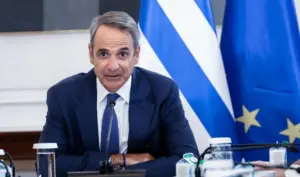
Meanwhile, the diplomatic clash between Greece and Turkey moved to the UN Security Council, where Prime Minister Kyriakos Mitsotakis raised the issue of the Turkey-Libya memorandum, presenting a map illustrating the disputed maritime claims. The Prime Minister stressed that the Turkey-Libya agreement disregards geographical reality and the rights of Greek islands, including Crete, Rhodes, Karpathos, and Kasos. “Turkey and Libya have tried to draw a maritime border between themselves, as if the Greek islands lying between their coasts simply do not exist.” The intervention drew an immediate response from the Turkish delegation, escalating into four successive exchanges between the two sides.
Greece argued that Turkey and Libya do not share opposite or adjacent coastlines that would justify a common maritime boundary, while Ankara insisted on the need for bilateral negotiations. Earlier, Foreign Minister Giorgos Gerapetritis, following his meeting with UN Secretary-General António Guterres, made clear that maritime zones are not subject to negotiation or bargaining.
Crete-Cyprus electricity interconnection: The NAVTEX notice, the surveys, and Turkey’s reaction
The Greek government is directly linking the defense of its sovereign rights to the implementation of strategic energy projects in the Eastern Mediterranean, including the resumption of surveys for the Crete-Cyprus electricity interconnection. The French research vessel Abeille Marengo has been docked in Heraklion since Tuesday, awaiting the issuance of a Greek NAVTEX notice.
According to exclusive information from Kyriakatiki A, the notice is expected to be issued in early November. Turkey has formally requested written notification regarding the surveys, with reports indicating that the relevant communication will be channeled through the French side. Athens, however, firmly rejects any interpretation that would frame this process as a request for Ankara’s permission — while keeping open the matter of what it describes as a “standard notification procedure.”
Diplomatic fever
Beyond the public statements, the behind-the-scenes diplomatic activity is equally noteworthy. Foreign Minister Giorgos Gerapetritis is maintaining open lines of communication with counterparts from allied nations, including US Secretary of State Marco Rubio. According to exclusive information from Kyriakatiki A, during his recent visit to the United States, Greece’s top diplomat held a phone call with a senior official at the highest levels of the American administration. This contact takes on added significance in light of the State Department’s second statement on the Turkey-Libya memorandum.
In a departure from its initial position, the US State Department used notably stronger language this time, describing the ratification of the agreement as a provocative and unconstructive development. Washington, however, stopped short of abandoning its traditional balancing act between the two NATO allies, calling on Greece and Turkey to address their differences through bilateral dialogue. This message — combined with Cairo’s unequivocal stance and the confrontation at the UN — paints a vivid picture of the complex diplomatic landscape taking shape in the Eastern Mediterranean, with Ankara searching for footholds and Athens working to secure both its alliances and its rights.
Originally published in Kyriakatiki Apogevmatini