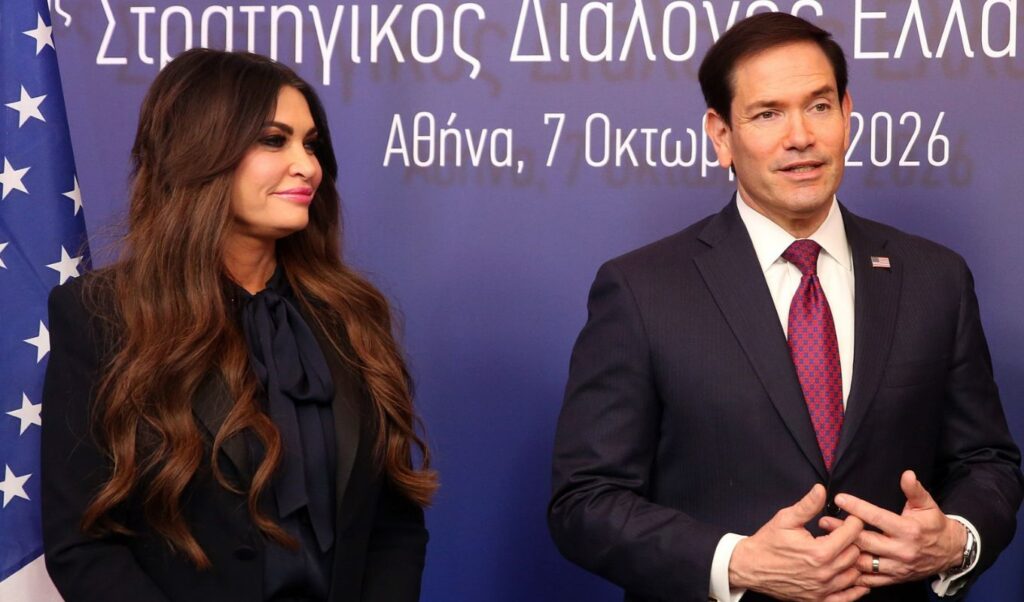
US Secretary of State Marco Rubio has sent a clear and unequivocal message: American foreign policy toward Greece remains firmly committed to the strategic strengthening of bilateral relations — and this will not change in the wake of Kimberly Guilfoyle‘s departure from the US Embassy in Athens.
Read also: Rubio on Greece: A very significant country and important ally — deserving an ambassador with President Trump’s full confidence
The head of US diplomacy made clear that Guilfoyle’s exit should under no circumstances be interpreted as a sign of retreat or downgrading of US-Greece relations. Without going into detail about the events that led to the former ambassador’s removal, Rubio clarified that the White House has not yet decided who will take over the American diplomatic mission in Athens. However, stressing that Greece “deserves a strong and capable ambassador” with direct access to the US president, Rubio assured that in the interim, Washington will ensure the American Embassy in Athens is staffed by the right team of experienced professionals.
In one of his first public statements following Guilfoyle’s departure — speaking to Breitbart News and journalist Matthew Boyle just 48 hours after his visit to Greece — Rubio underscored the importance the United States places on its relationship with Athens.
International relations expert Alexandros Despotopoulos told parapolitika.gr that “Mr. Rubio is outlining a reality: the very close relationship between Greece and the United States, and the pivotal role Greece plays in connecting Europe to American natural gas — and to Africa. And that this relationship transcends individuals. It is no coincidence that Mr. Rubio said that an ambassador must come who has access to President Trump, showing just how important he considers Greece to be.”
For Kostas Ifantis, Professor of International Relations at Panteion University, Rubio’s statements reflect the consistency of American policy in supporting the Greek-American strategic relationship. As he told parapolitika.gr, “there is a shared understanding on many issues. The United States has invested in Greece — the Defense Cooperation Agreement, the Vertical Corridor, and of course access to high technology, such as the F-35s.”
Rubio placed particular emphasis on Greece’s energy role, noting that the country occupies a unique geographic and political position. As he explained, Athens is not only open to energy resource exploration — it actively encourages it, a direction that appears to enjoy broad support from Greek society. “Energy only has value to the extent that you can transport it,” he noted pointedly, highlighting the importance of moving energy both northward and southward. In this context, he made specific reference to the Vertical Corridor for the transport of American liquefied natural gas to Central and Eastern Europe, including Ukraine, expressing Washington’s desire for other European countries to follow Greece’s example.
According to Professor Ifantis, major energy projects are not expected to be affected by Guilfoyle’s removal. As he argues, “these had started before Kimberly Guilfoyle arrived in Greece. None of this was the former ambassador’s own project. She obviously advanced these initiatives during the year she was here, as she was supposed to, but that’s as far as it goes. She didn’t start anything. So her departure doesn’t change the plans for the Greek-American relationship. These have a different depth. Strategic cooperation does not depend on who the ambassador is. Even if no one comes — even if Rubio and Trump fail to send an ambassador — because there is a possibility that after the midterm elections, the congressional majorities could favor the Democrats, leading to a level of polarization where none of the president’s nominations get confirmed. Not because of anything to do with Greece, but because of the Democrat-Republican rivalry. I don’t think anything can really change in the Greek-American relationship.”
Furthermore, the Secretary of State chose to highlight Greece’s strategic importance, describing it as an “outstanding ally” that has helped the United States in many ways and is a critical partner for the future. He emphasized that Greece stands at the core of America’s key priorities — regional stability, NATO cohesion, and energy independence — once again demonstrating that Washington’s approach to Greece differs markedly from its approach to Turkey.
According to Ifantis’s analysis, for now Greece is gaining more than Turkey — whether at the institutional level, in Congress, or in terms of the investment Greece is making in the Rubio policy track. This contrasts with Turkey, where President Erdoğan speaks directly with Trump, but beyond compliments, has received little else. “The US-Turkey relationship has its own complexities, but there too, at least for the moment, there is a degree of stagnation,” Ifantis noted.
As for the direct access to the Oval Office that many seek, analysts suggest it may actually be wise not to engage President Trump in direct talks — because when you do, you should be prepared to offer something in return. What remains clear, however, is that the head of American diplomacy has once again confirmed that US-Greece relations are better today than they have ever been.