With each passing day, Alexis Tsipras is stepping up his pressure on the Greek government over energy costs and the rising cost of living. Senior figures within SYRIZA believe that through his latest moves, the former prime minister is effectively forcing Kyriakos Mitsotakis into policy retreats. In recent weeks, Tsipras has made a point of meeting with professional associations and trade unions that are either already mobilizing or preparing to launch protest actions in the near future.
Read also: Alexis Tsipras in Thessaloniki: The battle among SYRIZA members over who stands by his side — and the fishermen’s pointed jab
It is telling that shortly after Tsipras met with fishermen in Thessaloniki, Prime Minister Mitsotakis announced additional financial support for professional fishermen — noting that the government was already working on ways to support the sector, even as the fishermen’s strikes were still ongoing.
Tsipras fires back over energy costs
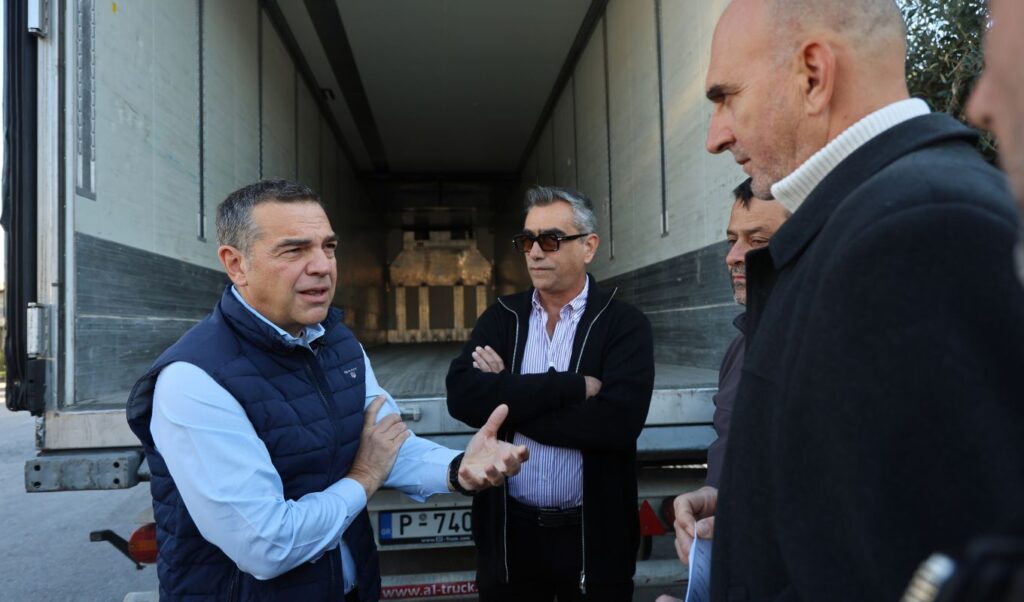
Yesterday, Alexis Tsipras met with representatives of transport companies and the Panhellenic Union of Transport Enterprises. During the meeting, the SYRIZA leader expressed serious concern about the trajectory of energy prices and the broader cost of living heading into winter.
The former prime minister focused particularly on the impact of rising energy costs on professionals, emphasizing that fuel and energy price hikes are placing an increasing burden on the entire economy — costs that ultimately get passed on to consumers.
“The day before yesterday it was farmers, yesterday it was fishermen, today it’s transport workers,” he said pointedly. “The key message coming out of all these mobilizations and demands is that it simply ‘doesn’t add up.’ Costs have now risen so high that in the key professional sectors underpinning our economy, the financial burden has become unsustainable. And that cost gets passed on to citizens, to consumers, to households,” the SYRIZA leader added.
Tsipras linked the issue of energy costs directly to the use of fiscal surpluses, arguing that available public resources could be redirected immediately to support both professionals and households. “The government is obliged to put that money back at the pump — back into the hands of the professionals and the people who keep this economy running. Let’s put an end to the tired question of ‘where will you find the money?’ They’ve already found it — sitting in the public coffers, from VAT revenues that remain high while inflation runs at 3% to 4%,” he said.
The SYRIZA leader also warned of the severe pressures that households and professionals are expected to face in the coming months, calling for immediate action and intervention at the European level. “We are facing a crisis that has exceeded all boundaries. What we will experience this winter in terms of the cost of living and energy prices will be unlike anything we have seen before. We need to immediately call on the European Commission — the European Commission must be briefed,” he stressed.
He further argued that available public revenues should be directed toward addressing the immediate needs created by rising energy costs, with particular emphasis on professional sectors that are directly dependent on fuel. “So that homes can be heated and your trucks can run, and the fishermen’s boats, and the tractors,” he said vividly, painting a picture of the real-world consequences of soaring energy prices.
His criticism also extended to the government’s repeated fiscal overperformance, with Tsipras arguing that consistently exceeding surplus targets is no longer a coincidence. “What has now happened for the fourth consecutive year — surpluses exceeding targets by more than €3–5 billion — is not accidental, it’s not a mistake. A recurring mistake is no longer a mistake,” he said.
Meanwhile, SYRIZA officials are highlighting that Greece is facing exceptionally high levels of energy poverty and dangerously low purchasing power. Citing Eurostat data, they pointed out that “Greece has the highest rate of energy poverty in Europe,” that “1 in 5 citizens struggled to heat their homes in 2025,” that 67% of citizens feel financially poor, and that Greece has “the lowest purchasing power in Europe — we are right next to Bulgaria, and that is a fact.”
In a particularly striking statement, SYRIZA spokesperson Theoni Koufonikola noted that Greece “has some of the most expensive fuel prices in the world — it currently ranks 11th globally for the highest petrol prices.” She continued her criticism by stating that “the government continues to lie about the Excise Duty on fuel,” adding that “initially they told us the EU didn’t allow a reduction, then they said the EU does allow it but that they need to secure an escape clause.”
On the specific issue of fuel excise duty, she argued that the government has the immediate ability to reduce it, pointing to the significant gap between Greece’s current rate and the EU minimum threshold. “In Greece, the excise duty on unleaded petrol is 70 cents per litre, while the European minimum is 35.9 cents. That means the government could reduce the tax by 34.1 cents per litre — right now, immediately,” she concluded.