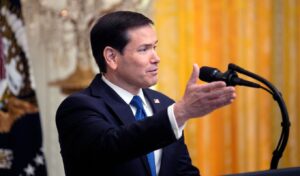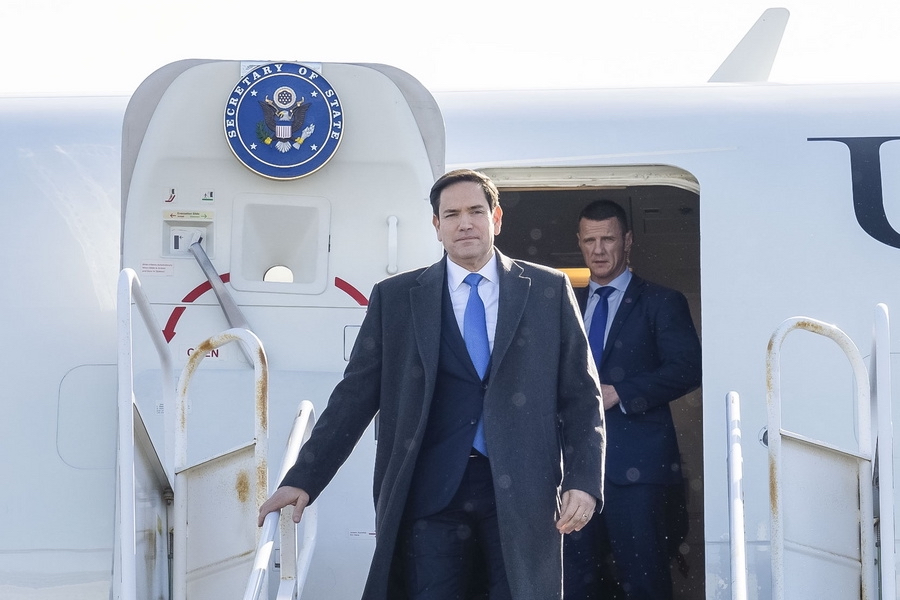
At a critical geopolitical juncture and amid a complex international environment, U.S. Secretary of State Marco Rubio is visiting Athens for the first time since taking the helm of the State Department nearly two years ago. With Reykjavik, Iceland as his first stop and Lisbon, Portugal as his third and final destination, the 55-year-old diplomat is making a carefully chosen tour of Europe — a continent deeply anxious about the trajectory of two ongoing wars in Ukraine and the Middle East. “Greece, of course, is a very important ally of the United States. It is a country where we not only have a military presence, but also strong economic ties,” the top U.S. diplomat stated just 24 hours before his arrival in the country.
Read also: Rubio’s visit to Athens: Emergency traffic measures and ban on public gatherings on Wednesday
Rubio is set to arrive in Athens this evening and will hold bilateral talks with Greek Foreign Minister Giorgos Gerapetritis tomorrow morning. The two foreign ministers will then deliver statements to the press before officially launching the 6th Round of the Greece–U.S. Strategic Dialogue. A plenary session of the Strategic Dialogue will follow, aimed at further deepening the bilateral partnership across key priorities of the U.S. government — including defense cooperation, regional security, and energy security, as outlined in the relevant State Department announcement. A meeting with Prime Minister Kyriakos Mitsotakis at the Maximos Mansion is scheduled for 7:00 p.m.
Energy and defense at the heart of the Strategic Dialogue
The Greece–U.S. Mutual Defense Cooperation Agreement, the situation in the Middle East and Greece’s role in the Red Sea, and bilateral trade are among the issues expected to be discussed between the two delegations — as is energy. The presence of the two largest American energy companies, Chevron and ExxonMobil, is viewed by the Greek government as a vote of confidence in the country and as a reinforcement of Greece’s role as a strategic energy hub in the Eastern Mediterranean. The State Department has also acknowledged that Greece has demonstrated leadership in reducing Europe’s energy dependence on Russia by increasing imports of American liquefied natural gas (LNG) and contributing to regional energy security. Both the prospect of future natural gas extraction by American companies — in partnership with Greek firms — and the supply of American LNG to the European market via Alexandroupolis and the Vertical Corridor are expected to feature prominently in tomorrow’s discussions in Athens.
Chevron, ExxonMobil, and LNG: Athens’ energy agenda
“The strategic relationship between Greece and the United States of America is continuously strengthening. This is demonstrated by a series of moves, such as major energy agreements with American giants,” government spokesperson Pavlos Marinakis stated yesterday, while Minister of Environment and Energy Stavros Papastavrou highlighted the growing American interest in Greece’s energy sector, citing investments by U.S. energy companies in hydrocarbon exploration in Greece. Rubio is well acquainted with both the people and the issues at play in Greece and the broader region. Among other things, he co-sponsored — alongside Robert Menendez — the “United States–Greece Defense and Interparliamentary Partnership Act of 2021” five years ago, which included provisions for upgrading defense cooperation and supporting the modernization of the Greek Armed Forces, ultimately paving the way for the Hellenic Air Force’s acquisition of F-35 fighter jets. While Rubio is not expected to take a position on Greek–Turkish relations, the very fact that he is visiting Athens without pairing the trip with a stop in Ankara carries its own symbolic weight.
The message to Ankara and the new defense cooperation
It is no coincidence that yesterday, on the eve of Rubio’s arrival in Athens, Prime Minister Mitsotakis took another indirect jab at Ankara — this time with a European dimension. “We certainly recognize the need for the European defense industry to remain open to partnerships with third countries. However, their participation in programs supported by European resources cannot be unconditional. To join SAFE or similar initiatives, a country must, first and foremost, respect the security interests of EU member states — without asterisks,” the Prime Minister said in his statements following his meeting with Lithuanian President Gitanas Nausėda at the Maximos Mansion.
Washington continues to apply steady pressure for more armaments programs “made in USA,” yet Greece–U.S. defense cooperation is already at a very high level. Greece is a NATO ally and one of the few countries already spending more than 3% of its GDP on defense. The Souda Bay base plays a key role in the Eastern Mediterranean and the Middle East, particularly during this exceptionally critical period. On the procurement front, Greece has an active agreement for fifth-generation F-35 fighter jets, with the first aircraft expected to arrive in 2029 — though the weapons systems they will carry remain subject to ongoing negotiations. The Hellenic Air Force is also upgrading its F-16s to the top-tier Viper configuration; the 56th modernized F-16 Viper was recently delivered in cooperation between Lockheed Martin and the Hellenic Aerospace Industry (HAI), bringing the fleet upgrade program to nearly 70% completion. Greece has also taken delivery of three MH-60 Romeo helicopters and is in the process of receiving four more. Finally, a distinct chapter in tomorrow’s talks is expected to be Greece’s new partnership with the Florida National Guard under the State Partnership Program, which provides for joint training activities and enhanced interoperability.