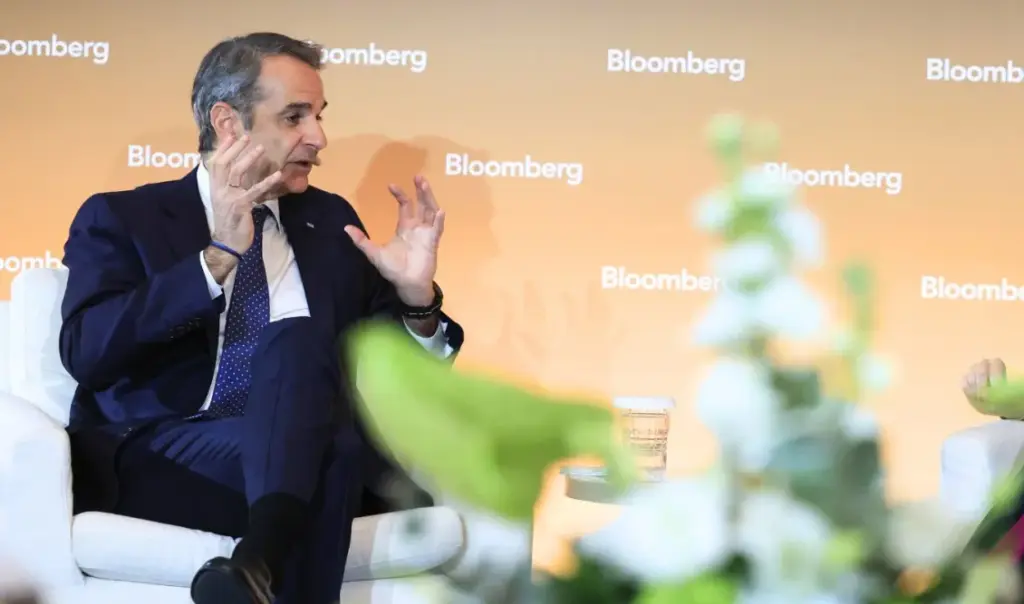
Greek Prime Minister Kyriakos Mitsotakis has called for greater flexibility in European fiscal rules in order to provide meaningful relief to households struggling with rising energy costs, in an interview with Bloomberg.
The Prime Minister noted that Athens has fully met its fiscal targets, generating a surplus and rapidly reducing its deficit — creating the necessary fiscal space to support household incomes. He warned, however, that without decisive action from Brussels, the coming winter could pose serious challenges for the European economy. “At some point, perhaps Europe will also need to act and allow us a little more fiscal flexibility. Otherwise, it’s going to be a difficult winter,” he said, adding: “The only way we can reduce this tax is if we get a waiver, an exemption from Europe. Otherwise, I don’t think we have the fiscal space to act.”
Mitsotakis placed particular emphasis on the fiscal flexibility the EU should be extending to member states like Greece — whose economy is accelerating — arguing they have the necessary room to support citizens during a crisis driven by the wars in Ukraine and the Middle East.
“Nobody believed until a few years ago that Greece would be able to borrow at lower rates than four G7 countries” — Kyriakos Mitsotakis
What Mitsotakis demanded on fuel taxes
At the heart of his remarks was the issue of fuel taxation. Acknowledging the heavy burden on consumers, Mitsotakis pointed out that Greece has a strong, export-oriented refining industry, but stressed that any reduction in fuel taxes would require a specific exemption from EU rules. He confirmed that discussions on this matter are already underway at the European level, while also making clear that such a temporary adjustment would not represent a step back from the green transition agenda.
What he said about the Strait of Hormuz and the Red Sea
On the ongoing turmoil in the Middle East — which continues to drive up fuel prices — and Greece’s potential role in the Strait of Hormuz, the Prime Minister was unequivocal: any Greek participation in a multinational operation in the region would first require consensus among all parties involved. “As a seafaring nation, we are ready and present in the Red Sea to repel Houthi attacks. However, no one is going to send military assets into an area where hostile fire is ongoing. As for the Strait of Hormuz, we could play a role, but an agreement must come first.”
When asked about the possibility of imposing transit fees for ships passing through the strait — and reports that Greek shipowners might be open to accepting such charges — the Prime Minister firmly opposed the idea, warning of the knock-on effects on shipping costs and, ultimately, on consumer prices. “We are against tolls because that would set a dangerous precedent, and in the end, it would be consumers who pay,” he said.
On the energy front, Mitsotakis highlighted the country’s significant progress, noting that more than 55% of Greece’s electricity now comes from renewable energy sources. At the same time, he made clear that fossil fuels will continue to play a critical role in ensuring energy security in the near term, making a balanced transition essential.
“Nobody believed Greece would borrow at lower rates than four G7 countries”
The Prime Minister revisited Greece’s remarkable economic turnaround since the austerity years, highlighting as a key credibility milestone the fact that Greece’s borrowing costs now sit below those of four G7 member states. “Nobody believed until a few years ago that Greece would be able to borrow at lower rates than four G7 countries,” he said, adding that this hard-won credibility gives Greece the institutional standing to push Europe — with real authority — for targeted exemptions and fiscal adjustments that benefit its citizens. “We have credibility in Europe and we can talk about possible exceptions. And I say this as a European, not just as a Greek.”
Originally published in Apogevmatini