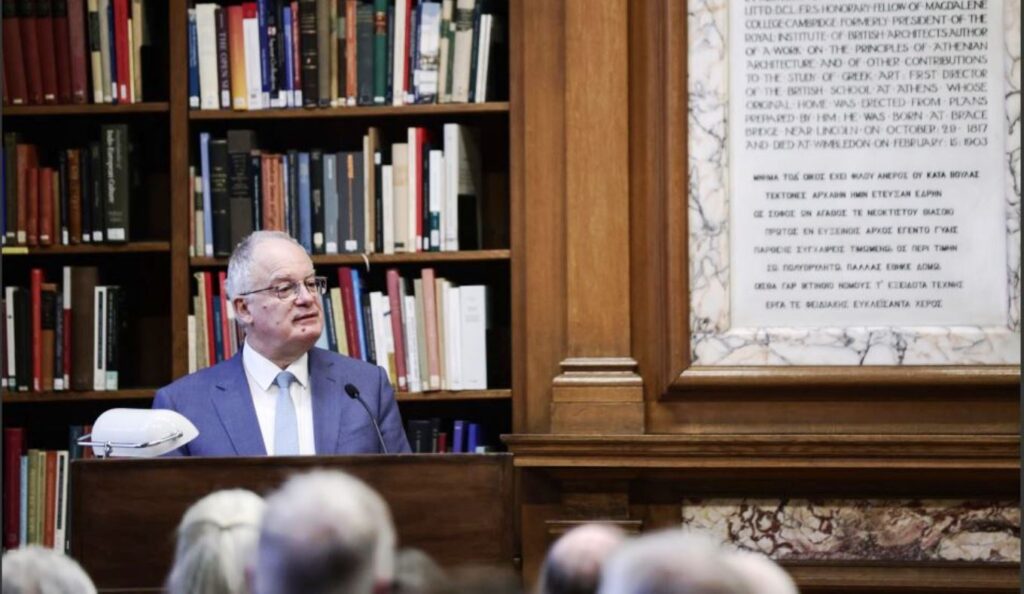
The Parthenon Marbles and their reunification took center stage at the close of a wide-ranging address by Greek President Konstantinos Tasoulas on Greece’s relationship with European archaeology and foreign Archaeological Schools. Speaking at the British School at Athens, President Tasoulas linked the protection of cultural heritage to the modern principle that archaeological finds belong to their place of origin, and made a clear case on the Parthenon question, stressing that it cannot be accepted that the monument should remain indefinitely without its Sculptures.
Read also: Mitsotakis meets JP Morgan CEO Jamie Dimon in New York
Parthenon Marbles: “A gesture of immense significance”
“The reunification of the Parthenon Marbles would be a gesture of immense significance,” the President of the Republic declared, urging his audience to consider “the magnificence of a true reunification of the Parthenon Sculptures, which would follow the magnificence of such a gesture.” As he underlined, “if we accept that the Parthenon is the beacon of the European spirit and Western thought, we cannot accept that it must remain indefinitely without its Sculptures.”
The remarks were made as part of his speech on the contribution of foreign Archaeological Schools to the promotion of ancient Greek civilization. Konstantinos Tasoulas highlighted their role in reconstructing the historical memory of both Greece and Europe, as well as in championing the classical heritage as a universal ideal and as the foundation of a European identity. He also noted that their establishment was driven not only by the search for European roots in classical antiquity, but also by the effort to organize archaeology as a scientific discipline grounded in methodology, documentation, and international collaboration.
From collection and exportation to a new understanding of archaeological finds
The President of the Republic placed particular emphasis on the shift that has taken place in the way antiquities are treated. He recalled that in the 19th century, archaeology was often associated with collection, exportation, and appropriation. By contrast, throughout the 20th and 21st centuries, foreign Archaeological Schools — working alongside the Greek Archaeological Service — have helped shape a fundamentally different approach, one in which “finds belong to their place of origin, research must be conducted transparently, and its findings shared, since documentation is an act of responsibility.”
In his historical overview, he also touched on the rise of philhellenism, the protection of Greek cultural heritage, and the institutional organization of archaeology following the establishment of the modern Greek state. He recalled, among other milestones, that in 1827 the Constitution of Troezen prohibited the sale or exportation of antiquities without government authorization, while in 1829 the first archaeological museum was founded on the island of Aegina. These were followed by the official establishment of the Greek Archaeological Service in 1833, the first comprehensive archaeological law in 1834, and the founding of the Archaeological Society at Athens in 1837.
The 19 foreign Archaeological Schools and the “memory of yesterday”
Konstantinos Tasoulas noted that after World War II the number of foreign Archaeological Schools multiplied, and today stands at 19, operating as “arks of knowledge and experience.” He described them as an institution that “began from philhellenism, matured through science, and today functions as a global community of memory and knowledge.”
In his closing remarks, he underscored their contribution to the revitalization of Greek identity and culture, describing them as bridges between ancient Greece and the international scientific community. “We therefore hold in our hands today all the materials needed to build the future. Because the seeds of the future lie within the memory of yesterday,” the President of the Republic concluded.