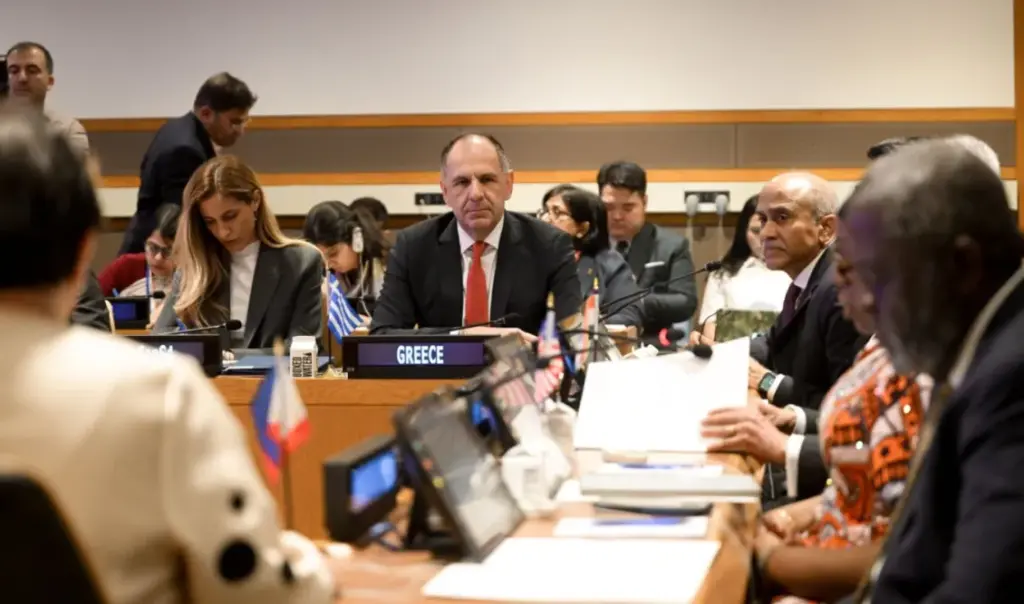
Greek Foreign Minister Georgios Gerapetritis highlighted the strengthening of Greece’s diplomatic footprint in a statement to ERT, summarizing his engagements on the fifth day of the 81st Session of the United Nations General Assembly.
Gerapetritis: Greece’s diplomatic footprint is growing stronger
Minister Gerapetritis highlighted the trilateral meetings between Greece-Cyprus-Jordan and Greece-Cyprus-Egypt, as well as his meetings with Foreign Ministers from Global South nations, underscoring the importance of interregional cooperation. He also referred to the Greek-Indian initiative on Artificial Intelligence in maritime affairs and Greece’s participation in the inaugural session of the Group of Friends for the Safety and Protection of Shipping and Seafarers.
He further noted that Greece will assume the Presidency of the UN Security Council for the second time in October, during a period when major international crises and the selection process for the new UN Secretary-General are expected to dominate the Council’s agenda.
Statement by Foreign Minister Georgios Gerapetritis
“With our thoughts remaining in Greece following the devastating events there, we had the opportunity today, at the United Nations General Assembly, to hold a series of meetings and events aimed at strengthening our country’s diplomatic footprint.
First and foremost, we held two important trilateral meetings — Greece-Cyprus-Jordan and Greece-Cyprus-Egypt.
These are exceptionally significant for the presence of both Greece and Cyprus in the broader region, and for strengthening our relations in an area that is being shaken by wars across the wider Middle East, by turmoil and by armed conflict.
In addition, we had the opportunity to meet with prominent Foreign Ministers from Global South countries — from Brazil, India, Eritrea, and regions such as Africa, Asia, and Latin America.
The Global South is growing rapidly. It is very important for Greece to remain in constant engagement with these nations. Interregional cooperation, especially today given the scale of global challenges, is becoming increasingly vital.
We also had the opportunity to participate in two very important events held on the sidelines of the General Assembly. The first, and particularly significant one, was a joint initiative by Greece and India concerning Artificial Intelligence — specifically, the application of AI in shipping, maritime security, and freedom of navigation.
It is critically important that the progress made in Artificial Intelligence keeps pace with social values and remains in the service of humanity. The challenges are immense. Greece has taken on a significant initiative that it will continue to advance, ensuring that Artificial Intelligence operates within boundaries — boundaries defined by human progress and well-being.
We also participated in the inaugural session of the Group of Friends for the Safety and Protection of Shipping and Seafarers. This is a very important initiative. Freedom of navigation is not only a central priority for Greece as a leading global maritime nation — it is a universal demand. Any crisis in shipping, any obstruction to freedom of navigation, poses an enormous threat to global supply chains and, ultimately, to the prosperity of peoples everywhere.
Greece assumes the Presidency of the United Nations Security Council in October for the second time during its two-year term. This is an exceptionally significant period. The great issues that plague humanity will be placed on the table, including matters relating to armed conflicts.
Furthermore, we will oversee the selection of the new United Nations Secretary-General — a defining choice for the future of the Organization, as well as for regional relationships and global challenges. Greece stands at the center of diplomatic interest. We are building Greece with a strong diplomatic footprint, with powerful alliances, and with a very ambitious, highly active, and deeply engaged foreign policy.”