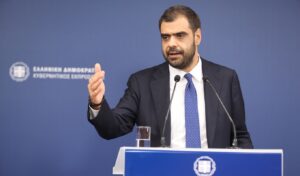
Athens is studying the possibility of extending its maritime boundaries to 12 nautical miles. Government spokesperson Pavlos Marinakis reiterated yesterday that this move “constitutes a unilateral right of Greece,” which, as he emphasized, will be exercised in the manner and at the time the government chooses. He also reminded that “for the first time, Greece has recorded this specific issue in an official diplomatic note to Turkey,” formally embedding a longstanding Greek position into a verbal diplomatic note.
Analysts believe that this warning Athens is sending to Ankara represents one of its strongest cards, should Turkey follow through on its announced plans to legislate the “Blue Homeland” doctrine in the coming period. It is worth recalling that under the relevant bill, Turkey seeks to declare an Exclusive Economic Zone (extending up to 200 nautical miles from Turkish shores, as Bloomberg reported) that would authorize the Turkish president to assert rights over fishing, mining and drilling, and to establish the maritime parks it has announced in the northeastern Aegean and in the Eastern Mediterranean around Kastellorizo.
The Greek prime minister’s visit to Kastellorizo, which signaled Greece’s firm resolve to reject any revisionist doctrine from its neighbor, provoked strong reactions in Turkey, reflected on the front pages of the pro-government press, which framed Mitsotakis’s visit as an escalatory move against Turkey. Furthermore, in the coming period — possibly within the next few weeks — the French company Meridian is expected to begin seabed survey procedures in the Eastern Mediterranean, east of Kasos, in order to restart the laying of the Great Sea Interconnector (GSI) cable. France’s involvement in the project is expected to temper Turkey’s reactions, as the research vessel conducting the seabed surveys will fly a French flag.
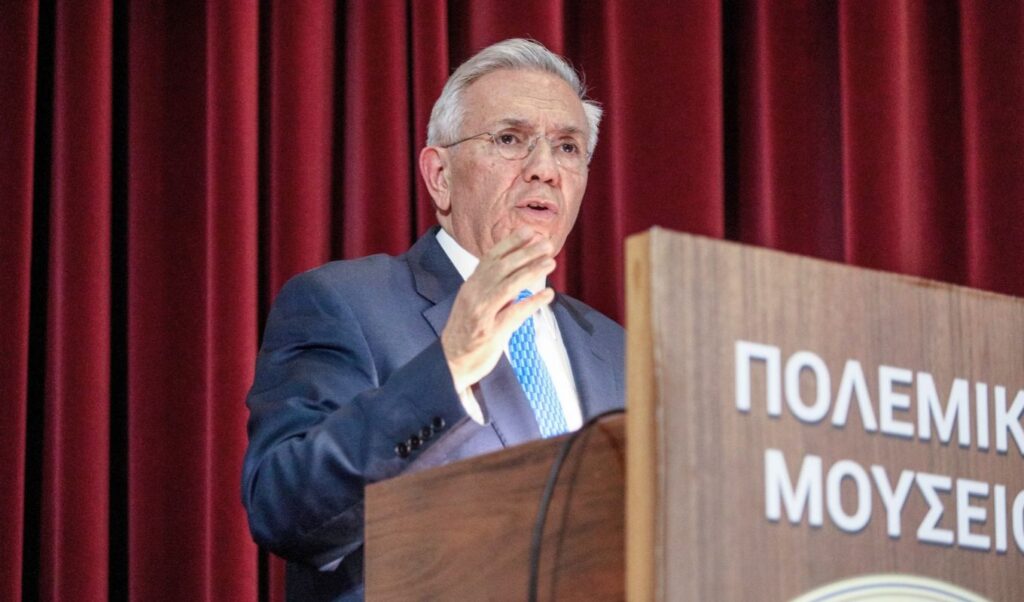
Yannis Valinakis to parapolitika.gr: “It is a strategic mistake to assume that what Turkey says is merely for domestic consumption and that it doesn’t mean it”
Former Deputy Foreign Minister Yannis Valinakis, speaking to parapolitika.gr, argues that it is a strategic mistake to assume that what Turkey says is merely for domestic consumption and that it doesn’t really mean it. As he explains, “in strategy, you always start from the worst-case scenario. The worst-case scenario is that your neighbor will carry out its threat to use military force — so you must be ready to enter the ‘madhouse’ yourself, as old George Papandreou used to say. I don’t think there has been a Greek government that wanted to go to war, while at the same time not preparing to go to war if Greek territory is struck. It’s a complex issue. It is wrong for many people to say, ‘let’s go tomorrow, extend to 12 miles and the problem is solved.’ I don’t believe there is any chance Greece will actually do it. It would positively surprise me if it did — and we’re only talking about southwest of Crete, of course. But it’s not easy, because even there Turkey has a kind of casus belli. It’s not as strong as in the Aegean, but it exists. And when the Turks have gone ‘wild,’ I believe they will react forcefully. Now, are you ready to go to war? I don’t think so, because war is for countries that want to change borders. We don’t want to change borders. We don’t want to go to war. So we must handle this issue diplomatically.”
Mr. Valinakis also questions Greece’s readiness to proceed with the laying of the GSI cable, calling it “ridiculous” to argue that because “they’ll put a French flag on the ship, Turkey won’t react. And then France will come with its aircraft carrier to strike the Turkish frigates that show up… These things don’t happen in the real world. Unless Macron told him, ‘go ahead and I’ll come clean things up’ — which there is absolutely no way he said.”
The former Deputy Foreign Minister also invokes the statement by former French Ambassador to Athens Laurence Auer, that the strategic relationship between Greece and France would only be activated in the event that Greek territory (an island) is struck by Turkey — relating, that is, to the country’s sovereignty — and not Greece’s sovereign rights in the Eastern Mediterranean (the cable). According to Mr. Valinakis, the first stages of the implementation of the “Achilles’ Shield” program, expected in 2027, will act as a “red flag” for Turkey. “So Israeli systems will arrive right under the Turks’ noses, a hundred miles (or two miles, as is the case with Kastellorizo) from the Turkish coast, and the Turks will just stand by passively and watch? There is no chance,” he says emphatically.
Meanwhile, the militarization of the Greek islands is firmly in the crosshairs of Turkish media, with images of Prime Minister Kyriakos Mitsotakis inspecting frontier outposts dominating television discussions. Particular attention is being paid to the Greek-Israeli defense agreement “Achilles’ Shield,” with the outlet Sözcü emphasizing that “Athens has armed 23 islands with Israeli weapons,” while other newspapers feature maps highlighting islands with a significant military presence, including Lemnos, Lesbos, Chios, Samos, Ikaria, Kalymnos, Kos, Rhodes, and Kastellorizo.
Turkish analysts and journalists are attributing war scenarios to the Greece-Israel alliance, envisioning a potential Greek-Turkish conflict. Even the editor of the high-circulation Milliyet, Özay Şendir, argues in an article that “it is Israel that wants to provoke a Greek-Turkish war,” while maintaining that “Turkey has no intention of using force against Greece.”