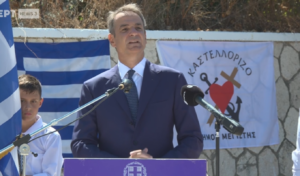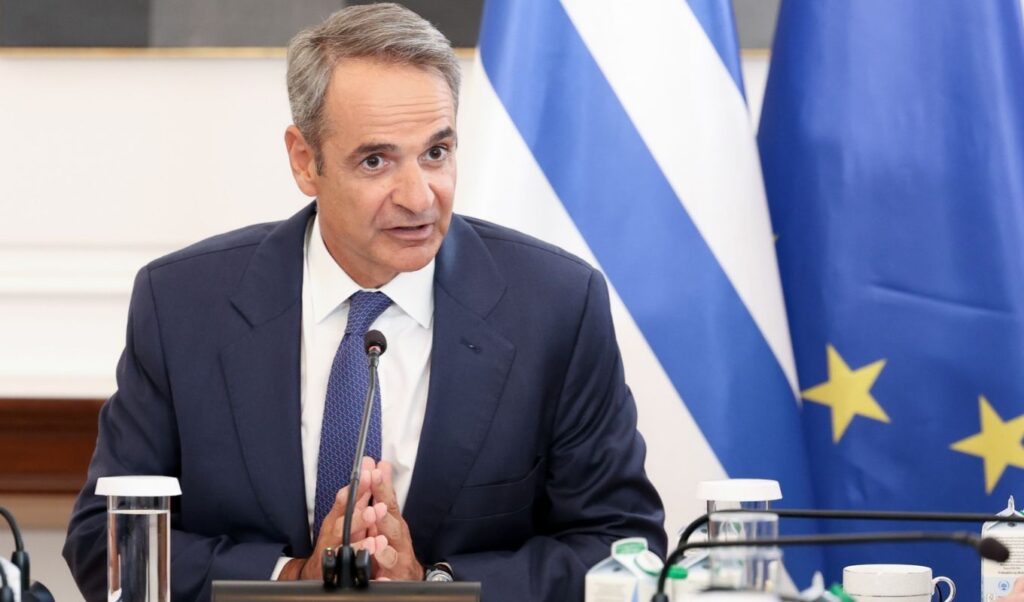
Speaking from Kastellorizo, where he traveled today to mark the anniversary of the island’s liberation, Kyriakos Mitsotakis delivered his regular Sunday review on Facebook. The Prime Minister drew a symbolic connection between his presence at the easternmost point of Greece and a new series of government initiatives to support border island communities, while also highlighting policies being advanced across multiple fronts. Mitsotakis sent a clear message on foreign policy and strengthening the country’s deterrent power, stressing that pursuing stability in the region “in no way means retreat, nor tolerance of faits accomplis.” He also announced that the core command-and-control software for the “Achilles’ Shield” defense system will be Greek-made, and previewed a major announcement in support of Kastellorizo’s residents.
He also made special reference to the measures announced at the Thessaloniki International Fair (TIF), totaling €2.2 billion. At the center of the package are tax cuts, support for families, pensioners and civil servants, as well as a new children’s savings account. Mitsotakis also addressed opposition criticism over the scope of the government’s interventions, presenting the government’s position on the measures and their fiscal sustainability.
The Sunday review also covered changes in education coinciding with the start of the new school year, as well as interventions in the healthcare sector. Notable highlights include initiatives to reduce energy costs and major infrastructure projects currently underway in Athens and Thessaloniki. The Prime Minister also touched on the latest developments in defense and foreign policy, and gave special mention to the first Greek participation in a crewed space mission.
Kyriakos Mitsotakis’ full post:
“Good morning from the frontier island of beautiful Kastellorizo. I always feel moved and proud to set foot on the first piece of Greek soil to be liberated on this day in 1943, during World War II, when our destroyer ‘Admiral Kountouriotis’ sailed into the island’s harbor. I also visited Ro, as a small tribute to its ‘Lady,’ Despina Achladiotou, who for 40 years raised the blue-and-white flag every single morning — a small act of immense national significance. From here, the easternmost point of Greece and the European Union, we will today present a comprehensive plan to make the island more resilient, more functional and more vibrant year-round, as well as a major announcement offering concrete support for its residents. Because supporting our frontier islands cannot be limited to symbolism or empty promises. It requires specific projects and permanent incentives.
Repetition is the mother of all learning, as children returning to school these days know well. On the occasion of the new school year, let me recap some of the significant changes we are already implementing in education. Nearly 240 school units have been renovated under the second phase of the ‘Marietta Giannakou’ program, bringing the program’s total impact to approximately 670 schools in just two years. Additionally, 5,259 new permanent appointments have been made for teachers and members of Special Educational and Special Support Staff, while in the first phase, 29,948 substitute teachers and EEP–EVP members were hired. For the first time, the International Baccalaureate program is operating in 10 certified public high schools, while a new Ethics course is being introduced for students exempt from Religious Studies. Furthermore, a free electronic State Language Proficiency Certificate will be piloted for ninth-grade students at the end of 2026, with the goal of full rollout by 2027. I wish everyone a productive and rewarding school year.
Let me now turn to the TIF announcements. Last Sunday we skipped the review, but we did announce €2.2 billion in new measures being returned to society as a dividend from economic growth in 2026. A package that combines tax and contribution reductions, wage and pension increases, incentives for entrepreneurship and investment, new tools for the younger generation, and targeted interventions for families, regional communities and housing. These measures fall within our fiscal limits and the economy’s capacity, yet they touch nearly every professional and social group — which is why I find the opposition’s complaints that “we gave too little” rather petulant. I won’t bore you by going through all the measures again, but I would like to highlight a few that will take effect from this November and in 2027, to illustrate the full scope of the package.
For 90% of self-employed professionals, the bulk of imputed income will be abolished. Two new financing instruments totaling €5 billion will be created for small and medium-sized enterprises. Tax prepayment for businesses will be further reduced, and depreciation for new investments will be accelerated. Farmers earning up to €20,000 will pay no income tax at all — the same applies to families with three or more children. Employee social security contributions in the private sector will be cut by a further half percentage point. The permanent benefit for pensioners over 65, people with disabilities and the uninsured will rise to €400. From December next year, civil servants will receive a permanent €500 supplement. Disability benefits will be index-linked; daycare voucher reimbursements and birth allowances for large families will increase. The ENFIA property tax will be abolished for settlements of up to 2,000 residents. And this December, the “My Home 3” program launches, with an expanded pool of eligible beneficiaries.
I’d like to make special mention of the “piggy bank” for the younger generation — the dedicated investment account that can help families plan more optimistically for their children’s future. For every euro a parent deposits after their child’s birth, the state will match it with another euro, up to a cap of €1,200, which will be adjusted every five years. In other words, we are creating a savings pathway for the middle class and vulnerable groups — hence the €1,200 ceiling — that follows the child from the age of two until adulthood, providing a meaningful financial cushion at the start of their studies or working life. Of course, even this clearly positive, socially progressive measure was swiftly attacked by the opposition. Never mind. I’m confident that citizens will embrace it, precisely because they will see in practice that even small amounts saved gradually are immediately doubled. For the record, a similar measure was introduced in the UK by the Labour Party and then scrapped by the Conservatives. In Greece, it is being implemented by a center-right government.
At the TIF, we also announced an intervention plan aimed at reducing wholesale electricity prices by 30% gradually by 2029. We announced a 50% reduction in Public Service Obligation (PSO) charges on household bills from 2027. Immediate relief for household budgets and businesses comes from the reduction in PPC’s fixed-rate tariff for next year. PPC — a public utility that was, let’s not forget, on the brink of bankruptcy in 2019 — announced that its fixed tariff for next year will drop to €0.115/kWh with a standing charge of just €3.50. And this in an environment of rising global energy prices that, in another era, would have meant automatically higher bills for every Greek household. This would not have been possible without a financially strong public electricity company capable of absorbing part of the cost itself rather than passing it on to consumers.
Let me now turn to public health. I’ll start with an incident that occurred a few days ago in Thessaloniki, which illustrates just how important the installation of 84 defibrillators at Metro stations — in both Thessaloniki and Athens — and the training provided to staff truly is. A 53-year-old man, for those who didn’t hear, was saved thanks to an immediate response, on-the-spot CPR, and the assistance of EKAV paramedics and a doctor. I would once again like to commend Diamantis Masoutis for donating the defibrillators. May others follow his example.
On the more operational health front: on September 1st, public hospitals were connected to the electronic prescription system, enabling accurate tracking of each patient’s medication regimen without errors or duplicate entries. There is now also digital recording of drug consumption in hospitals, allowing the Ministry of Health to monitor pharmaceutical expenditure, identify deviations and plan procurement more effectively. Another very welcome development is the expansion of the “PROLAMVANO” (I Prevent) screening program, now including free dermoscopy for the early detection of skin cancer. It is available to all citizens, but especially to those most exposed and vulnerable — such as workers in the primary sector who, due to prolonged sun exposure, face an elevated risk and often don’t get screened in time.
Among other government actions over the past two weeks, I’d also highlight the launch of an electronic platform for legal objections that will clear the courts of thousands of long-pending cases. To give a sense of the scale: only one-third of the 36,500 pending objections are active, according to Ministry estimates. The problem is most acute at the Athens Court of First Instance, where hearings have been scheduled for 2039. Clearing these cases means less paperwork, fewer inactive objections on court dockets and, most importantly, faster resolution of genuine pending matters. A landmark reform for the justice system will be the electronic filing of legal documents and the launch of the digital case file in civil courts — expected within the coming week. But I’ll save that digital leap for the next review.
On foreign policy, the recent trilateral meeting in Cairo confirms that Greece is pursuing an active foreign policy, closely monitoring developments primarily in our own region. Our country does not threaten anyone. We pursue stability through functional relationships grounded in international law. Stability in no way means retreat, nor tolerance of faits accomplis. This policy is delivering results on the ground: EEZ agreements with Italy and Egypt, maritime spatial planning, the extension of territorial waters in the Ionian Sea, the acquisition of Rafale jets, the Belharra frigates and the two Italian FREMM-class frigates of the Bergamini class. One of the most ambitious defense programs in recent years is “Achilles’ Shield,” which is moving from plans to implementation following the signing of the relevant intergovernmental agreement with Israel. The Greek dome will elevate our country’s air defense to a whole new level — and for those with concerns, the core command-and-control software will be Greek, developed by Greek companies participating in the program. As agreed, they will receive both operational and technological support to develop Greek source code tailored to Greek operational requirements.
I now come to the creation of the AENAON Metropolitan Park at Faliro Bay, which is entering its final stretch with the signing of the construction contract. The AENAON Metropolitan Park will be exactly what its name implies: a continuous “lung” of progress and a catalyst for sustained development along Attica’s coastal front. It will be one of the most beautiful and most sustainable coastal parks in the Mediterranean — with more than 4,000 trees, walking paths, cycling lanes, sports courts, cultural spaces and playgrounds, all without disturbing the character of the local wetland habitat. This is a project that, like many others, unfortunately carries its own history of bureaucratic chaos and neglect — incomplete designs, delays and entrenched obstacles of every kind. The government, together with the Regional Authority, overcame countless hurdles to secure €370 million in EU funding, finally putting an end to a decades-long impasse. At the same time, this represents the settling of a long-overdue debt to residents of the neighboring municipalities, to the wider population of the Attica basin and to its visitors — who for far too long watched one of the most beautiful areas of Attica remain entirely dormant. The coastal front redevelopment rounds out the map of major projects being implemented across the basin, including the restoration of Tatoi, the new Athens Olympic Sports Complex (OAKA), the Rowing Center, the Schinias grove, and the highly significant dual redevelopment of Votanikos and Alexandras Avenue. And of course, the broader public and private initiatives developing this unique Athenian Riviera, stretching essentially from Piraeus all the way to Sounio.
Major projects are also underway in Thessaloniki. One is the new Center for Cellular and Gene Therapies at the “Georgios Papanikolaou” General Hospital — the most advanced Hematology Center in the entire country and across the Balkans, equipped with specialized laboratories, highly trained personnel and patient beds, ensuring our patients have access to the best possible treatments. The new Center is the answer to those asking where the Recovery Fund money went: into public infrastructure like this, which upgrades the National Health System — honoring the commitment we made to leave it in better shape than we found it.
Thessaloniki’s other pride and joy, the Alcazar, may not be an entirely new acquisition, but its restoration — again funded through the Recovery and Resilience Facility — has effectively returned to the city a “new” monument: fully restored and magnificent, inextricably linked to the city’s history and enduring memory. The Hamza Bey monument had been covered in scaffolding for more than three decades, as at least two generations of Thessaloniki residents and visitors will remember.
I’ll close this review with a piece of news from Paris that fills us all with pride — while reminding us that behind every such achievement lies a plan, hard work and investment in knowledge. For the first time ever, a Greek national — Adrianos Golemis — will participate in a crewed space mission: PAM-6, bound for the International Space Station. This is a significant milestone for our country, and a beautiful reminder of how far our people can go when given the opportunity to put their talent and scientific expertise to work. At the same time, Greece is not merely a spectator in the emerging new space ecosystem. With 18 satellites already in orbit, the HELLAS-SPACE 2.0 program, and above all our research infrastructure and its collaboration with the European Space Agency, we are gradually developing our own capabilities. The National Observatory of Athens is at the forefront of this effort: from Kryoneri, where an important Space Hub for Southeastern Europe is being created along with satellite and space debris monitoring infrastructure, to Helmos and the ‘Aristarchos’ telescope, which participated in the historic European effort to achieve optical laser communication with NASA’s Psyche spacecraft in deep space. These successes are not isolated events. They are pieces of a long-term strategy to make Greece a producer of knowledge and technology, not merely a consumer. A country that invests in its scientists, its research infrastructure and its young people can participate in major European and international missions and help shape the future. And that may be the most important achievement of all: that Greece now looks to space not only with wonder, but with confidence.
Thank you very much for taking the time to read this review. Until next Sunday!”