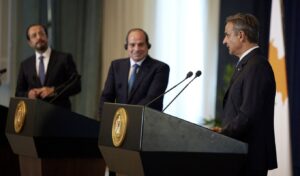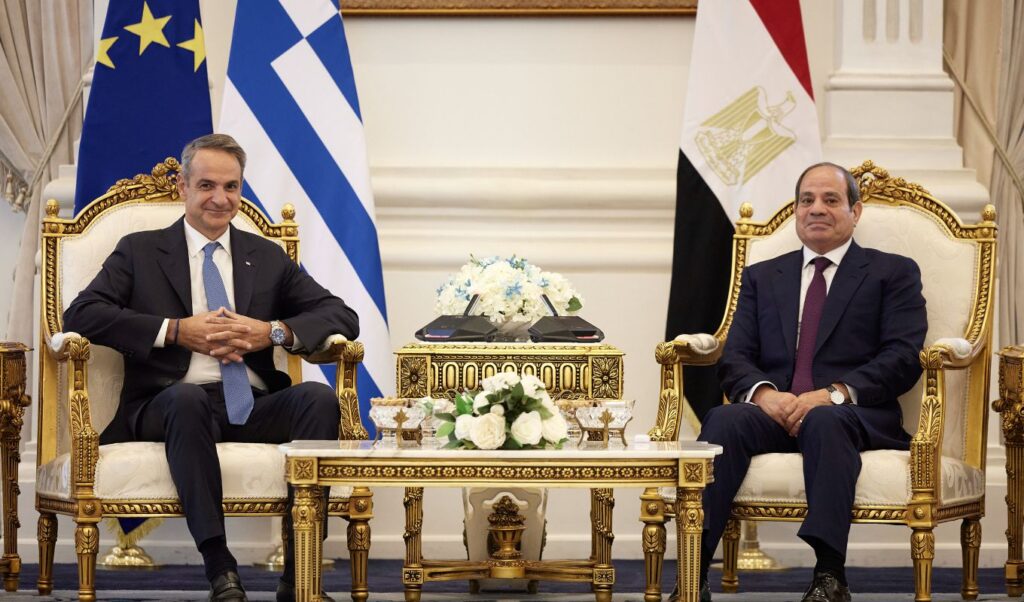
Energy is bringing Greece and Egypt closer together, potentially reshaping the dynamics of the Eastern Mediterranean while strengthening Greece’s regional role. This conclusion emerges not only from yesterday’s meeting between Kyriakos Mitsotakis and Abdel Fattah Al-Sisi in El Alamein, but also from the trilateral summit that included Nikos Christodoulides.
A year earlier, the Greek Prime Minister, welcoming the Egyptian President in Athens, emphasized that the EU-Egypt Strategic Partnership Agreement would create an opportunity to secure funding for “highly significant projects of common interest, such as the electricity interconnection project — the GREGY pipeline — which will enable Greece and Europe to import cheap energy, solar but primarily wind, which you are able to produce at very competitive costs and export to Europe,” as he stated, addressing Al-Sisi directly.
GREGY aims to transform Greece and Egypt into an energy bridge from Africa to Europe
The Egyptian President, in his own remarks, underscored the strategic importance of the Greece-Egypt electrical interconnection, with energy reaching Europe via Greece. GREGY is a project on which Mitsotakis and Al-Sisi had agreed in principle five years ago — an undersea cable running from Wadi El-Natroun in Egypt to Attica. The project aims to transform both countries into a bridge for transferring electricity from Africa to Europe, carrying significant energy and geopolitical value.
In the interim, intensive consultations and studies are underway to secure the necessary funding, which totals at least €4.2 billion. A total of 3,000 megawatts of “green” electricity will be transmitted through the submarine cable from Egypt to Greece, generated by 9.5 GW of renewable energy installations to be built on Egyptian soil.
The emphasis on energy security
Speaking from El Alamein yesterday, Kyriakos Mitsotakis stressed that strong support for the GREGY electrical interconnection had been reaffirmed. “As we have said many times, this is a project of strategic importance that will transfer cheap renewable electricity from Egypt to Europe, further enhancing energy security and making the Eastern Mediterranean an energy ‘bridge’ between North Africa and Europe,” the Prime Minister noted. He also introduced an additional dimension to the two countries’ energy cooperation: “Consider that gas produced in Cyprus could be transported to Egypt, use that friendly country’s infrastructure for liquefaction, and theoretically return to Europe through regasification facilities in Greece — at Revithoussa and Alexandroupolis — to ultimately meet, via the Vertical Corridor, the energy needs of countries in Southeast and Central Europe,” he said.
On the subject of energy, the Egyptian President made clear that cooperation sits at the forefront of the trilateral relationship. His country, he said, attaches particular importance to advancing electricity interconnection projects — especially the Egypt-Greece interconnection, which he described as a “true milestone” for strengthening regional energy integration.
It is worth noting that, as Mitsotakis revealed, the Greek Presidency of the UN Security Council — beginning next month, in October — plans to launch new initiatives to highlight the importance of freedom of navigation. As he stressed, “security at sea and the free movement of vessels are prerequisites for progress and development for all nations, and clearly a critically important priority for three maritime nations such as Greece, Cyprus and Egypt.”
Mitsotakis sends a message to Erdoğan from Egypt
Turkey, which closely monitors alliances and movements on the Eastern Mediterranean chessboard, watched as Kyriakos Mitsotakis also delivered a clear message to Tayyip Erdoğan through his statements: “Greece does not threaten anyone — it pursues stability through functional good-neighbourly relations, always on the basis of international law. Stability, however, does not mean concession or tolerance of faits accomplis. Greece is therefore not afraid to defend its positions with confidence, nor to engage in dialogue. These are two sides of the same responsible foreign policy,” the Prime Minister stated.
Later today, Mitsotakis will travel to Paris, where he will attend the International Space Summit. He will subsequently meet with French President Emmanuel Macron and attend the dinner hosted by Macron at the Élysée Palace in honour of the leaders participating in the summit.