On Monday, Alexis Tsipras invoked the story of promising young footballer Giannis Konstantelias — who suffered a serious injury shortly after transferring to Germany — as a metaphor for the missed opportunities facing Greece.
Missed opportunities and Tsipras’s message for the road ahead
Speaking about the opportunities Greece must create — particularly given the underutilization of the Recovery Fund — Tsipras remarked: “I won’t make any more football references, because we all saw what happened to the one who made a wish about Konstantelias the other day,” delivering a thinly veiled jab at the Prime Minister.
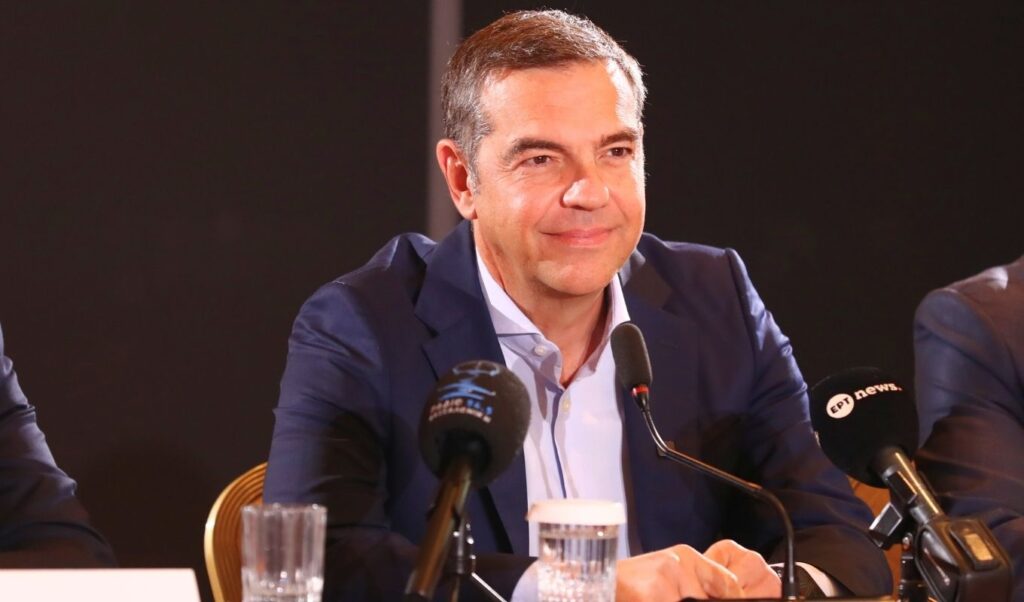
In truth, Tsipras used Monday’s appearance in Thessaloniki to set the tone ahead of Tuesday evening’s formal presentation of his party’s program. During his meeting with the city’s business and productive sector representatives, the former Prime Minister stressed that “as a country, we must stop missing opportunities — and the opportunities ahead of us are not unlimited,” adding that Greece must “stop waiting for others to hand us opportunities and instead create and seize them ourselves.”
Tsipras’s criticism of taxes and the burden on small and medium-sized businesses
The SYRIZA leader also addressed the challenges weighing on the market, stating: “It has been eight years since Greece exited the Memorandum crisis and the debt crisis, yet remnants of that era that should have been eliminated still remain today. We still carry the ‘tail risks’ from that period — burdens that affect you, and especially professionals and small and medium-sized business owners. Whether it’s the business activity levy, advance tax payments, the inconsistency in VAT rates, or the persistently high VAT across the board.” He continued: “But I believe one of the most pressing issues affecting the market — and small and medium-sized businesses in particular — is the accumulation of oligopolies in nearly every sector of the Greek economy. This squeezes SMEs, the self-employed, and small businesses. It is something that has intensified greatly in recent years, and — as you can appreciate — wherever oligopolies exist, it becomes extremely difficult for entrepreneurship to flourish, especially at the mid-market level. And one of the most significant cartels we must confront in the Greek economy is that of the banks. It is officially a cartel — they even have their own association, the Hellenic Bank Association. Nothing like it exists anywhere else. Most of you know that, beyond the exorbitant fees, for a business to secure a loan today, it must first prove that it doesn’t actually need one. And that is simply not the case in any other country in the European Union.”
Miltos Hatzigianakis: “Oligopolies are the most serious problem”
Also taking part in the meeting was Miltos Hatzigianakis, Secretary of the Political Committee of SYRIZA, who noted that “small and medium-sized business owners in Thessaloniki are still grappling with problems that should have been resolved years ago — such as the business activity levy, advance tax payments, high VAT rates, and presumptive taxation. Eight years on, these burdens remain. But the most serious problem is oligopolies. In nearly every sector of the economy, a handful of large companies are squeezing out the small ones. The most glaring example is the banks, which operate as a cartel, with their own association to represent them. Today, for a business to obtain a loan, it essentially has to prove it doesn’t need one — something that happens nowhere else in Europe. We cannot keep waiting for opportunities to come from outside, as happened with the Recovery Fund, which was not utilized to the extent it should have been. We have to build those opportunities ourselves.”