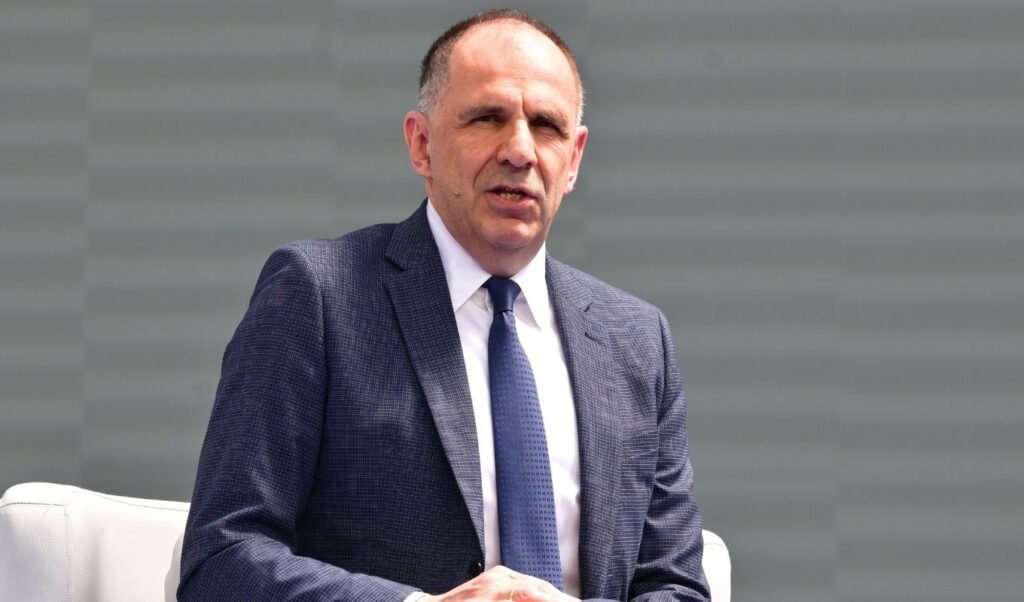
At the informal EU Foreign Affairs Council taking place today in Wicklow, Ireland, Foreign Minister Giorgos Gerapetritis is set to raise Turkey’s violations of international law through its declaration of two marine parks in the Northern Aegean and Kastellorizo.
Gerapetritis at the EU: Athens seeks allied support against Turkey
Greece’s top diplomat is expected to call on his European counterparts to stand behind Greece in the face of Turkey’s revisionist ambitions. At the same time, Athens has delivered a diplomatic note verbale to the Turkish government through its embassy in Ankara, signaling its firm intention to move forward with the GSI submarine cable project — a development that has become a major flashpoint in Greek-Turkish relations.
Athens and Nicosia united on GSI cable — Cypriot government sources speak out
After a period of uncertainty over whether to proceed with the project, Athens and Nicosia now appear to be moving in lockstep. Following Foreign Minister Giorgos Gerapetritis’ statement on Parapolitika 90.1 that construction work on the power interconnection could likely resume within 2026, Cypriot government sources have spoken exclusively to parapolitika.gr to dismiss any reports of hesitation — as have been circulating in the Cypriot press — and to reaffirm their full support for the project.
“We support both the construction phase and, further down the line, potential investment participation through equity. What we’re waiting for right now is the updated feasibility study from the European Investment Bank regarding the financial parameters, so we can determine how to move forward. But we have no reservations, no objections, nothing of the sort. Our position is exactly what was agreed upon with the Prime Minister,” Cypriot government sources stated.
Furthermore, according to well-placed sources, the decision to proceed with the cable-laying works was also discussed during a recent phone call between Greek Prime Minister Kyriakos Mitsotakis, French President Emmanuel Macron, and Cypriot President Nikos Christodoulides.
Turkey warns over GSI — What the Turkish press is reporting
On the Turkish side, there has been no new official public statement regarding the cable. However, the Turkish government has signaled through press leaks its intention to push back if Ankara’s approval is not sought before the project moves ahead.
Meanwhile, reports in the Turkish media reflect the significant alarm caused in Turkey by yesterday’s signing of the Greece-Israel defense agreement known as the “Shield of Achilles.” The bilateral deal has dominated coverage across virtually the entire Turkish press. Indicative is a report by the Daily Sabah, which states that the move “will likely infuriate Ankara” and reminds readers that “in June, President Recep Tayyip Erdoğan warned that Israel and its ‘collaborators’ are involved in stoking ‘fire’ in the Mediterranean, particularly around the island of Cyprus.” In another passage, the paper strikes a threatening tone, quoting Erdoğan as saying that “certain small circles whose ambitions exceed their size” have hitched themselves to the Israeli wagon and are acting as “contractors of Zionism.” He added: “They are chasing dreams in the Eastern Mediterranean. Let me be clear: do not engage in military adventurism, do not follow the tails of the Zionist network of assassins. Our response to efforts against the rights and sovereignty of Turkey and Turkish Cypriots in the Eastern Mediterranean will be clear and very strong.”
Eftychidis: “Greece is building a multi-layered defense that unsettles Turkey”
International relations analyst Thrasyvoulos Eftychidis, speaking to parapolitika.gr, offered the following assessment: “Just a few months ago, we saw Erdoğan openly displaying an overtly offensive weapon — the Tayfun ballistic missiles. They even showed maps illustrating that the missiles’ range was sufficient to strike Athens. And we didn’t react the way we should have. Right now, while we are installing a purely defensive system, the entire Turkish press is pushing the narrative that Greece and Israel are encircling Turkey — and they’re even claiming that this brings Israeli weapons to Turkey’s borders.”
According to Eftychidis, through the “Shield of Achilles” agreement, Greece has secured a highly capable system that builds a strategic development framework for the country and establishes a multi-layered defense posture that is deeply unsettling to Turkey. He emphasized that “it unsettles Turkey because it forces them to revise the operational plans and military calculations they had in place for the Aegean. Of course, what remains to be seen is how we will leverage this — and whether we will become not merely buyers of the technology, but genuine partners in the architecture of an air defense system that will protect the country from any threat, whether from short-range weapons via the Spyder system, medium-range threats via the Barak MX, or ballistic missile strikes via David’s Sling.”