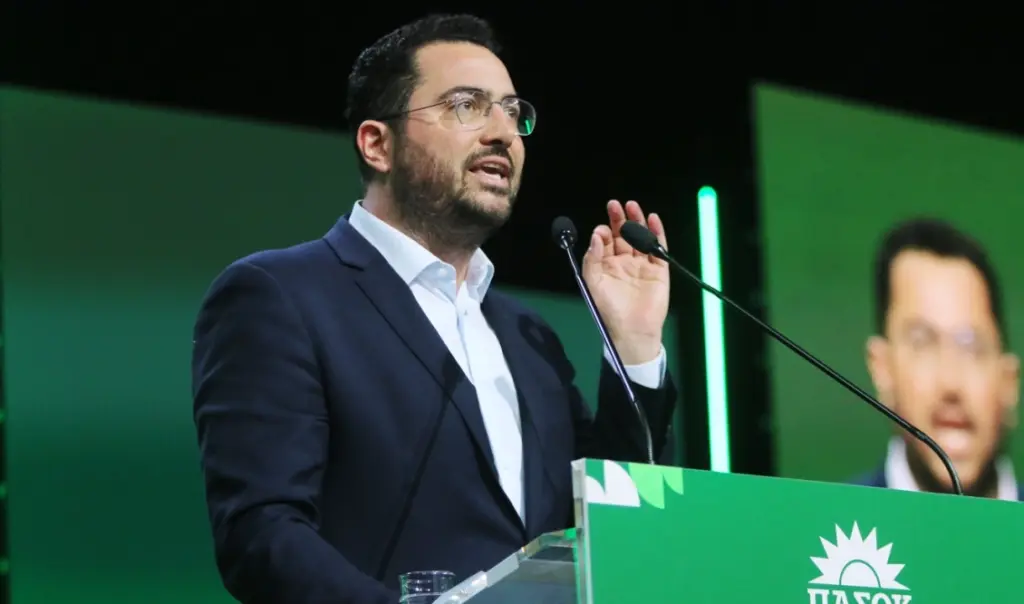
In an interview with Karfi, PASOK Political Council member and former party secretary Andreas Spyropoulos sends a clear message about winning first place in the next elections, stressing that while this is neither an easy nor a guaranteed goal, it is absolutely achievable — and politically essential.
When asked whether falling short of first place would constitute a failure, Spyropoulos makes it clear that PASOK is fighting with everything it has — both inside and outside parliament — to achieve that goal. On the question of a potential post-election coalition, he is equally clear: any such discussions must take place after the vote and on the basis of policy convergence.
On the issue of PASOK’s expansion strategy, he emphasizes that it does not mean dissolving the party’s political identity, abandoning political ethics, or accepting uncritical transfers. He stresses that it is a deeply political and ethical matter for politicians from other parties to join or return to PASOK — and that they must do so with genuine respect for the party’s history. As for the party’s policy priorities as the main opposition, he identifies tackling the cost-of-living crisis as the primary objective.
Andreas Spyropoulos: The full interview
As we head into an election year, what are PASOK’s policy goals and what is your top priority?
PASOK has already presented — and continues to develop — a comprehensive, fully costed programme that was built in collaboration with civil society, scientific bodies, professional associations, local government representatives, and ordinary citizens. Our goal is to keep communicating and refining it. Our key political priority, through the promotion of our programme, is to restore citizens’ trust in the state, in the economy, and ultimately in politics itself.
That means a strong welfare state, public health and education services that don’t leave people to fend for themselves, better wages and a productive economic model that creates quality jobs, support for families and solutions to the demographic crisis and the housing access problem, strong regional development, and a state that is functional, meritocratic, and genuinely digital.
But our number one priority is tackling inflation and the cost of living. A country cannot show macroeconomic growth while millions of citizens struggle every month to meet their most basic needs. Growth only means something when it translates into a better life for the majority of society.
PASOK’s expansion strategy has attracted varied commentary. Is there room in the party for people who in the past either left or actively opposed it?
PASOK is a party with a proud history — but it is not a prisoner of that history. Expansion does not mean dissolving our political identity, abandoning political ethics, or accepting people without scrutiny.
There is a place for every democratic citizen who agrees with PASOK’s core principles, policy positions, and political vision, and who wants to contribute to the effort for progressive and fairer governance. Naturally, there is a difference between political disagreement and personal or political contempt for the party. This applies particularly to figures with a leadership background in other parties. It is a profoundly political and ethical matter for politicians who have served in other party formations to join or return to PASOK — and they must do so with genuine respect for the party’s history, its positions, and its voters, who stood firm during the hard times, kept the movement alive, and are now growing it again in successive elections. In any case, the expansion PASOK deserves must be social, political, and programmatic before it becomes organisational.
New Democracy consistently leads in the polls, and Alexis Tsipras’s recent comeback places him in second. Given this landscape, is winning the election a realistic goal for PASOK?
Polls are useful tools for understanding trends at a given moment — but they are not election results. That has been proven in almost every recent electoral contest.
We certainly monitor and analyse them, but our role as the main opposition party and a genuine alternative government is not to simply follow the polling news cycle. We want — and we work every single day — to build a relationship of mutual trust with citizens, so that they give us the mandate to shape a fairer future with more opportunities, fewer inequalities, and functioning institutions.
Our goal must be crystal clear: to compete for first place and to be the political force that defines what comes next for this country. That is, of course, neither easy nor guaranteed. But it is absolutely achievable — and above all, politically necessary for Greece and its people.
If PASOK does not finish first, would that be a failure?
PASOK’s historic goal is to become once again the great political force of the progressive camp and to pursue governmental power. Political change is an absolute national and social necessity at this moment. We see in most of the surveys we mentioned earlier that this is also a social demand — and an overwhelming one at that. The only way to achieve this political change is for PASOK to finish first in the national elections and receive the mandate to form a government. We have seen in all recent electoral contests, as well as in the way political forces have aligned themselves and opposition has been conducted throughout this period of New Democracy governance, that PASOK alone represents the credible, programmatic governmental alternative — and the only coherent political force capable of delivering it. That is the goal we are fighting for with everything we have, inside and outside parliament, in every corner of Greece, and we will ultimately be judged by the mandate the Greek people choose to give us.
Which parties could PASOK communicate or cooperate with if no party wins an outright majority?
Any discussion about coalitions must take place after the Greek people have delivered their verdict, and on the basis of policy convergence. In no democratic country in Europe or the world — even those with a strong and long-standing tradition of coalition governments — is any co-governance plan laid out before the election. Forgive the expression, but that kind of talk is simply not serious politics.
The institutional and policy-based opposition we have exercised both inside and outside parliament, along with the recent decisions of our party congress, have already made clear where our red lines lie when it comes to dialogue and agreement with specific political groupings.
We are seeking our fellow citizens’ votes to bring about political change in the economy, the welfare state, our institutions, the functioning of government, and the country’s development trajectory. We want the mandate to form a government that will secure a dignified standard of living for Greek citizens, restore trust in the political system and in justice by investigating and assigning responsibility for the institutional deviations and scandals of recent years — scandals that have cost the country dearly, both financially and in terms of credibility, institutional integrity, and democracy.
We are reaching out to all citizens — regardless of how they have voted in the past — who want a better future for themselves and for our country.
Originally published in Karfi