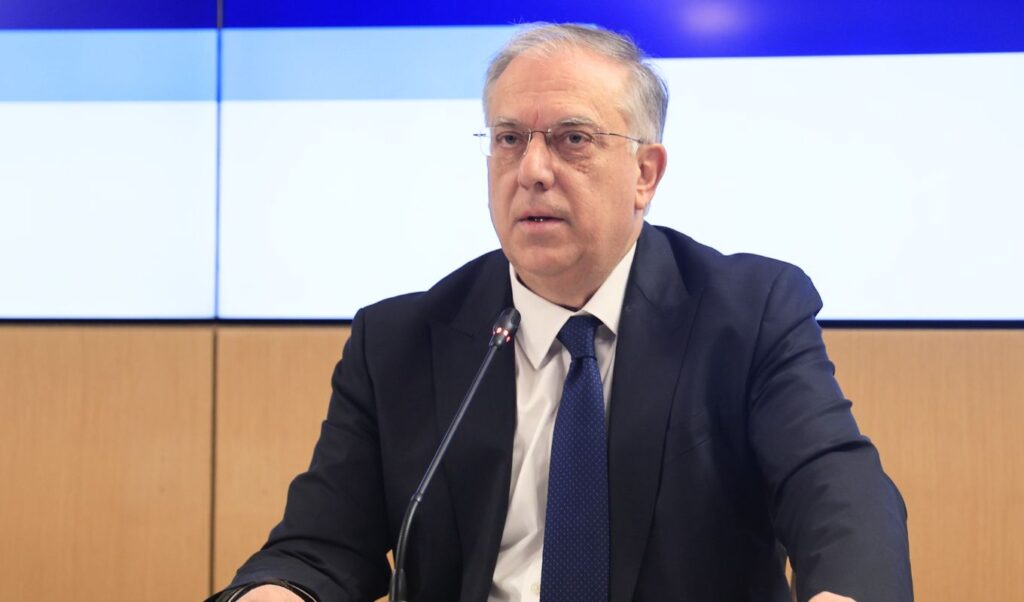
Greece’s Minister of Development, Takis Theodorikakos, spoke about major infrastructure and investment projects underway in Thessaloniki and the broader Macedonia region during an interview on ERT3’s evening news bulletin. Thessaloniki is “claiming the title of capital of the entire Balkans,” he stressed, adding that “the Ministry of Development is funding 282 investment projects in Macedonia, representing investments of approximately €1 billion.”
Takis Theodorikakos: “Thessaloniki has entered a new era”
“Thessaloniki has entered a new era. It is at the forefront of a new Greece — one that moves with purpose, vision and results towards 2030, with a more productive, more competitive and more resilient economy, with industry at its core,” said Development Minister Takis Theodorikakos, noting that Thessaloniki is “claiming the title of capital of all the Balkans.”
He made special reference to the Metro extension, the redevelopment of the Thessaloniki International Fair (TIF) grounds and the creation of a Metropolitan Park, the new Pediatric Hospital, and the Flyover project, pointing out that these are works that “completely transform the city’s image, capabilities and prospects.”
He also noted that “the Ministry of Development is funding 282 investment projects in Macedonia — investments of approximately €1 billion — which are creating more than 5,000 jobs, most of them in industry.” These plans, he said, “are all in progress and are taking shape,” adding that “we want an even stronger industrial base and a more productive and competitive economy.”
“We are here to build a strong Greece”
Mr. Theodorikakos made special reference to the dedicated development framework established for the country’s border regions: “Our goal is for young Greeks born in border prefectures and in the Greek regions to stay in those areas. This is a matter of national security and patriotism, but also an opportunity for better living conditions,” he noted, adding: “For me, the most important issues are demographics and development across all regions of the country.”
On the subject of the cost of living, he pointed out that “the problem has two sides: either wages go up or prices come down. A more productive economy can deliver better wages. At the same time, we are intervening in the market to create conditions for a fairer marketplace, with lower prices wherever that is achievable.”
Regarding the National Price Reduction Initiative, set to launch on 31 August, he noted that approximately 1,500 product codes have already been enrolled, adding: “From Monday, supermarkets will carry a significant number of products — targeting essential food and household items — with prices reduced by at least 5%. This is a national initiative that will last four months and can be particularly helpful for those who are struggling the most.”
According to Eurostat data, he said, “food prices fell by 2.3% from June to July, while year-on-year food inflation stands at -0.4%,” making clear that “we are not declaring victory and we are not resting on our laurels.”
In response to a question about support for diesel prices at the pump, he said he had discussed with Prime Minister Kyriakos Mitsotakis the possibility of extending the measure beyond its expiry date of 31 August, and that he expects an extension to be announced, the duration of which will depend on international developments.
As for the next general election, Mr. Theodorikakos said it is “absolutely achievable to win a parliamentary majority again, and that is our goal,” noting that New Democracy will go into the election on the strength of its governing record and a clear plan for Greece in 2030.
Finally, on the subject of Turkish provocations, he made clear that “there is no chance this government will allow even the slightest sovereign right of our country to be called into question. We are here to build a strong Greece, a productive Greece, a safe Greece.”