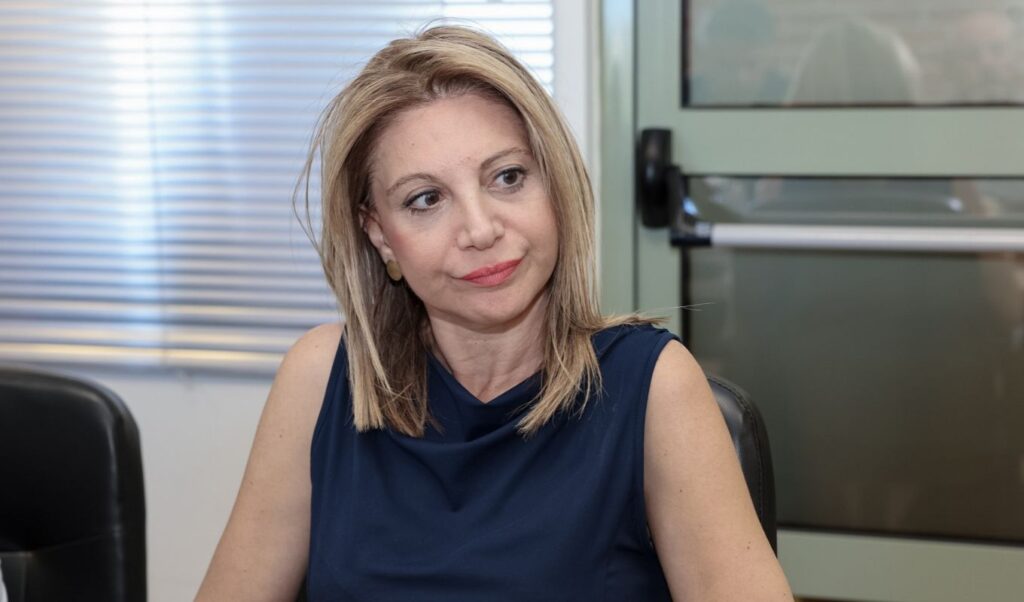
Maria Ioannidou has levelled serious accusations against Maria Karystianou and the leadership of “Elpida for Democracy”. The psychologist, who has already resigned from the party’s political council, accused Karystianou of effectively forcing her out, while also calling attention to the complaints that preceded the resignations — complaints about “decision-making, dissent, internal democracy, and the relationship between the leadership and the rest of the party’s members.”
Read also: Karystianou: “We’re removing the deadweight and Elpida will soar — they kept us grounded, but we’re meant for greater heights”
Ioannidou fires back at Karystianou over the “deadweight” comment
“When similar questions resurface in a different setting, but around the same person, I believe we have an obligation not to brush them aside,” she said, pointedly adding that “Elpida for Democracy” does not belong to “anyone — not even Karystianou.” “Because when a different point of view is not genuinely heard, when dissent cannot influence decisions, and when participation begins to mean nothing more than compliance, then one’s presence in a collective body risks becoming purely decorative,” she added in her post, in which she also commented on the departure of Thanasis Avgerinos, noting that “Maria Karystianou had publicly claimed she was blindsided (!!!) by his resignation.”
Maria Ioannidou’s full post
“EVERY VOICE COUNTS” — or only the ones that agree? From “generals” and “deadweight” to the “seizure” of leadership.
When Elpida for Democracy was founded, many of us believed we were joining something different. A truly collective citizens’ movement. Without “bosses” or “owners,” as the founding declaration explicitly states. A space where “every voice counts equally.”
But democracy is not tested when everyone agrees — it is tested when the first serious disagreement arises.
And that is where the serious concerns begin. When members started resigning, the initial narrative presented was that these were people who CHOSE to leave. In the case of Thanasis Avgerinos, Maria Karystianou even publicly claimed she had been blindsided (!!!) by his departure.
Just days later, however, the story changed: we were now told that “we removed the deadweight.”
We also heard that people who knew her personally may have wanted to become… “generals.”
And here I cannot help but ask a very simple question: if some of us truly wanted to become “generals,” why did we leave?
Why would we abandon a project in which we had already invested time, labour, and personal sacrifice — one in which, by staying, we could potentially have pursued roles, positions, and political influence?
If the goal was the seats at the table, the logical move would have been to stay. Not to leave.
As for my own case, I can speak plainly, as I have already stated publicly: I did not resign because I stopped believing in the need for deep political change. Nor did I stop believing in the original hope that gave birth to this movement.
I resigned because I experienced the conditions that had been created as COERCION INTO RESIGNATION.
Because when a different point of view is not genuinely heard, when dissent cannot influence decisions, and when participation begins to mean nothing more than compliance, then one’s presence in a collective body risks becoming purely decorative.
And then something even more troubling emerged.
The Political Council, in a so-called “unanimous” announcement — how unanimous could it really have been, when a member of the Political Council resigned the very day after the meeting and before the official statement was even published? — publicly spoke of “internal infiltration,” “usurpation,” and even the “seizure of the leadership.”
The word “seizure” carries particular weight. Because someone can only “seize” something if we first assume that it belongs to someone in the first place.
And so a fundamental question arises: who does the leadership of an Independent Citizens’ Movement belong to? To one individual? To a closed inner circle? Or to its members and their democratic processes?
The question becomes even more pressing when the official name of the political party itself includes the name of Maria Karystianou, and when fears keep resurfacing publicly that certain people are attempting to “take” the movement or its leadership.
I am not claiming this proves that anyone considers the movement their personal property.
But I do ask: why does the impression arise so strongly that there is something that can be “taken from her”?
And, unfortunately, this is not the first time such concerns have surfaced.
Before Elpida, there was the Association of Relatives of the Tempi Victims.
In January 2026, five of the seven members of the Board of Directors called for Maria Karystianou’s resignation, alleging among other things that she was taking initiatives and making public statements on behalf of the Association without prior notice, discussion, or the consent of the other members.
They had even stated that the Association should not be turned into a “vehicle for personal ambitions.”
Today, within a different collective structure, complaints are once again emerging around decision-making, dissent, internal democracy, and the relationship between the leadership and the rest of the party’s members.
This does not constitute proof of anyone’s guilt. But when similar questions resurface in a different setting, around the same person, I believe we have an obligation not to brush them aside.
Especially when we are talking about a movement built upon an enormous reservoir of social hope. Because thousands of people did not simply believe in Maria Karystianou. They believed that through her, something deeper in this country could change. And that trust alone creates an enormous responsibility.
The greatest trap for a society that wants to change the political system is to repeat the very same mistakes of the system it denounces: to replace institutions with a single individual, collective decision-making with devotion to a leader, constructive criticism with suspicion, and dissent with “sabotage.”
A truly democratic movement does not fear those who disagree.
It does not turn former fellow travellers into “deadweight.”
It does not treat every challenge to the leadership as a “seizure.”
And it does not need “soldiers” and “generals.” It needs equal citizens.
Perhaps, then, the most important question for Elpida is not who attempted to “take” the movement.
It is a far more fundamental question:
When did we decide that the movement belongs to someone — so that someone else could take it away?
Because Elpida — if it truly wants to be hope for democracy — cannot be anyone’s property.
Not mine.
Not those who left.
Not those who stayed.
And not Maria Karystianou’s own.