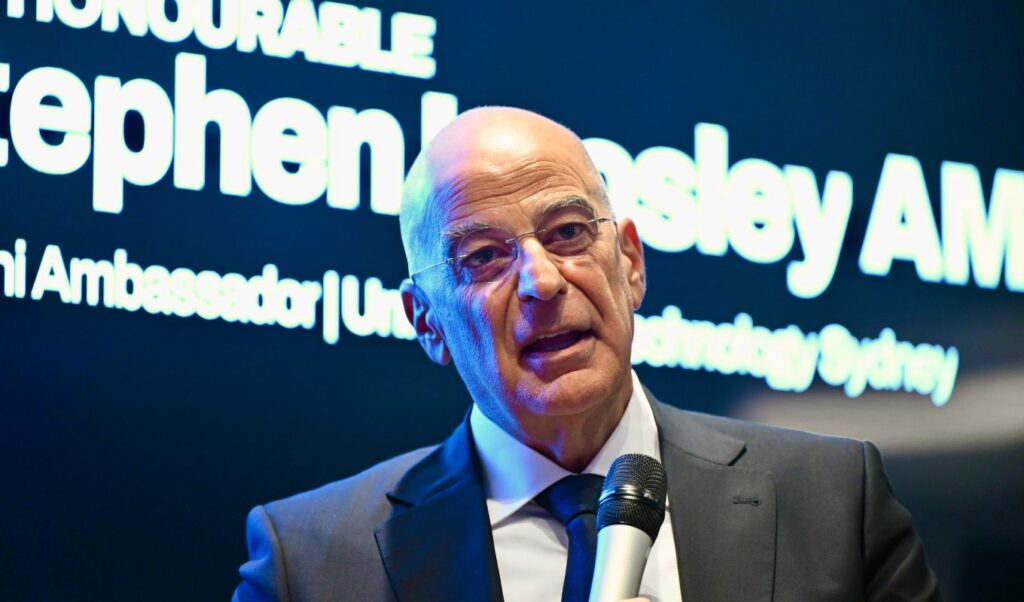
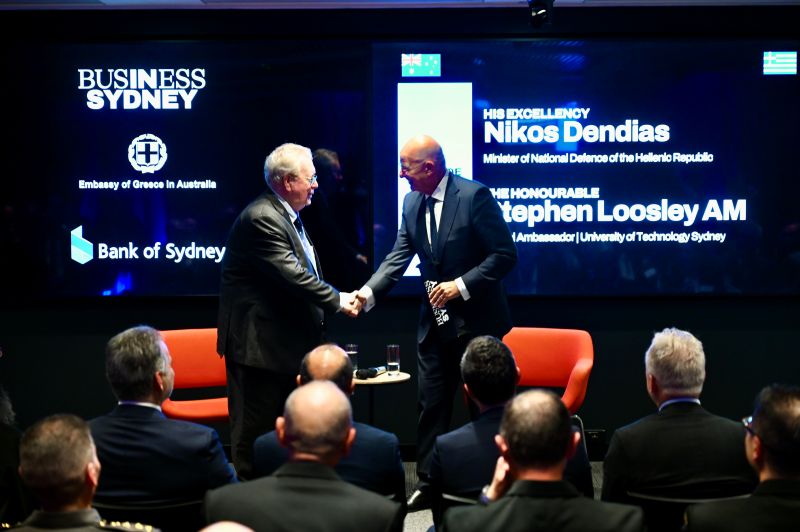
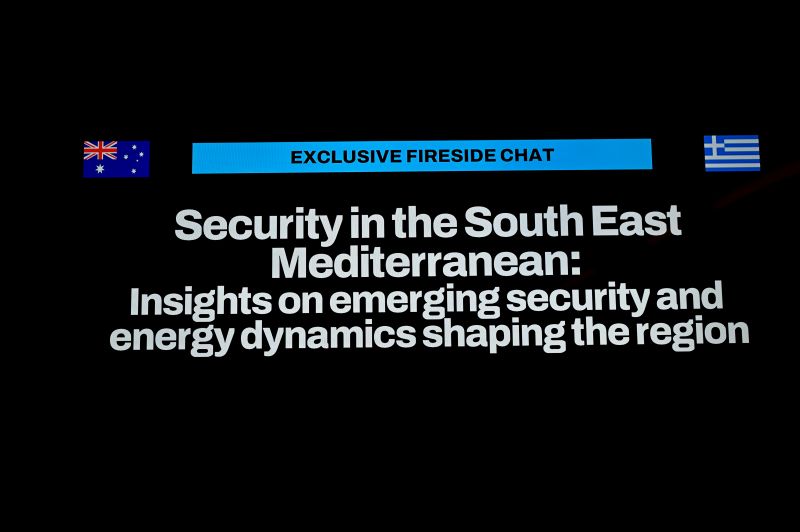
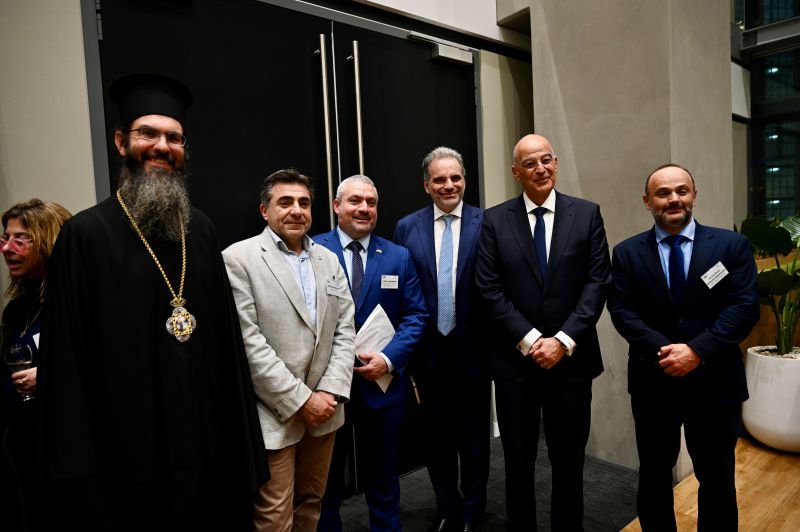
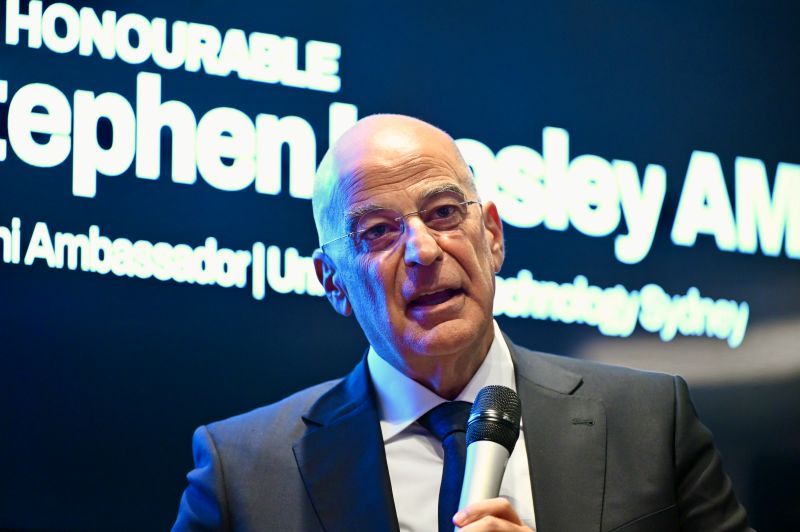
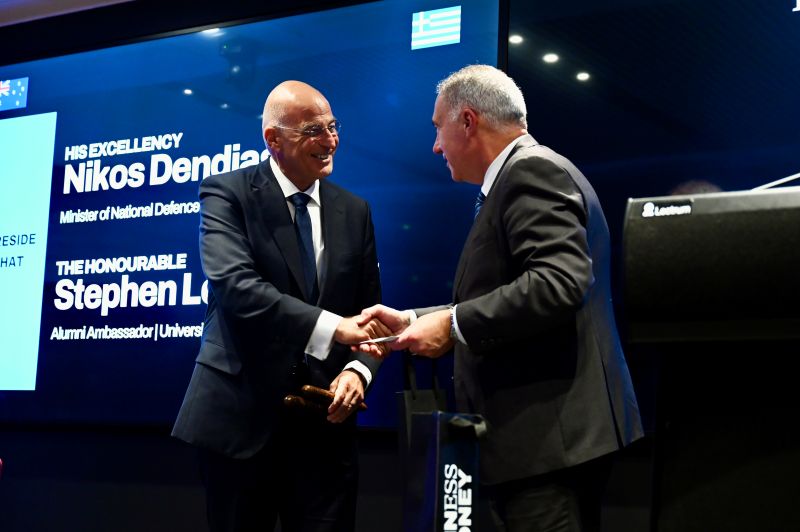
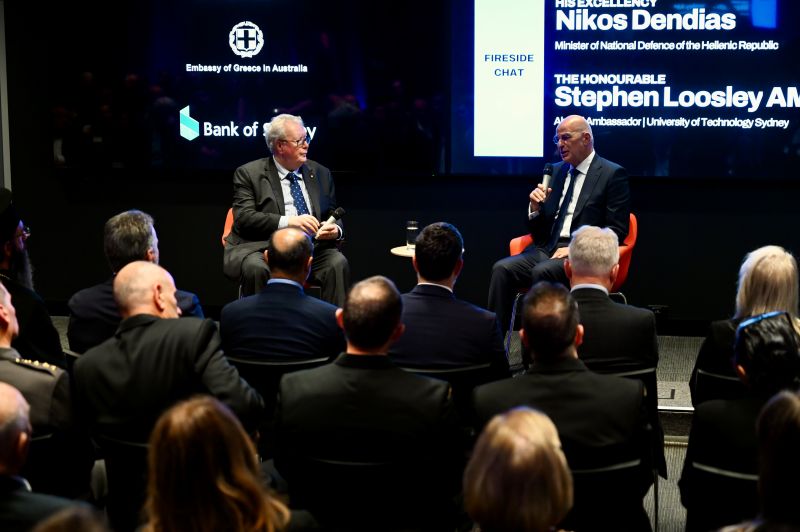
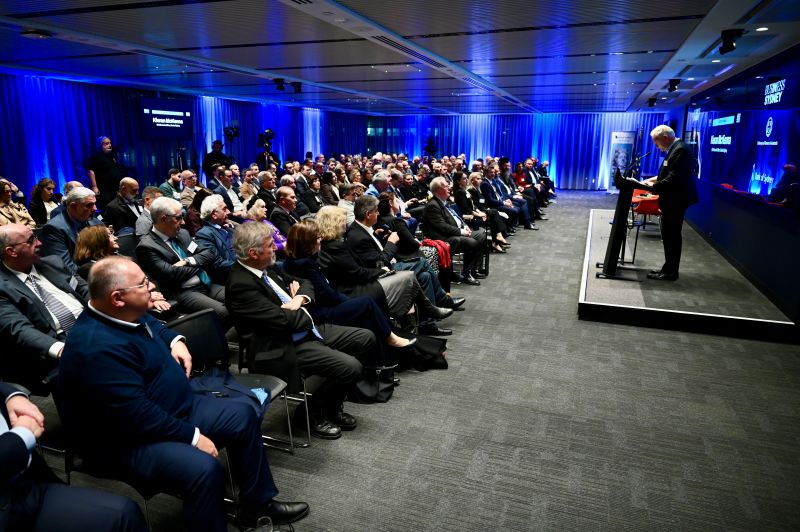
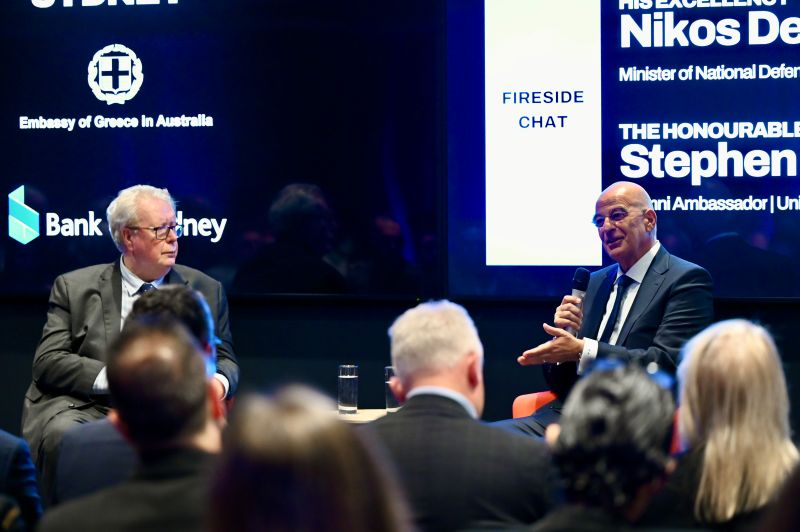
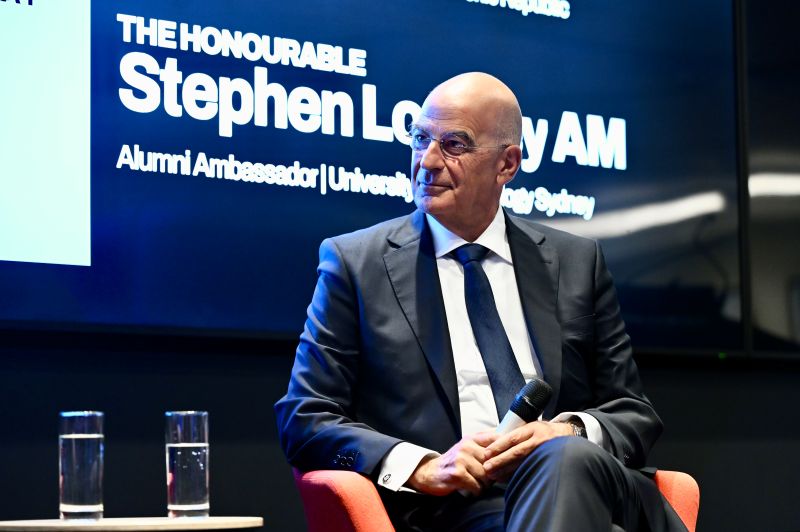
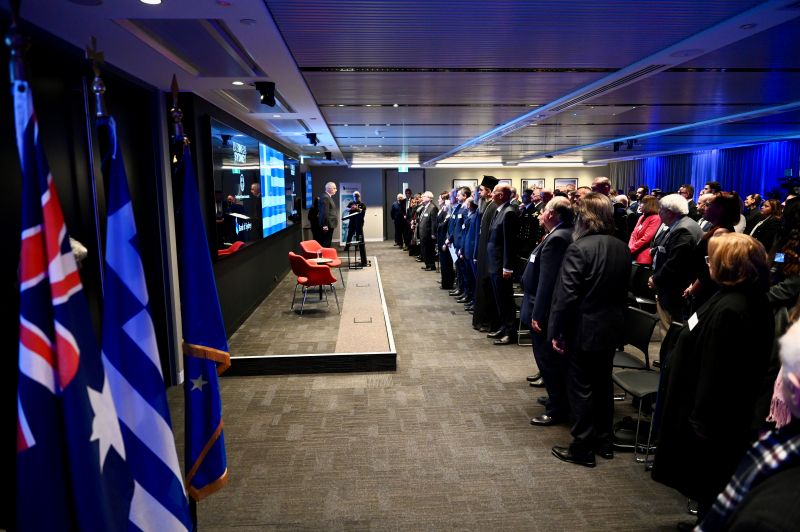
Speaking on security in the southeastern Mediterranean — the topic of a dedicated discussion panel — Nikos Dendias addressed an audience at Business Sydney in Sydney, Australia. The Greek Minister of National Defence described the Cyprus issue as a vital and defining barometer for relations between Greece and Turkey, while also allowing a note of cautious optimism to surface regarding the United Nations’ renewed efforts on the Cyprus problem. “Cyprus is the key issue for there to be good relations between Turkey and Greece,” he stated. He further noted that “whatever is agreed” between the two governments, the underlying disputes between the two states will not be meaningfully resolved.
Nikos Dendias: “Light at the end of… a very long tunnel”
Regarding UN Secretary-General António Guterres and his engagement with the Cyprus issue, Dendias said: “I am glad to see that the UN Secretary-General is making a new effort.” He expressed hope that the parties involved would be able to return to the convergence points that had been recorded at the Crans-Montana negotiations. He argued that a settlement would be beneficial for Cyprus as a whole — for both the Greek Cypriot and Turkish Cypriot communities — as well as for security and stability across the Eastern Mediterranean. “For the first time in many years, I have great hope that there appears to be some light at the end of the tunnel — even if it is a very long tunnel,” he remarked pointedly. The Defence Minister also sees untapped opportunities for Greek-Turkish cooperation that could be unlocked once the Cyprus issue is resolved — a problem that has hung over the Eastern Mediterranean like a sword of Damocles for 52 years, since 1974.
The “dual” nature of the Eastern Mediterranean
The Defence Minister described the Eastern Mediterranean as a region where geography simultaneously functions as both a source of danger and a great opportunity. “The challenge is a double-edged sword,” he said, emphasising that the region has the potential to become a hub of energy, trade, connectivity, and innovation linking Europe, Asia, and Africa.
Electrical interconnections, natural gas and oil pipelines, trade flows, and new investment can, according to Dendias, create an entirely different future for the region — under one essential condition: peace. “When there is peace, this part of the world can achieve extraordinary prosperity,” he noted. He acknowledged, however, that the region remains far from that prospect, as the major crises in the Middle East and the Gulf remain unresolved.
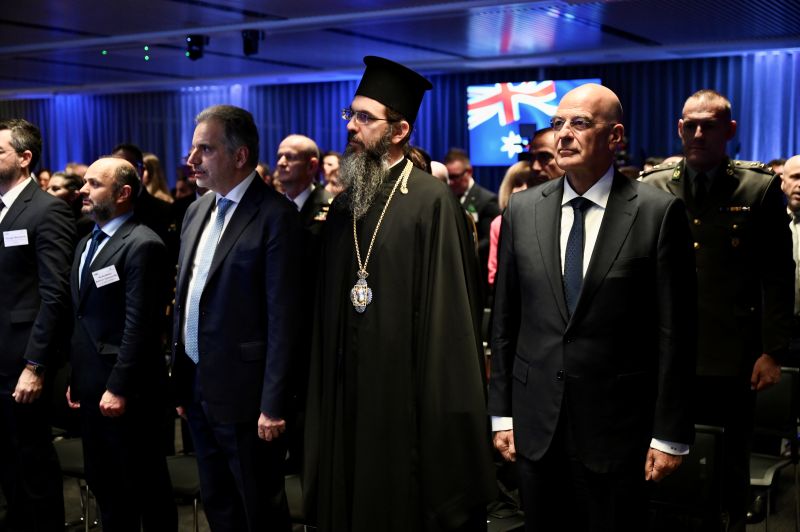
Defending the homeland: “a right and an obligation”
On the broader question of European security, Nikos Dendias argued that Europe had neglected its defence preparedness for decades and is now being called upon to make up for lost time. In his view, European societies must rebuild their military equipment, develop defence capabilities, and fundamentally shift the mindset with which the younger generation approaches its obligation to defend their country.
“Every young person — every young man and woman — must understand that they will need to defend their country,” he stressed. Defending one’s homeland, he said, is “a right but also an obligation” that Western societies had largely forgotten. Referring specifically to compulsory military service in Greece, he acknowledged that for years it had been treated more as a formality than as meaningful training. “The new generation served in the armed forces, but rather procedurally — not to genuinely acquire the skills required of a modern soldier,” he noted. “Now we must build those capabilities. All democracies must do so,” he added.
Ο πόλεμος στην Ευρώπη ήταν κάτι που δεν είχαμε καθόλου κατά νου. Αγνοήσαμε ότι πρέπει κάθε σοβαρή χώρα να προετοιμάσει την άμυνάς της. Να υπερασπιστεί τις αξίες τις οποίες πρεσβεύει.
Και τώρα πρέπει να κατασκευάσουμε εξοπλισμούς, να δημιουργήσουμε ευκαιρίες αλλά και να αλλάξουμε… pic.twitter.com/DP2BpExTIV
— Nikos Dendias (@NikosDendias) July 16, 2026
Russia and NATO
On NATO and its role in southeastern Europe, Nikos Dendias had nothing but words of firm support. He noted that the Alliance has guaranteed Greece’s freedom, democracy, and human rights. He recalled that Greece and Turkey joined NATO together in 1952, and suggested that without the Alliance, the Warsaw Pact could well have extended its influence over both countries. “Without NATO, European countries cannot confront a challenge such as the one posed by Russia alone,” he stated.
Russia, he noted, despite its economic constraints, managed to build a war economy — while Europe was sidelining its own defence preparations. The minister acknowledged that NATO’s eastward expansion may have generated a sense of insecurity in Moscow. He firmly rejected, however, the notion that Russia can dictate strategic choices to European nations. “I cannot accept that Russia can tell the governments of former Warsaw Pact members whether they should join NATO or the European Union,” he emphasised.
As for the Kremlin’s claims that NATO is preparing to invade Russia? “Does anyone seriously imagine NATO forces advancing into the Urals? That is never going to happen,” he said.
The US and China
Nikos Dendias did not conceal his concern over whether the United States will continue to play an active role in European security. He noted that the way the American administration expresses itself from time to time raises doubts — both in Europe and around the world — about the durability of the US commitment.
He said he remains personally convinced, however, that the active engagement of the United States in Europe also serves American interests. Referring to Donald Trump, he advised Europeans not to focus exclusively on his rhetoric, which he acknowledged can be “aggressive” or even “offensive.” “I would pay more attention to what Washington does than to what President Trump says,” he pointed out.
On China, the minister described it as a complex power with three distinct dimensions. “China is simultaneously a potential business partner, a competitor, and a security challenge,” he said, underlining that the West must navigate all three dimensions of the relationship at once. “We respect China, but we also demand its respect in return. We must be careful,” he added. In closing, Nikos Dendias stressed the importance of upholding international treaties and keeping lines of communication open, warning that any discussion of changing borders is “extremely dangerous.”