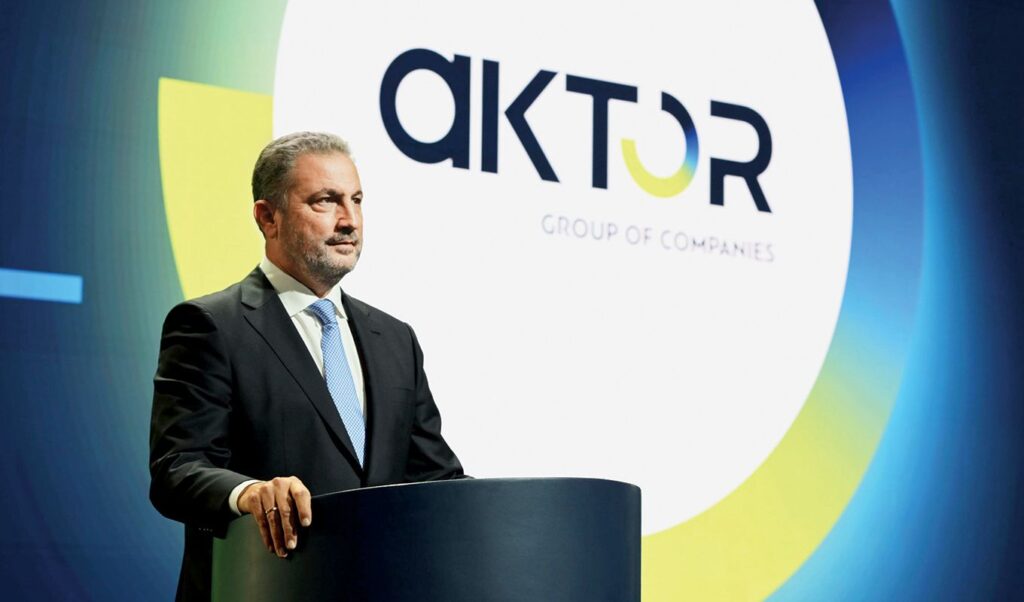
The “pressing of the button” on AKTOR’s share capital increase — following its approval by the General Assembly of shareholders on Thursday, July 16 — officially marks the beginning of a new chapter for the Group. Starting next week, when the fundraising of over €1 billion will be completed (through a combination of the share capital increase, which is set to exceed the original target of €650 million, and a €300 million bond issue), AKTOR will be “stepping on the gas” to implement its €3 billion investment plan across its four strategic pillars: LNG, renewable energy sources, construction, and concessions. This plan is set to drive significant growth in the Group’s key metrics over the coming years, without compromising its financial strength — a point repeatedly stressed by AKTOR’s Chairman and CEO, Alexandros Exarchou. A key advantage in this journey will be the strengthening and internationalization of the Group’s shareholder base, as the capital increase is expected to serve as a vehicle for the entry of major foreign funds alongside the three existing core shareholders.
Read also: AKTOR expands into tourism: Group signs €400 million deal with ONYX for 650-acre development in Sani, Halkidiki
Alexandros Exarchou (AKTOR): Updates on the dual deal with Motor Oil expected this autumn
At the same time, the completion of the share capital increase and bond issue — which rounds out the financing mix for the investment plan alongside project finance and equity — will pave the way for the Group’s significant business initiatives announced in recent months to take shape. The starting point will be the twin strategic deal with Motor Oil, which is designed to strengthen AKTOR’s profile in both the concessions and LNG pillars — the new areas of activity on which the Group is placing considerable bets.
In this context, as Mr. Exarchou noted, the agreement for the acquisition of a 75% stake in HELECTOR and Thalis — companies active in the recycling and water management sectors — is expected to be finalized by September. This will provide the Group with a new source of stable, long-term cash flows.
The roadmap for FSRU Dioriga Gas
According to the plan, the next step will be the signing of the preliminary agreement with the Vardinogiannis Group for the acquisition of a 50% stake in Dioriga Gas — Motor Oil’s subsidiary running the Floating Storage and Regasification Unit (FSRU) project in Agioi Theodoroi — expected to materialize within the coming months. This will create a powerful investment vehicle that, in short order, will finalize the project’s business plan and financing structure, with an estimated cost of €350–400 million. “The most important thing is that we’ll be doing it together,” Mr. Exarchou said pointedly, adding that the partnership with Motor Oil is underpinned by the expectation that the full commercial exploitation of the Vertical Corridor — through the planned activation of the branch toward Hungary and Slovakia, as well as its extension toward the Western Balkans (North Macedonia, Serbia) — will lead to new LNG supply agreements requiring new infrastructure. He clarified, however, that the FSRU’s progress with Motor Oil is not contingent on the long-term LNG supply contracts — both those already finalized and those being negotiated by year-end — for a total of 4.5 bcm/year secured by Atlantic SEE LNG, in which AKTOR holds a 60% stake and DEPA Commercial 40%. As he explained, these volumes do not require the construction of a new FSRU and can be served through the existing LNG terminals at Revythousa and Alexandroupolis, where DEPA has already reserved time slots. Nevertheless, the momentum building around the Vertical Corridor in recent months and the ongoing drive to reduce dependence on Russian gas are creating favorable conditions for agreements involving far larger volumes — and that is precisely the business case for the FSRU at Agioi Theodoroi.
AKTOR Renewables: Vertical integration and a path toward a stock market listing
Beyond LNG, the other major energy pillar of the AKTOR Group is AKTOR Renewables, which currently has solar photovoltaic projects at its core. By end-2026, it will have a portfolio of 500 MW in operation, with a target of reaching 1 GW by 2027. As Mr. Exarchou revealed, the Group is in negotiations to acquire two battery storage parks in Bulgaria — reflecting the growing strategic importance placed on energy storage — while among the new renewable energy projects to be developed from AKTOR’s existing license pipeline, the balance will shift in favor of wind energy, in order to diversify the green energy generation mix. The next step is an entry into the retail electricity market — the precise mechanism for which was not specified — and the transformation of AKTOR Renewables into a vertically integrated energy platform encompassing generation, storage, and retail electricity supply. The goal is to reach sufficient critical mass to list AKTOR Renewables as an independent company on the Athens Stock Exchange by 2030.
Construction remains the “heart” of the Group
AKTOR’s diversification strategy does not imply a retreat from the construction sector. On the contrary, the Group’s management is clear that construction will remain the company’s “heartbeat” — the foundation upon which all other activities will be built, including renewable energy, LNG, concessions, and the circular economy.
As CEO Alexandros Exarchou emphasized, the goal of the new business plan is not to shrink construction activity, but to further strengthen it, with an even larger order backlog and a strong presence in major infrastructure projects. The shift the Group is pursuing concerns the composition of its operating profits: today, approximately 68% of EBITDA comes from construction, but by the end of the business plan this figure is expected to drop to around 35% — not because construction activity will decline, but because the contribution from renewables, LNG, and, subsequently, concessions will grow significantly.
AKTOR’s CEO underscored that construction remains the mechanism through which the Group will deliver infrastructure and energy investment projects, stressing that the diversification strategy aims to generate more stable and predictable cash flows without altering the company’s fundamental identity as a builder. “We are not reducing our presence in construction. We are seeking to strengthen it, while simultaneously creating secure and predictable cash flows from other activities,” he stated.
Regarding concessions, management believes they will become a significant revenue source after 2030, given the long maturation period inherent to such projects. As an illustration, the Northern Road Axis of Crete (VOAK) has not been factored into the business plan as a concession revenue source before 2031, as it is expected to still be under construction until that point.
He also put an end to speculation about AKTOR entering the real estate market as an investor, making clear that the Group has no plans to invest in property. As he explained, even the recent agreement in Halkidiki with Onyx for the €400 million tourism development is exclusively tied to construction activity and does not involve property development or ownership.
Referring to the extension of the Thessaloniki Metro toward Kalamaria, Alexandros Exarchou stated that AKTOR will have fulfilled all of its contractual obligations by July 27–28, noting that from that point forward, the delivery date and inauguration ceremony fall exclusively within the responsibility of the State. He indicated that the company will have handed over the project within the agreed deadlines, while declining to comment on when the extension will enter commercial operation.
Regarding the tender for the major expansion of Athens International Airport, he made clear that there has been no change to the construction consortium through which the Group is participating in the competitive process. As he stressed, AKTOR continues to participate in the tender alongside Turkish firm IC Ictas, dismissing reports suggesting any changes to the joint venture’s composition.