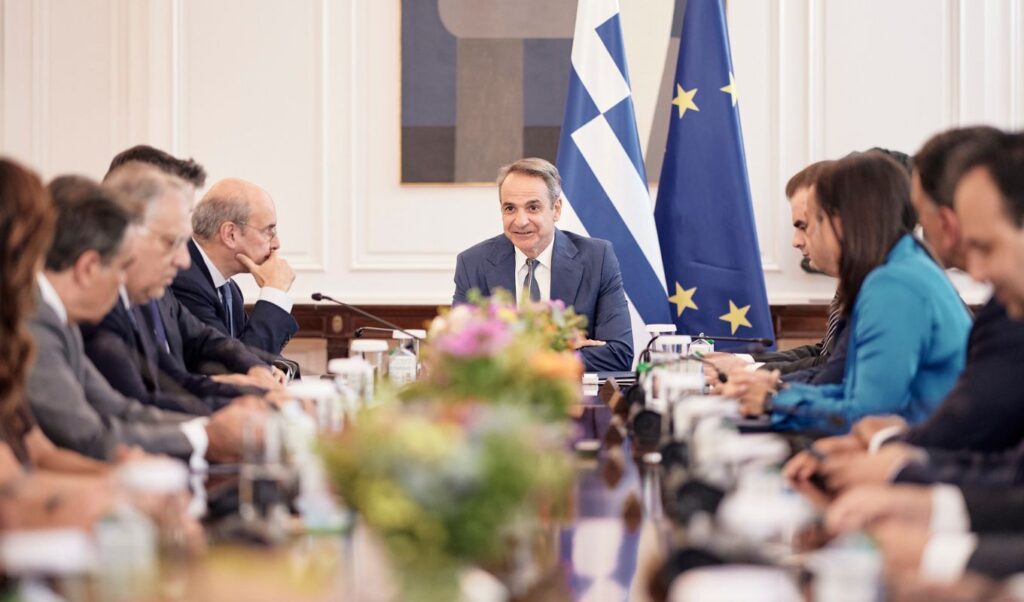
“The amount of €49.5 billion for our country” is included in the European Commission’s initial proposal, Prime Minister Kyriakos Mitsotakis stressed, among other things, during today’s session of the Government Council on Economic Policy (KYSOIP), held at Maximos Mansion. He also took the opportunity to address the earlier announcement by the European Public Prosecutor’s Office regarding the OPEKEPE case, as well as infrastructure networks.
Mitsotakis: €49.5 billion for Greece and bid for additional funds from new Competitiveness Fund
In his opening statement, the Prime Minister said in detail: “I want to remind you that the European Commission’s initial proposal includes the amount of €49.5 billion for our country. To this, however, must be added the potential resources of the new Competitiveness Fund — a fund currently valued at €450 billion — which will operate on a competitive basis.”
Addressing today’s announcement by the European Public Prosecutor’s Office on the OPEKEPE case, Kyriakos Mitsotakis stated: “The full truth and the real dimensions of the OPEKEPE case are now being brought to light in an emphatic way,” adding that “honest politicians were dragged through the mud for weeks.” He noted that 13 ministers and members of parliament from New Democracy had been targeted, with the cases against nine of them now closed, while four more officials will face further examination for minor misdemeanour offences.
He concluded: “Who today will apologize for those outrages? This concerns, above all, the opposition of this country, which refuses to respect the presumption of innocence as a matter of principle — or rather, respects it only when convenient. But unfortunately, it also concerns the European Public Prosecutor’s Office, which ultimately appeared, in its own way, to be entangled in domestic party-political rivalry.”
The Prime Minister’s full statement:
“Good morning, ladies and gentlemen, colleagues. Today we will examine two issues that are at the heart of our development policy. The first concerns the complex negotiations over the EU budget — the next Multiannual Financial Framework. The second concerns the overall progress of our country’s infrastructure networks through to 2030.
On the first issue, we are essentially discussing the resources that will flow into the Greek economy from Brussels in the years ahead. Regarding the ongoing negotiations, Greece’s positions are well known. Not only we, but many other European countries, are insisting on the preservation of Cohesion funds and the Common Agricultural Policy. At the same time, we advocate for greater flexibility so as to ensure the maximum possible support for farmers, regions, and competitiveness.
The responsible ministers will then present the new architecture of the EU budget so that everyone can understand exactly how it will function — and this, of course, assuming we remain aligned with the European Commission’s initial proposal. We are obviously engaged in discussions with many other European countries, and we are building our own alliances so as to incorporate national priorities into European objectives.
The Deputy Prime Minister is coordinating the entire process, which clearly has a broad, multi-ministerial character. The Deputy Foreign Minister, who is currently en route to Dublin to discuss the MFF negotiations with the Irish Presidency, is the minister with primary responsibility for these talks.
I want to remind you that the European Commission’s initial proposal includes the amount of €49.5 billion for our country. To this must be added the potential resources of the new Competitiveness Fund — currently valued at €450 billion — which will operate on a competitive basis. It is therefore up to Greece, and to Greek businesses, to put forward well-crafted proposals in order to secure significant additional resources from this fund. There are, of course, the other funds already in the pipeline, which we have discussed extensively in the Cabinet as well.
Our shared hope at the European Council is that these negotiations will be concluded by the end of the current year. This will be difficult, as there are currently significant gaps that need to be bridged, and there is not yet even agreement on the own resources needed to finalize the overall financial framework of the budget. We must therefore be aware that it is quite likely these negotiations will conclude during the Greek Presidency, in the second half of 2027. This makes the outcome of the spring 2027 elections even more critical, since Greek citizens will essentially be choosing which government will preside over the European Union at a juncture that will be exceptionally consequential — not only for national priorities, but for the future of Europe as a whole.
I now turn to the second issue we will be discussing. On the subject of networks, we are essentially talking about a web of critical road, rail, energy, and telecommunications infrastructure that is fundamentally transforming the face of our country. We have spoken many times about the significant progress we have made in the field of infrastructure. On the road network front, we will have the opportunity, dear Minister of Digital Governance, to join you in your region next week to officially open the E65 — the last major road axis of mainland Greece — which I believe will give a new developmental momentum to Western Macedonia and western Thessaly.
Work on the Northern Road Axis of Crete (VOAK) is progressing. Our fellow citizens in Crete can now see that VOAK is transforming from a dream into a project being delivered at a rapid pace. I want to stress that, in total, we have carried out interventions covering more than 130 kilometres of the existing road — significant road safety improvements that have completely changed the experience of travelling along the Northern Road Axis of Crete.
We will then discuss the major rail connections, the restoration works following Storm Daniel, and the significant electricity interconnections for the northern and southern Aegean, following the completion of the landmark dual interconnection with Crete. These are interventions that not only ensure energy adequacy and security for our islands, but also ultimately reduce electricity costs for everyone — because I want to remind you that through the Public Service Obligation (PSO) mechanism, all consumers effectively bear an additional cost for powering our islands.
And of course, many more projects are underway. The Flyover project in Thessaloniki is on schedule and will be completed in the first half of 2027. And there are many more important new plans concerning Attica, which we will be able to discuss in more specific terms in the months ahead.
Allow me to close with a statement concerning today’s development — the announcement by the European Public Prosecutor’s Office, which I believe brings to light in an emphatic way both the true dimensions and the full truth of the OPEKEPE case. I want to stress that at the outset of this affair, 13 ministers and members of parliament from New Democracy were targeted. Of those 13, nine are today proven to be completely innocent, while four more of our officials will face further examination by the justice system — but only for minor misdemeanour offences.
I would like to make special mention — given that we are meeting as a government council — of the three ministers whom I asked to step aside as a matter of propriety. They are honest politicians who were dragged through the mud for weeks, at a time when some were calling us, collectively, a “government of the accused.” And I ask myself: who today will apologize for those outrages? This concerns, above all, the opposition of this country, which refuses to respect the presumption of innocence as a matter of principle — or rather, respects it only when convenient. But unfortunately, it also concerns the European Public Prosecutor’s Office, which ultimately appeared, in its own way, to be entangled in domestic party-political rivalry.”
Hatzidakis: The news is broadly good, but nothing is guaranteed
For his part, Deputy Prime Minister Kostis Hatzidakis stated:
“I want to recall that for more than a year now, the government and the relevant ministries have been preparing and actively engaged in the negotiations for the European Union’s Multiannual Financial Framework 2028–2034. Greece is participating actively, with clear positions and by forging appropriate alliances in what are becoming difficult and complex negotiations — with the aim, of course, of serving the national interest and avoiding what many analysts have termed a ‘fiscal gap’ for the country after 2028, due to the expiry of the Recovery Fund.
The news, based on the European Commission’s proposal, is broadly good — but nothing is guaranteed. There are countries, primarily in the north, that traditionally seek to constrain the budget, particularly for Cohesion and Agriculture. This underscores the need for a credible and serious government to represent us effectively in Brussels. The fact that we will also hold the Greek Presidency at a critical juncture in the negotiations makes this need even more pressing.
I want to highlight a new element of the Multiannual Financial Framework that sets it apart from all previous ones: the European Competitiveness Fund. Based on current information, there are no national allocations — no guaranteed amounts per country. However, if one applies population-based criteria, Greece could potentially secure between €8 and €10 billion in additional funding — on top of the European Commission’s initial proposals — provided it submits credible proposals. Ladies and gentlemen, colleagues, that is half a Recovery Fund.
I take this opportunity to make clear — from this meeting as well — to our universities, research centres, and businesses: this is an enormous opportunity, and we would all be unforgivable if we failed to seize it. It requires mobilisation and credible, serious proposals, primarily in the field of research and technology.
I also want to say a few words on the second item on the agenda. We regularly discuss network planning with the relevant ministries — and we have revisited this topic in previous KYSOIP sessions. From last year to this year, very significant progress has been made, as the Prime Minister noted: the Thessaloniki Metro has been completed, the submarine electricity interconnection with Crete has been finalised, and we are now moving forward with the inauguration of the E65.
However, we also have a series of critical projects that must be delivered — both as part of the government’s ongoing work and within the planning framework for the coming four-year term, what we call the “Agenda 2030.” Beyond what the Prime Minister mentioned, I want to focus on the railway network — something that has historically been neglected. In the coming months, works on the main Athens–Thessaloniki backbone line will be completed, with electrification, double track, and remote management systems, and this will allow us to plan ahead to 2030 for other railway lines as well — particularly in northern Greece: Thessaloniki–Alexandroupoli–Ormenio.
We can, must, and will proceed with further electricity interconnections — particularly those with economic, environmental, and strategic national significance: the interconnections with the southern and northern Aegean. Next-generation fibre optic networks and all related telecommunications infrastructure will complement these efforts, alongside major urban regeneration projects.
In Ellinikon, from February we will have the first residents, the first tenants. This is no longer theory. Ellinikon has begun to become reality. In Elaionas, the government has also launched another major, cross-ministerial urban regeneration effort. And in Thessaloniki, the “Gonou” and “Pavlos Melas” military camps are moving forward. So we have a multi-layered programme of action, and we are delivering results every single day. This will continue to be our mission in the months ahead — and in the next four-year term.”