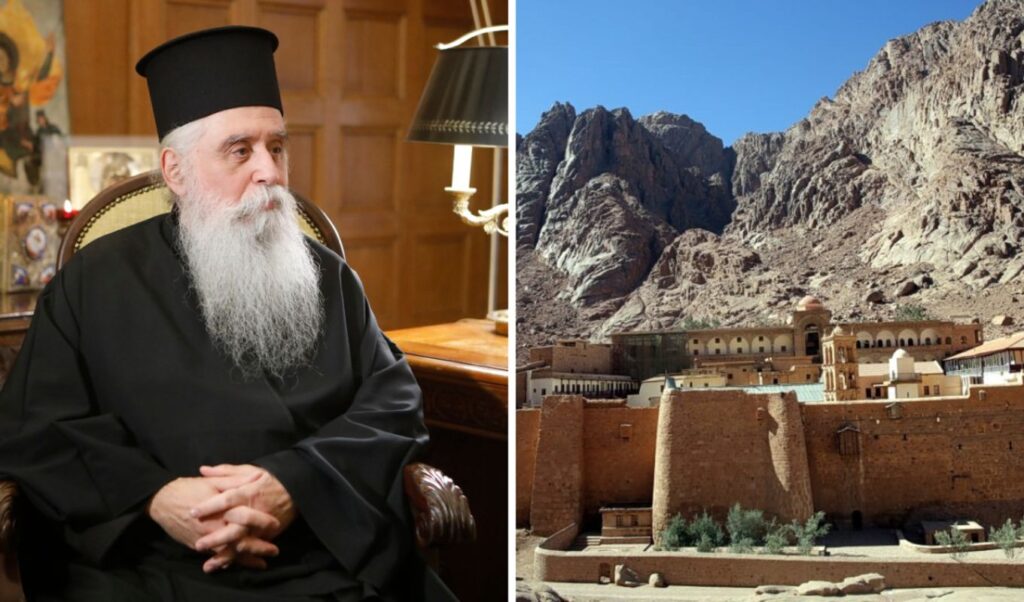
Archbishop Symeon of the Monastery of Sinai has expressed his conviction that positive news on the resolution of the Holy Monastery of Sinai dispute will emerge very soon, speaking exclusively to parapolitika.gr. “Yes, I have this hope that by the end of the summer there will be developments, because there is a deadline,” he says. He also conveyed his satisfaction with the working relationship he has built with the Egyptian state authorities, adding: “I am not speaking to you with complete optimism. I am not speaking to you with pessimism either. But with hope. Because I live these situations. And I am certainly not alone. And we are not alone.”
Mr. Symeon spoke about the effort he has invested in rebuilding trust with Egyptian authorities — trust that had been severely shaken following the incidents of May 2025, when monks of the Sinaite Community locked themselves inside the Monastery of Saint Catherine and refused to allow pilgrims and visitors entry. This came in the immediate aftermath of the publication of the Ismailia Court of Appeals ruling, which called into question the ownership status of the lands belonging to the Holy Monastery of Sinai, determining that they fall under antiquities legislation — and this despite the agreement reached between the Greek Prime Minister and the Egyptian President.
As Archbishop Symeon told parapolitika.gr, “for months now we have been trying to build an atmosphere of trust with the country in which we live. And yet some people continue to make public statements against Egypt, supposedly on behalf of the Monastery. Here, with due respect, as a subject, you must ask persistently and patiently. In the near future you will hear something, and you will see that we are not sitting as quietly as some people think.”
In this way, the Archbishop of Sinai gave voice to his bitterness over the accusations leveled against him by his predecessor, former Archbishop of Sinai Damianos, who in a letter made public on July 12, 2026, argued that “various publications are attempting to present as a ‘success’ an agreement that, if it reflects reality, essentially constitutes a complete failure and a dangerous undermining of the Monastery’s future.” Citing media reports, Damianos referred to an agreement that would recognize Egyptian state ownership over all the Monastery’s properties, granting the Holy Monastery perpetual possession and use without financial compensation. As the former abbot noted in his letter, “the agreement covers all buildings and installations within the walls, as well as the chapels outside the walls, such as the Church of the Holy Summit, while the gardens — which are vital to the monks’ daily life — are fully confiscated. There is also talk of a long-term lease in exchange for a symbolic fee, as if these were commercial properties rather than the very heart of monastic life.”
Responding indirectly to his predecessor, the current Archbishop of Sinai Symeon argued that “perhaps some people sense that we may be getting somewhere, and for their own reasons — because I have the feeling that almost none of the instigators behind all these publications, I don’t know if there are any among them who truly love the Monastery.” Referring to the struggles the Sinaite Community has faced since the Ismailia Court ruling in May 2025, the abbot described how “day by day, with great effort and pain, cultivating an atmosphere of trust, we are trying to change the climate that has now been enshrined as state law — and I am referring to the Ismailia Court ruling.”
Whatever the case, it appears that a final agreement between the Monastery of Sinai and the Egyptian state may not be far off. It is worth noting, however, that the presidential decree formally appointing the abbot to the archiepiscopal throne has yet to be issued. Nevertheless, Mr. Symeon assures that he faces no obstacles in carrying out his duties, except in some bureaucratic matters — all of which are being resolved in a spirit of mutual respect and constructive cooperation that the new leadership of the Monastery of Sinai has successfully established with the Egyptian government.