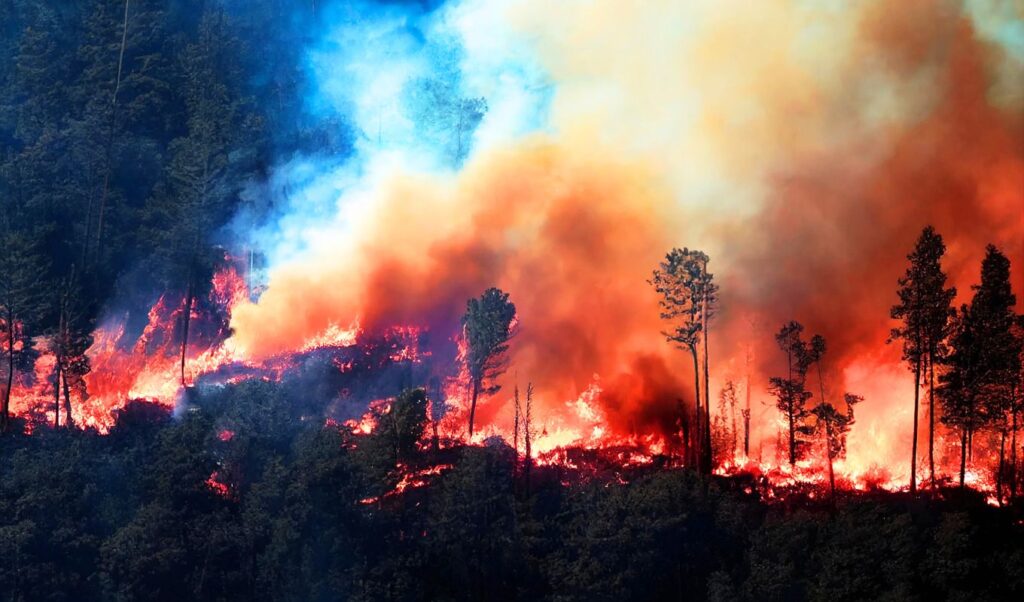
More than 800 wildfires are currently burning across Canada, with authorities on high alert. Stunning footage capturing the extremely dire situation unfolding across the country was recorded by a pilot during a flight over Thunder Bay, Ontario. The video reveals enormous pyrocumulus clouds — massive storm-like formations triggered by the intense heat and upward airflow generated by large-scale wildfires.
Massive smoke plumes filled the sky as in-cockpit footage captured hundreds of wildfires burning across Canada. pic.twitter.com/FfFJQnQCDD
— Breaking911 (@Breaking911) July 16, 2026
Air quality emergency across Canada and the northern United States
Smoke from the raging wildfires has now crossed into the United States, causing serious air quality problems across several northern states.
🇨🇦 😷 Toronto air quality among world’s worst due to wildfires
Toronto experienced the worst air quality of any major city in the world on Wednesday, edging out New Delhi and Kinshasa, according to the Swiss firm IQAir, as wildfire smoke turned skies yellow. More than 800… pic.twitter.com/VM7lVfM4Tm
— AFP News Agency (@AFP) July 16, 2026
According to the U.S. Air Quality Index (AQI), large parts of Michigan and Minnesota have reached levels classified as “hazardous,” with authorities urging residents to limit outdoor activity and stay indoors. The latest data from the Canadian Interagency Forest Fire Centre reports 857 active fire fronts across the country, 23 of which ignited on Thursday alone — with the majority still burning out of control.
Red skies from wildfire smoke, concerns mount over World Cup final
Multiple fire fronts in northwestern Ontario have cast a thick blanket of smoke over Thunder Bay and Toronto. Upper-level smoke has also traveled vast distances, reaching as far as New York City and painting the sky an eerie yellow-red hue. While strong thunderstorms are forecast for Ontario in the coming days, meteorologists warn that the expected rainfall will not be sufficient to significantly slow the spread of the fires.
🇨🇦 🔥 Multiple wildfires continue to rage across #Canada, with storm winds blowing the smoke from the blazes as far as #Toronto, degrading the city’s air quality significantly.
Environment Canada reported an Air Quality Health Index reading of 10+, classified as “very high… pic.twitter.com/rzEDAXlCEL
— FRANCE 24 English (@France24_en) July 16, 2026
Northwestern winds are expected to continue pushing smoke into northern U.S. states through the weekend — raising concerns for New Jersey, where the FIFA World Cup final is scheduled to take place on Sunday. Starting Monday, a shift in wind direction is expected to carry the smoke toward Quebec, allowing conditions to gradually improve across the southern United States. According to Swiss air quality monitoring firm IQAir, Detroit currently tops the global rankings for worst air quality, followed by Minneapolis and Toronto.
Smoke from more than 800 wildfires burning across Canada is drifting into the Philadelphia region, creating hazy skies and prompting air quality concerns. pic.twitter.com/Sh5Ew0BE1x
— Breaking911 (@Breaking911) July 16, 2026
Widespread destruction as communities flee the flames
The fires in northern Ontario have caused severe damage to homes and infrastructure, forcing hundreds of residents from First Nations communities to evacuate. Videos circulating on social media show residents of remote areas fleeing their homes — some by boat.
🚨 CANADA BATTLES MASSIVE WILDFIRES
Massive wildfires continue to spread across parts of Canada, with northwestern Ontario, including Thunder Bay, among the hardest-hit regions.
Thick smoke has blanketed communities, and evacuations are underway in some areas as crews battle… pic.twitter.com/aKpjfIymOY
— Rosa News Official (@Mirha1206) July 15, 2026
Grand Council Chief of the Anishinabek Nation Linda Debassige confirmed that numerous homes and facilities have suffered extensive damage. Meanwhile, footage from Ontario showed a freight train passing through an area completely surrounded by flames, as workers desperately called for immediate assistance. Canadian National Railway announced that all employees who had been trapped near the Armstrong area were safely evacuated, while rail services in the region have been temporarily suspended.