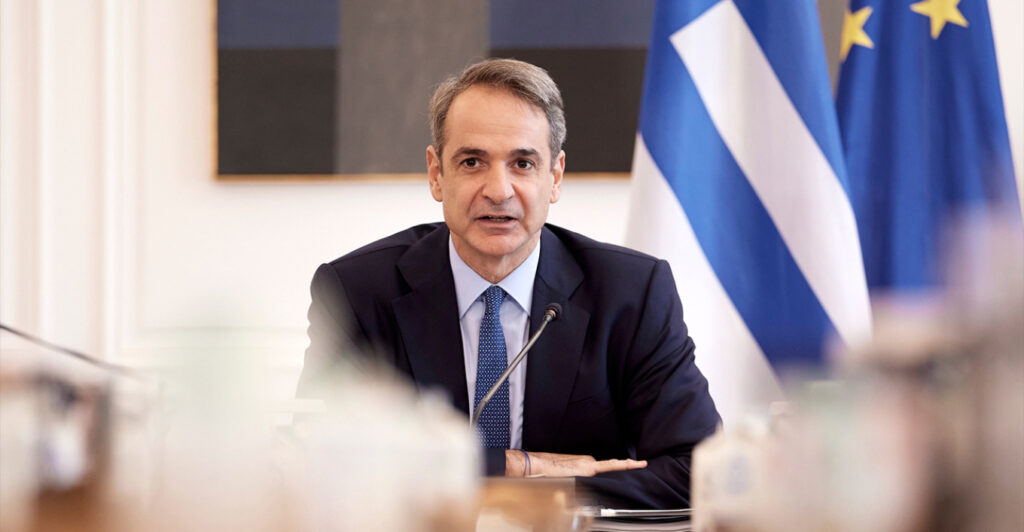
Greek Prime Minister Kyriakos Mitsotakis sent a sharp message regarding developments in the OPEKEPE case during a session of the Government Council on Economic Policy. “The European Public Prosecutor’s announcement reveals the true scale and full truth of the OPEKEPE affair. 13 New Democracy ministers and MPs came under scrutiny — 9 have been proven completely innocent, and 4 more of our officials will be further examined for minor misdemeanors,” he stated, adding:
“I asked three ministers to resign on grounds of political sensitivity. These are honorable politicians who were dragged through the mud for weeks, as some people called us a ‘government of the accused.’ Who will apologize today for those vile attacks? This concerns our country’s opposition, which shows no respect for the presumption of innocence — but unfortunately, it also concerns the European Public Prosecutor’s Office, which appeared to be entangled in domestic party rivalry.”
Mitsotakis: “Elections in spring 2027 — a critically important moment for national priorities and the future of Europe”
Against the backdrop of the battle over the EU budget, the Prime Minister placed particular emphasis on the upcoming electoral contest, which he said will take place in spring 2027, coinciding with the Greek presidency of the EU Council: “The Commission’s initial proposal allocates €49.5 billion for Greece, plus resources from the Competitiveness Fund. The negotiations may well conclude during the Greek Presidency in the second half of 2027 — which makes the outcome of the spring 2027 elections all the more significant. Citizens will be asked to choose which government will preside over a moment that is critically important both for our national priorities and for the future of Europe as a whole.”
The Government Economic Policy Council agenda
At the Government Council on Economic Policy session, Kyriakos Mitsotakis placed two weighty files on the table: the progress of major infrastructure networks and Greece’s position in the fight for the new Multiannual Financial Framework. Meanwhile, in line with the announcements made at the Thessaloniki International Fair, the Prime Minister was expected to emphasize that the economy’s positive trajectory must — and will — translate into tangible improvements in citizens’ daily lives through income growth.
More specifically, the agenda included timelines, outstanding issues, and project financing, as well as planning for the next generation of infrastructure, with a horizon extending well beyond spring 2027. At the same time, the government sought to send a clear message that its economic policy is centered on supporting society through growth and wealth creation, while simultaneously protecting the most vulnerable — especially during a period of ongoing geopolitical instability with direct consequences for the global economy and prices.
Having now entered pre-election mode, it is clear that the Maximos Mansion is banking on the budget’s capacity for social benefits — primarily through tax cuts — while aiming to highlight governmental effectiveness in contrast to the opposition’s promises. “We don’t stop and we don’t wait — unlike some others — until the pre-election period to stand by our fellow citizens. We are present, we address problems effectively, and we support local communities,” Mitsotakis declared yesterday in Evia, signaling his strategic direction.
The session’s agenda also featured the Multiannual Financial Framework (MFF), currently under negotiation among EU member states, with Greece prioritizing the preservation of what it calls its “flagship” policies — namely the Common Agricultural Policy and Cohesion Policy. The negotiation and finalization of the MFF for the 2028–2034 period is one of the key strategic goals of the Greek agenda during the EU Council Presidency in the second half of 2027, and Mitsotakis is ambitious for New Democracy to have secured a third four-year term by the time Greece takes the European helm.