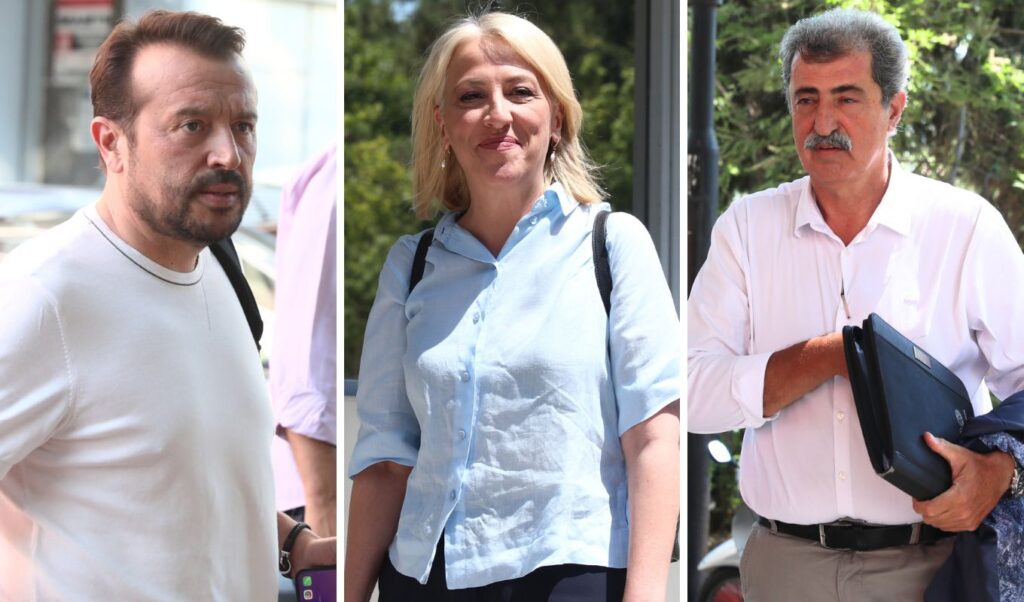
With the party losing members daily, its leadership scrambling to regroup, and Alexis Tsipras‘ camp now charting an entirely separate course, SYRIZA is living through what may be the most severe internal crisis in its history. The decisions of the Political Secretariat did not merely confirm the rift — they made clear that this political “divorce” is unlikely to be reversed. The message sent by the meeting was unambiguous: SYRIZA has chosen to fight the next election alone, rejecting any prospect of political alignment with the “Symparataxis” coalition being formed by the former prime minister. Meanwhile, the party’s day-after is taking shape around a new decision-making center. Rena Dourou, Nikos Pappas, and Pavlos Polakis are effectively assuming political management of the party until a new leader is elected — in a period marked by internal turmoil and fierce internal dissent.
Read also: SYRIZA: Political Secretariat meeting over party leadership marked by clashes and allegations of intimidation and threats — the “roadmap” for new leadership (Video)
Polakis: “Those who are leaving should not vote for the new leader”
Immediately after the meeting, Pavlos Polakis delivered a pointed message to members who have already decided to align themselves with Alexis Tsipras. The SYRIZA lawmaker called on those who are departing — or have chosen to join the new political initiative — to refrain from participating in the election of the party’s new president, arguing that they cannot be allowed to determine the future of a political organization from which they have already effectively distanced themselves.
For his part, Nikos Pappas appeared determined to defend SYRIZA’s path of independence, stressing that the party will be present and ready to fight the electoral battle — aiming to build a competitive progressive alliance against New Democracy as well as the new political balances taking shape across the center-left.
SYRIZA commits to the electoral battle
The Political Secretariat’s decision states that “SYRIZA – Progressive Alliance continues on its organized course. The Central Committee’s decision of July 11th marked a turning point in our journey to date. We will be present in the electoral battle, implementing the decisions of the 5th congress.” The Secretariat added that “this coming Saturday closes the chapter of ambiguity. The days ahead will mark the beginning of a necessary new unity among left-wing forces. The modern Left and its program are the answer to the needs of the social majority.”
Resignations with sharp words — a domino of departures
The already heavy atmosphere was made considerably worse by a wave of resignations from senior party figures. The party’s former deputy secretary, Anastasia Sapouna, announced her departure, stating she could no longer bear the weight of the internal conflict. In her statement, she spoke of an endless civil war driving SYRIZA into a dead end, warning that without an immediate change of direction the party risks having no political future. She also revealed that she had received threats in the preceding period, clarifying that while these were not the reason for her resignation, she could no longer support the choices being made by the current leadership team.
Alongside Anastasia Sapouna, Political Secretariat members Gkely Visviki, Despoina Sinou, Panos Stachtos-Lambrinidis, Eleni Symeonidou, and Stamatia Tsouea also submitted their resignations. In a joint statement, they declared their decision to leave “with seriousness and dignity,” firing pointed shots at the political developments inside SYRIZA and asserting that they can no longer serve the decisions of the current majority.
Fierce attack on Polakis from the SYRIZA Youth secretary
SYRIZA’s Youth secretary, Panos Lambrinidis-Stachtos, also chose to strike a particularly combative tone. In an emotionally charged intervention, he launched a direct attack on Pavlos Polakis, describing scenes of party collapse. He argued that certain individuals had deliberately sought to drive SYRIZA toward a split in order to gain political control over it, and made clear that neither he nor the members departing with him would lend legitimacy — as he put it — to this situation. He also stated that the party’s grassroots membership supports Alexis Tsipras’ political initiative, and expressed hope that the upcoming elections would usher in a new era for the progressive political space.
Kedikoglou’s resignation and message of support for Tsipras
All of this was preceded by the resignation of MP Symeon Kedikoglou from his parliamentary seat — a move laden with political symbolism. He made clear that he supports Alexis Tsipras’ new political initiative and that he did not consider it institutionally or politically appropriate to participate in the decision-making of a party he had already decided to leave.
The timeline
SYRIZA’s parliamentary group is set to convene on Wednesday or Thursday to elect a secretary who will initiate the process for reinstating Polakis. On Saturday, the Central Committee will meet again to shape the new leadership structure. The election of the parliamentary group’s president is expected to take place most likely at the beginning of the following week. In parallel, further declarations of independence by MPs and additional resignations of party officials are expected to escalate. Tellingly, the number of Central Committee members resigning has been so high that the list of alternate members has been exhausted — meaning the body’s membership shrinks with every new resignation.
What comes next for SYRIZA
The picture now emerging from within SYRIZA is that of a party in the midst of a total realignment. On one side, the leadership team is attempting to project unity and resolve, determined to lead the party into elections with an independent strategy. On the other, the relentless stream of departures and the open confrontation with the Tsipras camp paint a picture of deep political crisis — one that threatens to fundamentally reshape the course of the main opposition party. What is certain is that the battle will no longer be fought solely against political rivals, but also within the center-left itself, as SYRIZA and Tsipras’ new political initiative compete for the same electoral base and for dominance across the progressive political landscape.