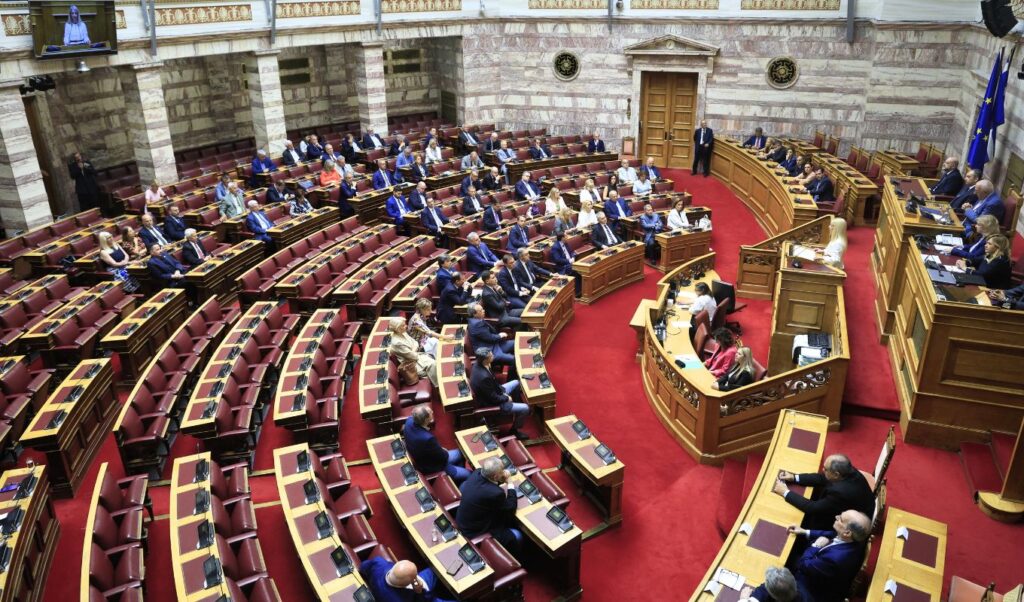
The Greek Parliament’s full plenary session is set to vote on Thursday (02/07) on a landmark bill addressing equal pay between men and women, as well as the reclassification of healthcare workers into hazardous and unhealthy occupations. The bill, introduced by the Ministry of Labor and Social Insurance, has completed its second reading in the Parliamentary Committee on Social Affairs and transposes an EU directive on equal pay into Greek national law.
Only the ruling party backed the equal pay bill
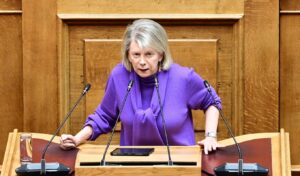
Only the ruling New Democracy (ND) party voted in favor of the bill’s core principles, while opposition parties — with the exception of the Communist Party (KKE), which voted against it — including PASOK, SYRIZA, Hellenic Solution (EL.LY), NIKI, and Course of Freedom, reserved their positions ahead of the full plenary debate.
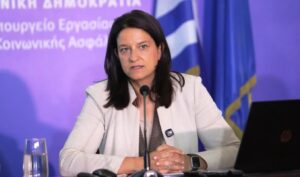
Labor Minister Niki Kerameos stated she was open to constructive amendments, while going on the offensive against opposition parties, accusing them of not only refusing to engage in dialogue, but of failing to express support for “such an important piece of legislation.” She called it “unthinkable that in 2026, a woman should be paid less than a man for the same position, the same responsibilities, and the same qualifications.”
Kerameos on labor inspections and collective agreements
Minister Kerameos opened by condemning what she called “shocking attacks” against New Democracy officials in Thessaloniki, calling on opposition lawmakers to issue similar condemnations.
Responding to PASOK’s rapporteur, Pavlos Christidis, who raised concerns about the adequacy of the Labor Inspectorate, Kerameos defended the agency as an “Independent Authority doing truly monumental work.” Citing official data, she noted that “2025 was a record year, with 82,412 inspections conducted, 17,556 sanctions imposed, and fines exceeding €53 million.”
Addressing criticism from SYRIZA’s rapporteur, Giorgos Gavrilos, over collective labor agreements and the National Social Agreement, Kerameos pushed back sharply, noting that “when New Democracy brought forward the National Social Agreement — not as a government bill, but as the product of consensus with all national social partners, representing both workers and employers — you didn’t vote for it.”
She also dismissed claims that the labor market has no prospects, citing the latest ERGANI system data for May, which she said showed “a record number of new hires in the first five months of the year since 2001.” As she explained, “this represents the most positive balance in 25 years, with 332,843 new jobs created — the highest first-five-month performance since 2001.”
On the 13-hour workday controversy
The Labor Minister firmly rejected claims made by KKE’s spokesperson, Christos Katsotis, about wage cuts, stressing that “Greek labor law explicitly prohibits wage reductions as detrimental alterations to employment conditions.”
She was equally categorical in dismissing opposition concerns about the introduction of a 13-hour workday, pointing out that “to this day, only 0.4% of salaried employees in the country make use of this option.” She also highlighted “the surge in recorded overtime hours, which reached 2.7 million more in 2025 compared to 2024,” adding that she would have expected at least the KKE to welcome the fact that “millions of overtime hours that were previously invisible are now being recorded.”
The minister also drew attention to “the recent extension of the Digital Work Card to an additional half a million employees,” as well as “the digital registry of collective labor agreements, through which all agreements, decisions, accessions, extensions, terminations, and notices are now submitted digitally.”
“The difference from the old model is that we are moving from fragmented, paper-based processes to a unified digital infrastructure accessible to everyone. This facilitates the monitoring of collective arrangements, enhances transparency, reduces bureaucracy, and creates a clearer picture of worker coverage. Every citizen will be able to search for and find the collective agreements that apply to them using simple criteria,” she emphasized.
Regarding the provisions on hazardous and unhealthy occupations, the minister reiterated that “no new category of workers is being added — rather, a 30-year distortion affecting public sector nurses is being corrected.”
Closing her remarks, Kerameos criticized the opposition for what she called “inaction on such a vital piece of legislation concerning pay equality,” adding: “I invited all parliamentary parties to participate in dialogue and not a single one showed up. Is this how much you care about equality? That, frankly, appalls me. Do we want dialogue or not?”
Stakeholder positions on the bill
The relevant external stakeholders invited by the Committee to present their views on the bill were, for the most part, broadly supportive of the transposition of the EU directive, while also proposing targeted improvements. Some organizations raised reservations or voiced outright objections.
In particular:
Aikaterini Daskalaki, Director of Labor Relations and Social Dialogue at the Federation of Hellenic Enterprises (SEV), expressed satisfaction with the bill’s provisions, noting that “several observations made during the prior consultation process were taken into account.”
“One very significant joint proposal by all national social partners that was adopted was the use of collective labor agreements as an important tool for ensuring non-discrimination in setting pay for equal work or work of equal value, based on objective and gender-neutral criteria. We believe this will contribute to the promotion of collective bargaining in our country,” she said. However, she cautioned that “the debate on equal pay cannot be isolated from the broader EU discussion on competitiveness,” adding that “effective equal pay protection cannot be achieved by creating disproportionate administrative burdens that would hinder the practical implementation of the new framework.”
In its submitted memorandum, the Panhellenic Union of Paramedics expressed disagreement with the exclusion of all healthcare workers from the hazardous and unhealthy occupations category, arguing that “it is contradictory to recognize the risk for newly entering professionals while disputing the exact same exposure to risk for more senior colleagues who have given years of service.” The union called on the Ministry of Labor to “immediately correct this provision, safeguarding the nature of our work and recognizing the long-standing contribution of our colleagues.”
“When dialogue and consultation work properly, we get genuine consensus — not imposed decisions,” said Georgios Christopoulos, Secretary for Communications and Social Media of the General Confederation of Greek Workers (GSEE). He described the bill as “one of those cases where social dialogue has borne fruit on a critical social issue,” pointing to the gender pay gap, which, based on official data, stands at approximately 13.6%.
The General Director of the Hellenic Confederation of Commerce and Entrepreneurship, Antonis Meggoulis, praised what he called “a constructive and highly effective dialogue with the Ministry of Labor,” noting that “many of our proposals were accepted and taken on board, so we are dealing with a framework we do not object to. Sooner or later, pay equality had to be introduced in our country — it is a shared European goal.” He did, however, express concern about “the shift of the burden of proof onto employers and the uncertainties around how the objective job evaluation criteria provided for in the bill will be applied in practice,” and called for “a longer transition period, until the end of the year, to allow for a proper assessment of the obligations relating to data collection, processing, documentation, and reporting, in line with the principle of proportionality.”
Theodoros Lytras, President of the Board of the Labor Inspectorate, assured the Committee that “we are already prepared to meet the new duties and responsibilities assigned to us under this bill.”
The Second Vice-President of the National Commission for Human Rights, Elli Varchalama, described the bill’s provisions transposing the EU directive as “a critical milestone for the continued work of the National Commission, as it makes a tangible contribution to promoting the principle of equal pay.” She also proposed “extending the bill’s scope to cover the important categories of workers employed under project contracts and retainer agreements, so as to serve the directive’s overarching purpose of universally promoting the principle of equal pay across all contracts in employment relationships or forms of work involving conditions of dependency.”
Yiatrina Paparigopoulou, President of the Legislative Drafting Committee for the Transposition of Directive 2023/970, expressed support for the new provisions, noting that “they were the product of social dialogue.” She added: “I can assure you that, to a very large extent, our committee’s report was adopted by the Ministry in its entirety, and where minor differences arose, they were for the better. They were genuinely for the better.”
Satisfaction with the proposed changes was also expressed by Mika Ioannidou, Head of the Greek Representation of the European Women’s Lobby, and by Maria Gianiri, President of the Panathenian Union of Women. The latter also raised the demographic challenge, stressing that it “must be addressed in conjunction with women’s participation in the workforce.”
“The bill is moving in a reactionary direction”
Taking a contrary stance, Konstantina Tsotra, President of the Federation of Greek Women, argued that “the government is bringing forward a bill that, under the guise of addressing the gender pay gap, presents the mere notification of workers about employers’ obligation to be transparent on pay as if it were a solution to wage discrimination against women.”
“But despite the appealing packaging, the bill is moving in a reactionary direction — it promotes individual negotiation of pay and working conditions and is underpinned by a leveling logic that erases women’s specific needs. The pay gap is calculated using averages and median levels that do not reflect the real inequality between women and men in work and in life. You say nothing and do nothing about the real causes driving existing wage disparities — namely, underemployment and flexible employment arrangements, which disproportionately affect women,” she said.
Nurses’ union president decries injustice against healthcare workers
The President of the Nurses’ Association of Greece, Dimitris Skoutelis, spoke of an injustice against nurses who remain excluded from the hazardous and unhealthy occupations classification. While acknowledging that “this legislative initiative is moving in the right direction and represents an important step toward redressing a longstanding inequity and fulfilling a consistent demand of our Association,” he stressed “the need to include nurses and nursing assistants working in hospitals — including military hospitals — and in other entities under the Ministry of Health that provide healthcare services, such as Health Centers under the Regional Health Authorities, the National Rehabilitation Center, Multi-Purpose Regional and Specialist Clinics, and Local Health Teams.”
“The principle of equal treatment demands equal treatment for equal working conditions. It is simply not acceptable for two nurses performing exactly the same work, facing the same occupational risks, to be treated differently merely because they work for a different entity within the public health or social care system. Completing this reform requires that it cover all structures where nurses provide services under heavy and unhealthy conditions. Only then will genuine justice be served, existing inequalities eliminated, and the contribution of a profession that stands on the front line of care every day be meaningfully recognized,” he said.
Michail Giannakos, President of the Panhellenic Federation of Public Hospital Workers, echoed these concerns. “We consider the provision classifying nursing staff and paramedics as workers in hazardous and unhealthy occupations to be a positive step, but we must point out that injustices persist, because thousands of our colleagues — whose occupations the state itself recognizes as hazardous and unhealthy under the IKA Regulations — have been excluded from this provision. At the same time, for many of us who are included, the classification is actually disadvantageous due to the high supplementary insurance premium buy-out we are required to pay,” he said, adding: “We see a provision that covers only nursing staff and paramedics while excluding frontline professions — and this is a serious injustice — such as medical laboratory technologists, radiology workers, paramedics, ward assistants, and other occupations that are unquestionably hazardous and unhealthy, and which the state itself recognizes as such.”
The President of the Federation of Private Sector Employees of Greece, Konstantina Gogkaki, opposed the new provisions, arguing that “they are being used as a vehicle to dismantle Sunday rest, serving the demands of business groups and making life hell for workers — not just in retail, but across multiple sectors.” She added: “It is truly provocative that in a bill which is supposedly, as you claim, a step toward addressing wage inequalities between men and women, you are launching yet another attack on working time.”
Head of the National Transparency Authority backs the bill
The Director of the National Transparency Authority, Alexandra Rogkakou, came out in support of the legislation. She explained that “the bill aims to strengthen pay transparency, ensuring that workers — and in some cases job applicants — have access to comparable and reliable data on remuneration, while also expanding and reinforcing the mechanisms for implementing and enforcing the principle of equal pay, with the aim of addressing the gender pay gap.”
“Under this bill, the National Transparency Authority will play a supporting role in this effort, exercising its competencies on pay transparency matters in the public sector by conducting checks, re-inspections, audits, and investigations,” she noted.
Collective agreements back on the table
In its submitted memorandum, the Greek Tourism Enterprises Association (SETE) emphasized the centrality of collective labor agreements, describing them as “a pivotal tool for ensuring uniform and objective pay rules.”
“The objective pursued by the directive is entirely legitimate and fully acknowledged, and despite the significant improvements achieved in the bill within the scope of what EU law allows, concerns remain regarding the administrative burdens it imposes on businesses and the practical implementation of the relevant provisions,” the memorandum stated.
Georgios Thanopoulos, representing the General Confederation of Greek Professionals, Craftsmen and Merchants (GSEVEE), stressed that “the successful implementation of the directive will not be judged by the strictness of the legislative framework, but primarily by whether it is workable in the day-to-day reality of businesses.”
“Supporting small and micro enterprises is therefore a critical factor in the meaningful achievement of the directive’s core objective — and of equality in practice,” he said.
He also flagged as “a matter of the utmost importance the legal and associated financial risks arising for businesses overall, which may prove particularly damaging for small and micro enterprises, given the reversal of the burden of proof and the possibility of awarding unlimited compensation introduced by the transposition of the directive.”
“Given the difficulties that small and micro enterprises face in drawing up and maintaining